
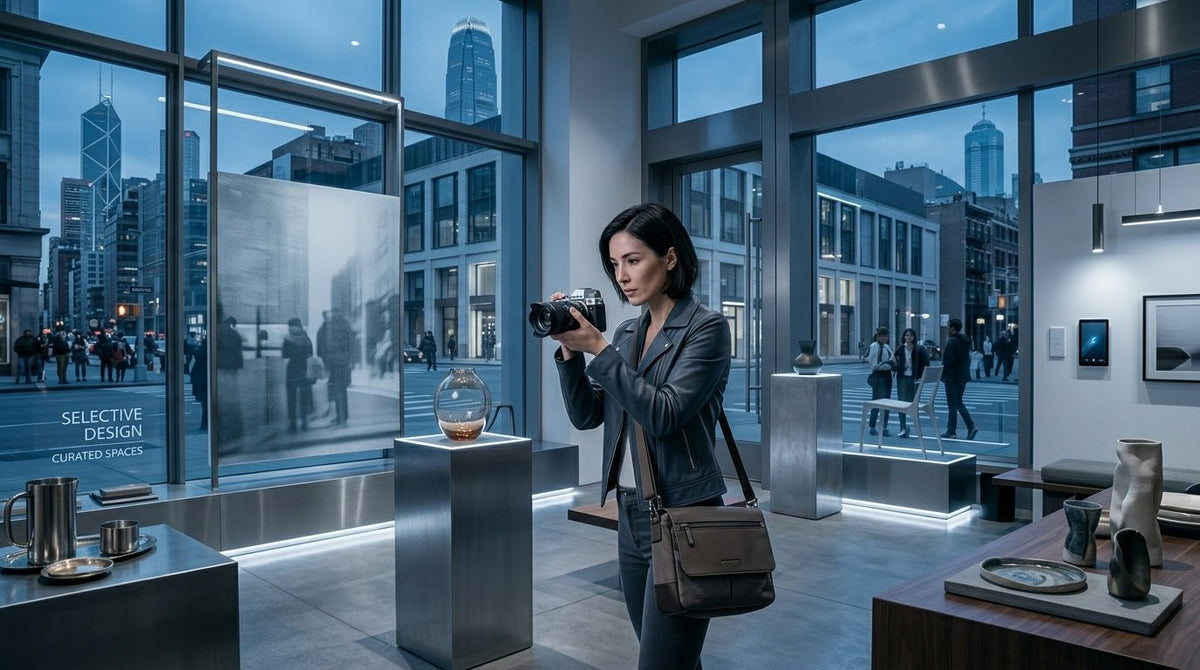
The Future of Design Retail Is Selective
A watch no longer needs to compete with every watch ever made. A camera does not need a page of technical jargon to feel worth owning. The future of design retail is selective: fewer watches, designer bags, backpacks, instant and retro cameras, and everyday carry accessories, chosen well and presented with enough context and storytelling to make the decision feel personal, confident, and clear.
For urban creatives and design-savvy shoppers, especially those in their 20s to 40s who want style and function in the same purchase, that shift is overdue. Shopping has become easy. Choosing has not. Search results can surface thousands of backpacks, instant cameras, and statement watches in seconds, but volume rarely creates confidence. It often produces the opposite: decision fatigue, questionable sellers, authenticity concerns, and a cart full of items that seemed right for a moment.
Design retail has an opportunity to make the experience more considered. Not by making it slower for the sake of it, but by making every product earn its place through authenticity, official backing, functional minimalist design, and thoughtful presentation across physical and digital retail that helps people buy products that actually fit their style and daily life. That is the space this article explores: curated watches, designer bags and backpacks, instant and retro cameras, everyday carry accessories, and how presentation, trust, and product selection work together to make modern retail feel useful again.
The Future of the Retail Industry and Design Retail Starts With Editing
The old ecommerce promise was abundance. More inventory, more filters, more reasons to keep scrolling. That model works for commodity purchases, where the difference between options is mainly price or delivery time. It is less convincing when someone is buying a piece of personal style.
A Gagà Milano watch, a waterproof Gaston Luga bag, or a Polaroid instant camera is not just a functional object. It sits on the wrist, in the frame of a mirror selfie, on a desk, or at a party. It becomes part of a person's visual language. When the purchase carries that much identity, shoppers do not need every option. They need the right options, with a clear reason behind each one.
That is what curation should mean. It is not a smaller catalog disguised as exclusivity. It is a disciplined selection built around design, usefulness, brand integrity, and a distinct point of view. A retailer should be able to explain why a product is here, who it is for, and what makes it different from the nearly-right alternative.
The trade-off is real. A selective retailer may not carry every color, every generation, or every price tier. Some shoppers will want the widest possible marketplace. But for customers who value taste and time equally, a focused edit is a service. It turns browsing into discovery rather than research labor.
Authenticity and Brand Loyalty Will Be Part of the Product
As design-led goods become easier to imitate, authenticity is becoming more visible in the buying decision. A convincing product photo is no longer enough. Shoppers want to know where an item came from, whether its warranty is valid, and whether the retailer will still be there if something goes wrong.
This matters especially in categories with strong visual appeal and active resale markets. Watches, cameras, and branded bags are frequently offered through unofficial channels at tempting prices. The lower number can look compelling until a customer encounters a missing warranty, uncertain condition, or a product that does not match what was promised.
The next generation of design retail will treat direct sourcing and authorized status as customer value, not fine print. Proof of legitimacy should feel as natural as product specifications. It supports a more confident kind of consumption: buy less often, choose something with a real provenance, and use it for years.
There is also an emotional payoff. A design object with a story feels better when that story is credible. The appeal of a Made in Japan watch is not only its restrained dial or finishing. It is also the care, heritage, and intention that sit behind it. Retailers that communicate those details clearly give products more staying power than a flash sale ever could.
Product Pages Need More Personality
Most product pages still speak in inventory language. Dimensions. Materials. Battery type. Shipping window. Those facts matter, especially when customers are comparing models, but they do not answer the question that drives many design purchases: will this fit the life I actually have?
Better retail storytelling connects features to a setting. A compact camera is for spontaneous street portraits, travel diaries, and the strange little moments that never make it to a phone's camera roll. A crossbody bag is for moving through a city with enough room for the essentials and none of the bulk. A distinctive watch can turn a plain black outfit into a finished look.
The goal is not to overstate every product as life-changing. A bag is still a bag, and a camera still has limitations. Honest framing creates more trust than manufactured hype. Explain the trade-offs: an instant camera creates tangible prints, but film costs money and imperfect shots are part of the format. A smaller bag looks clean and carries lightly, but it may not fit a laptop. The right customer will appreciate the clarity.
This is where editorial commerce earns its place in the broader retail experience. Journal stories, visual styling, gift guidance, and comparisons can use shopper insights to help customers understand a category before they are ready to buy. The strongest version does not interrupt the shopping experience. It can also engage customers before they are ready to purchase. It gives it texture.
Physical Feeling Still Matters in Physical and Digital Worlds Online
Design retail has a tactile challenge. Buyers cannot feel the grain of a bag, test the weight of a watch, or hear an instant camera print begin to develop through a screen. Yet the absence of physical contact makes visual precision and useful context even more important.
Images should show scale, material, and use, not only a perfect studio angle. A product looks different in a hand, beside a notebook, or worn with an everyday jacket. Descriptions should be specific enough to replace vague adjectives, while sustainable materials in store designs and display presentation can also signal quality online and in person. Instead of calling a bag premium, explain its waterproof finish, pocket layout, strap adjustment, and how it holds up on a rainy commute.
Technology can help, but practical technological integration matters more than spectacle. Augmented reality tools on digital platforms can work as practical product-visualization aids, and virtual reality should matter only when it answers a real question. Advanced high tech can also stay useful: smart hangers use RFID technology for personalized shopping experiences. The best experiences connect physical and digital worlds through physical spaces that integrate with digital tools, reducing uncertainty rather than adding novelty. A feature that exists only because it looks futuristic tends to fade quickly. The useful tools will be the quiet ones: the comparison that clarifies a choice, the sizing cue that prevents a return, the reminder that a certain film format fits a certain camera.
The Storefront Is Becoming a Cultural Edit
The most compelling retailers will feel less like digital warehouses and more like cultural editors, as the landscape shifts toward experience-driven, destination-style stores shaped by key trends across the retail landscape. Their assortment will reflect a point of view about how people live, create, travel, and show up.
That does not mean every product needs to be rare or expensive. It means each item should have a reason to exist alongside the others. A collectible mini camera can sit naturally beside instant film. A technical backpack can be paired with a clean, expressive watch. The connection is not forced. It is built around a shared customer who values objects with character and function. In that model, experiential showrooms are replacing traditional inventory-heavy displays.
For Bang On, that approach means treating watches, bags, cameras, and photography accessories as parts of a lifestyle rather than isolated departments. The customer may arrive looking for a gift or a new camera. They should leave with a clearer sense of what fits their taste. That is also why localized, small-format showrooms and shop-in-shops are gaining ground, as physical stores evolve within the future of retail rather than disappear, shaped more closely around local demographics and daily habits.
Retailers also need to resist the urge to chase every microtrend. Trend awareness is useful. Trend dependence is exhausting. The better strategy is to recognize what has enough visual energy to feel current while still offering value after the social feed moves on. Good retail design often uses lightweight, movable display units, modular layouts that support circular operating models, and material contrasts to shape immersive spaces and emotion in the store. The circular economy model reduces waste in retail. In sustainability-focused store planning, sustainable interior design increasingly uses eco-conscious and local materials. Sustainable hangers are becoming the industry standard. Good design has a longer memory than a viral product drop. Some environments now also operate as retail media networks, opening up added revenue.
Less Friction, More Conviction in Shopping Experiences
Convenience will remain essential, because consumer expectations and evolving consumer expectations now shape service, returns, and personalization alike. Many consumers now expect AI-assisted service, and over 60% prefer AI chatbots for routine support when they create a better experience. Today's consumers expect clear availability, dependable delivery, responsive support, personalization, and returns that do not feel like punishment. 66% of consumers prefer brands that prioritize sustainability and reflect their values. Separately, 66% of consumers prefer sustainable products. But convenience alone is easy to copy. What cannot be copied as quickly is conviction: a retailer's ability to make a strong selection and stand behind it.
That conviction should show up in the details. A concise explanation of why a model is worth considering. Clear warranty information. Photography that respects the object. In omnichannel retail, some shoppers prioritize online shopping convenience while others still prefer in-store experiences, so the goal is a seamless customer journey across platforms that can also drive sales. A category page that helps someone decide whether they want analog charm, digital portability, or a balance of both. With artificial intelligence, that guidance can read individual shopping behavior almost like a market of one and deliver more relevant recommendations through hyper-personalization and smarter marketing. It can also predict demand from historical sales data and trends, helping inventory decisions without losing the human touch. The role is no longer just selling; it is customer engagement rooted in personalized service for clients. These are small acts of guidance, but together they create trust between brands, companies, and the people they serve, strengthening the business beyond short-term transactions.
The future will not belong to stores that simply add more products to the feed, but to retailers that focus on helping people choose well because that is where long-term success starts. It will belong to retailers that help people choose objects they will keep, use, and notice long after the package arrives. When a product feels right in the hand and right in a life, the next purchase becomes easier too. That matters in a market where U.S. retail sales are projected to reach $5.48 trillion by 2025 and global omnichannel retail sales $31.3 trillion by 2025. To stay ahead, retailers need clear strategies and real commitment to ethical practices and sustainability.
Share
Analog photography trends are shaping a more tactile, personal camera culture. See why instant film, compact cameras, and imperfect prints matter today.