
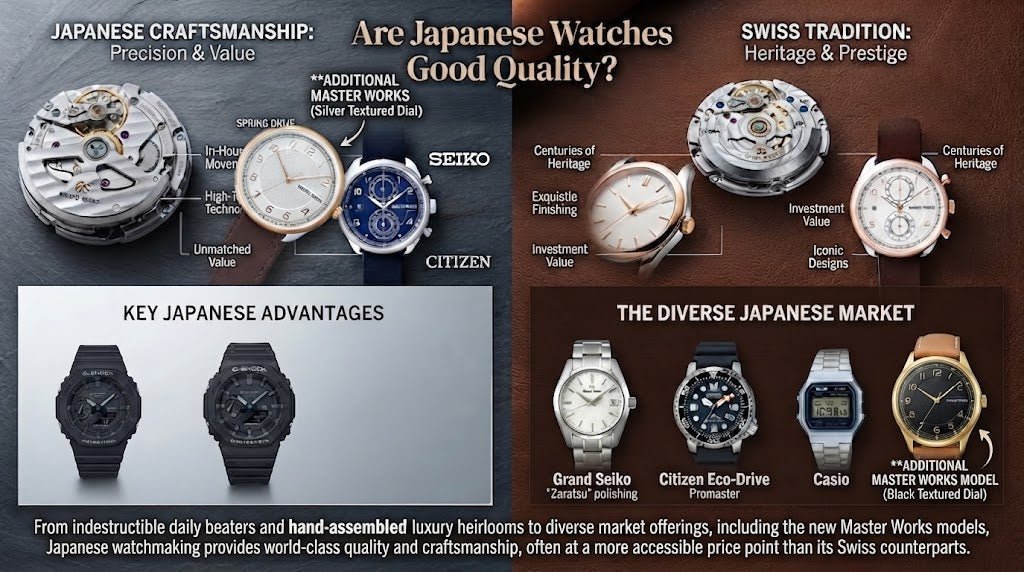
Are Japanese Watches Good Quality?
If you have ever handled a well-made Seiko, Citizen, or a smaller made-in-Japan label, the short answer is yes: Japanese watches are generally very good quality, often delivering standout reliability, thoughtful design, and excellent value for money. That is exactly why first-time buyers, daily wear shoppers, collectors, and gift buyers keep coming back to them when they want something authentic and well designed without unnecessary hype.
That reputation did not appear by accident. Japanese watchmaking earned trust through consistency, technical discipline, and a very clear point of view: a watch should work beautifully, wear comfortably, and justify its place in your daily rotation. For buyers who care about design as much as dependability, that can make the difference between buying on branding alone and choosing a watch that suits how you actually live. From quality and design philosophy to accuracy, value, movements, manufacturing transparency, how Japanese brands compare with Swiss watches, and who should seriously consider buying one, this guide is here to help you judge whether a Japanese watch fits your wrist, your standards, and your budget.
Are Japanese watches good quality in real terms?
Yes, and often to a remarkably high standard for the money. But quality is not one thing. It is the sum of movement performance, case finishing, dial execution, bracelet or strap comfort, durability, and long-term reliability.
Japanese watches tend to score well because the industry has spent decades refining production without losing sight of usability. You see it in the precise way hands align on a dial, the practical toughness of hardened cases, and the kind of movements that keep going for years with minimal drama. Even when the styling is expressive, the engineering usually stays grounded.
That does not mean every Japanese watch is automatically better than every Swiss, German, or microbrand alternative. It means the category has a strong baseline. When you buy from reputable brands and authorized retailers, the odds of getting honest value are very good.
Why Japanese watches built such a strong reputation
Japan changed the watch industry by taking precision seriously at scale. That reputation reaches back to Seiko, founded in 1881 by Kintaro Hattori, and to the 1913 Laurel, Japan’s first wristwatch. The quartz revolution was the most visible example, with Seiko introducing the world’s first commercially available quartz wristwatch in 1969 and Japanese brands pushing quartz technology through the 1970s to set new standards for accuracy, but the broader story is deeper than battery-powered accuracy. Japanese brands developed manufacturing systems that emphasized consistency, efficiency, and quality control. Major Japanese watchmakers also build nearly all movement components in-house to support that consistency. That combination made well-built watches more accessible to more people.
There is also a distinct product philosophy at work. Many Japanese watches are designed for real use first. You get legible dials, practical water resistance, sensible proportions, and movements chosen for durability rather than prestige alone. The result is often less about ceremony and more about everyday excellence.
For a lot of buyers, that is the appeal. A Japanese watch does not need to shout. It just needs to feel right on the wrist and keep earning your trust over time.
What Japanese watch brands usually do especially well
One of the biggest strengths is value, especially at the entry-level price point where Japanese watches often offer better value than many Swiss alternatives. Japanese watches are famous for delivering a lot of watch at an affordable price, whether that means solar technology, automatic movements, sapphire crystal, thoughtful finishing, or dependable build quality in an accessible range, with advanced materials also improving durability and scratch resistance.
Accuracy is another area where Japanese makers have been especially influential. Quartz models from Japan have long set a standard for reliability and low-maintenance ownership. Even in mechanical watches, many Japanese brands prioritize stable, durable performance over romantic marketing claims, with practical, everyday-focused design often doing more for owners than luxury signaling.
Then there is design. This part gets overlooked. Japanese watch design can be restrained, playful, technical, or deeply textural. Some dials feel almost architectural. Others lean into vintage sport cues or modern minimalism. Japanese watch brands are also widely respected for innovative design and craftsmanship, which helps explain the range between these approaches. The best examples have a quiet confidence that pairs easily with daily wear, which is exactly why they resonate with urban, design-aware buyers.
Where the quality shows up on the wrist
A good Japanese watch often reveals itself in use, not just in specs. The case may sit flatter than expected. The crown action may feel smooth and secure. The dial might catch light in a way that looks far more premium than the price tag suggests.
This is where quality becomes tangible. You notice how easily the watch fits into your routine, whether you are dressing for work, traveling light, or choosing one piece to carry you through the week. The strongest Japanese watches rarely feel fussy. They feel resolved.
That practical refinement is a major reason collectors keep returning to them. A watch can be technically impressive and still fail as an everyday object. Japanese makers are often very good at closing that gap.
Are Japanese watches good quality compared with Swiss watches?
This is where the answer becomes more nuanced. Swiss watches still hold enormous prestige, especially in luxury mechanical watchmaking, hand-finishing, and heritage storytelling, with Swiss watchmaking benefiting from roughly 500 years of heritage. If your priority is traditional haute horology, the Swiss category has clear strengths.
But quality and prestige are not the same thing. When comparing swiss and japanese watches, the key differences often come down to accuracy, technology, finishing, price, and prestige. Japanese watches frequently compete extremely well on accuracy, durability, innovation, and price-to-performance. At the entry-level and mid-entry end of the market, they often deliver better value than Swiss counterparts. In some cases, they exceed Swiss alternatives at the same budget. A Japanese watch may offer better daily practicality while a Swiss watch offers more brand cachet or artisanal finishing.
So it depends on what kind of quality you value. If you want dependable engineering, sharp design, and honest pricing, Japanese watches are often among the smartest buys in the market. Grand Seiko competes directly with Swiss brands on craftsmanship, and finishing techniques such as Zaratsu polishing show how refined Japanese watchmaking can be. If you want old-world luxury signaling, the conversation shifts.
The trade-offs buyers should know
Japanese watchmaking is strong, but it is not monolithic. Many Casio G-Shock models also come in under $200, making them a reasonable price entry point for buyers who want toughness without overspending. Entry-level models can still have mineral crystal instead of sapphire, stamped clasps instead of more refined hardware, or factory regulation that is acceptable rather than exceptional. You may also find finishing that prioritizes cleanliness over flourish.
Brand storytelling can be another difference. Orient commonly sits around $100 to $700 while still offering strong quality. Some Japanese watches are better than they are glamorous. They may not come wrapped in the same mythology as Swiss names, even when the product itself is outstanding.
And for style-focused buyers, not every Japanese watch will hit the mark aesthetically. Seiko, for example, spans roughly $100 to $3,000, which shows how Japanese brands can serve very different budgets. Some lean heavily functional, others very classic, and others distinctly niche. Quality can be high even when the visual language is not for everyone.
Mechanical, quartz, or solar?
One reason Japanese watches remain such strong recommendations is range. Japan excels across multiple watch movements instead of treating one category as the only serious option.
Quartz is the easy case. It is accurate, convenient, and often ideal for buyers who want a watch that works without ritual. Japanese quartz movements have helped define the standard here, and Grand Seiko’s 9F Quartz is a high-end example known for precision of about ±10 seconds per year.
Mechanical watches add emotion and character. Japanese automatics often emphasize reliability and sensible ownership costs. They may not always be decorated for display backs and collector theater, but they tend to be sturdy and wearable. Orient is a strong value example because it makes in house movement calibres, including automatic and mechanical movements, at competitive prices with consistent quality.
Seiko’s spring drive movement is a notable hybrid in between, combining mechanical and quartz technology for a smooth second-hand sweep and accuracy of about ±1 second per day.
Solar is where Japanese innovation really shines. Brands like Citizen helped normalize the idea that a watch could be low-maintenance, long-lasting, and modern without sacrificing style, and Citizen pioneered eco drive technology in 1976 with systems that charge from virtually any light source. For many people, that is the sweet spot.
Why made-in-Japan still means something
Not every Japanese brand produces every watch in Japan, and that distinction matters. Some collections are assembled elsewhere under strict standards, while others are explicitly made in Japan. Neither is automatically bad, but transparency matters.
When a watch is genuinely made in Japan, buyers often expect tighter finishing, more rigorous quality control, or a stronger connection to the brand's manufacturing heritage. That expectation is not just marketing. In many cases, it reflects real differences in process and positioning. Citizen, founded in 1918, is a good example of how long manufacturing heritage supports trust in Japanese watchmaking. It also strengthened that reputation by pioneering Eco-Drive solar-powered technology in 1976. Casio is another clear case: g shock launched in 1983 and helped define durable, shock-resistant Japanese watch design.
For style-conscious buyers, there is also a cultural appeal. Made-in-Japan products carry a certain design credibility - precise, intentional, and rarely overdone. That sensibility translates well in watches.
Who should buy a Japanese watch?
If you want your money to go into the object rather than the hype, Japanese watches make a lot of sense. They are especially strong for first-time buyers, daily wear shoppers, gift buyers, and collectors who appreciate thoughtful design without unnecessary noise.
They also suit people who care about balance. Not just specs, not just style, not just heritage. Balance. A watch should feel good, function well, and look right with the rest of your life.
That is why curated retailers tend to keep returning to this category. The right Japanese watch can land in that rare space between practical purchase and personal piece. At Bang On, that kind of product logic matters because good design should never feel accidental.
So, are Japanese watches good quality?
Yes - often exceptionally so. Their strength is not just one headline feature but a complete package of reliability, innovation, restraint, and value. They have earned their reputation the hard way, by performing well year after year.
The better question is what kind of quality you want to wear. If you want a watch that feels intelligently made, visually sharp, and easy to live with, Japanese watchmaking remains one of the best places to look. Choose carefully, buy from an authorized source, and let the watch prove itself the old-fashioned way - on your wrist, over time.
Shop the best giftable gadgets for creatives, from instant cameras to design-led everyday tools that feel personal, useful, and well chosen.