Camera and Film That Still Feel Right
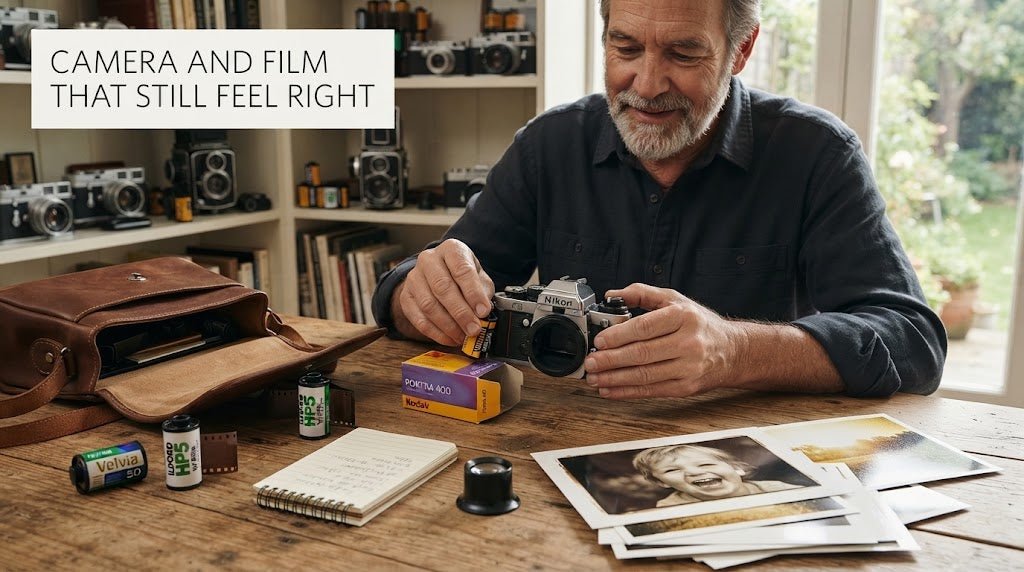
The best camera and film pairing usually says more about your taste than your technical skill. A compact instant camera tossed into a weekend bag gives off a very different energy than a reusable 35mm point-and-shoot or a half-frame model built for casual, frequent shots. That difference matters, because for most people buying analog today, the appeal is not only image quality. It is the way the object fits into a life.
Why camera, film, and film photography still matter
Phone cameras are excellent. They are fast, convenient, and always within reach. But convenience tends to flatten the experience. You take too many photos, edit later, forget most of them, and rarely hold any of them in your hand.
A camera and film setup that still feels right is one that fits not only your taste, but also the way you actually live. For urban creative professionals and design-conscious buyers who want something more tactile and intentional than another phone upgrade, that usually means choosing a film camera and format you will genuinely carry, use, and enjoy. You shoot less, but you look more carefully. You pay attention to light, framing, and timing because every frame has weight. That slight friction is part of the charm. It turns image-making back into a choice instead of a reflex, and this guide looks at the formats, design details, and everyday usability that shape that choice.
There is also the visual character. Film photography is built on chemical emulsions, not filters, and that physical process helps give the final image a more grounded feel. Different formats and stocks render color, contrast, and skin tones in ways that feel less processed and more atmospheric. Instant film adds another layer - the print becomes the final object, not just a file waiting to be sorted.
For design-conscious buyers, the hardware matters too. Classic cameras are valued not only for how they look, but for their tactile experience and mechanical reliability. A well-made camera has presence. It can be compact and playful, or minimal and refined, but it always feels more intentional than a slab of glass pulled from a pocket. In the right form, it becomes part of your everyday carry rather than another gadget.
Choosing a camera and film format for real life
The smartest way to shop analog is to start with use case, not specs. A camera that looks great on paper can still be wrong for how you actually live.
Instant camera and instant film
If your priority is immediacy, instant is the clear choice. You press the shutter, wait a moment, and get a physical print. That makes instant cameras ideal for parties, travel, creative workspaces, date nights, and gifting. They are social by nature. People gather around the print. The moment becomes tangible almost immediately.
The trade-off is cost per shot and less control. Instant film is more expensive than standard 35mm, and environmental conditions can affect results. But for many people, that unpredictability is exactly the point. It makes the image feel alive.
Polaroid remains one of the strongest expressions of analog joy in a digital world. The format is iconic, the prints feel substantial, and the color palette has a recognizable mood. If you want your camera to create both images and objects, instant is hard to beat.
35mm camera and film
For everyday versatility, 35mm is still the most approachable film format. It gives you more exposures per roll, wider film availability, and a balance between convenience and image quality. A good 35mm point-and-shoot works well for city walks, vacations, creative documentation, and low-pressure portraiture.
This format also rewards consistency. Once you learn how your camera meters light and how your preferred film stock responds, your results become more predictable. That makes 35mm a strong choice for people who want film to become part of their routine instead of an occasional novelty.
The downside is delayed gratification. You have to finish the roll and process it before you see the results. If you like anticipation, that is part of the experience. If you want instant feedback, it may feel slow.
Half-frame camera and film
Half-frame sits in a particularly interesting space right now. Because each frame uses only half of a standard 35mm negative, you get roughly double the exposures from one roll. That makes it a practical option for anyone who shoots casually and often.
There is also a creative benefit. Half-frame naturally encourages sequence. Two adjacent images can feel like a diptych, a before-and-after, or a mini visual story. For travel diaries, street details, and spontaneous moments, it has a rhythm that feels modern despite the analog format.
The compromise is resolution. Half-frame images are smaller, so they may show more grain or less detail depending on the film and scan quality. If your goal is polished enlargements, standard 35mm may be better. If your goal is expressive, frequent shooting with character, half-frame makes a lot of sense.
What to look for before you buy: image quality and more
A stylish camera is easy to love at first glance. Living with it is another matter.
Start with size. If the camera is too bulky, you will leave it at home. The best analog camera is often the one that slips easily into a bag and feels natural to carry every day, which is why the Olympus OM-1 remains so admired for its compact size and bright viewfinder. Portability matters more than many buyers expect.
Then consider the shooting experience. Some people want maximum simplicity - autofocus, auto exposure, easy loading, and very little to think about. Others enjoy a bit more manual control. Rangefinders work by aligning two images in a patch in the viewfinder. Neither approach is more authentic. It depends on whether you want film to feel effortless or hands-on.
Viewfinder clarity, battery type, flash behavior, and general ergonomics all shape whether a camera becomes a favorite. These details rarely headline product pages, but they define actual use. Vintage lenses can add natural vignetting and distinctive flares that feel evocative. Light leaks and motion blur can be flaws for some users, but for others they are part of what makes film photos feel memory-like. A beautiful camera that is awkward to hold or slow to operate tends to stay on the shelf.
Authenticity matters as well. With branded cameras and film, buying from an authorized retailer is not a small detail. It is the difference between getting legitimate stock with proper warranty coverage and taking a gamble on uncertain sourcing. For products built around design and collectibility, trust should be part of the purchase.
The style factor is real
People sometimes talk about cameras as if aesthetics are secondary. They are not. Physical dials and physical controls are part of why some digital photography tools feel closer to shooting like film. Especially in lifestyle categories, form shapes behavior.
A camera with a strong design identity gets carried more often, displayed more proudly, and used more intuitively. It feels like a personal object, not a disposable tool. The Nikon Zf, a full frame camera, is one example where retro handling helps create a film like experience. And digital cameras can also mimic film through film simulations, not just through styling. Fujifilm, for example, offers film simulation modes, and some models include 20 film simulations that make them a best digital camera choice for people chasing a film like look. That is one reason design-led analog products continue to resonate. They meet at the intersection of utility, memory, and self-expression.
This is also why curation matters. Not everyone wants to compare dozens of near-identical models or sort through gray-market listings and vague condition notes. Nikon's NX Studio can be used to shape custom color profiles for film like JPEGs straight from digital files, which can mean less post processing. Older mirrorless cameras and DSLR options with CCD sensors also stay popular on the used market because their color can feel especially like film. A selective edit is useful because it reduces noise. It helps buyers focus on products that are already filtered for design, reliability, and relevance.
That editorial approach is part of what makes stores like Bang On appealing to urban creatives. The point is not endless choice. The point is better choice.
How film fits into a modern routine
The strongest argument for film is not nostalgia. It is presence.
Film works beautifully alongside digital and film habits because many people now enjoy shooting digital while still wanting a slower, film-like rhythm. It slows you down just enough to make attention feel deliberate. Most digital cameras prioritize speed and convenience, but some users still look for other cameras that slow the process down. You notice the café light on a Sunday morning. The geometry of a train platform. A friend laughing before they realize the camera is on them. These are not grand occasions. They are everyday scenes made more memorable by restraint.
That restraint is useful for creative people who are visually saturated. When everything is documented, very little feels selected. For street photography, a small camera makes that kind of everyday observation easier to carry into a routine. Compact cameras with a fixed lens are often the most practical everyday choice for people who want film-like JPEGs without carrying a larger system. Film restores selection. It gives your archive shape.
It also makes a better gift than most tech products. A thoughtfully chosen instant camera or compact film model carries emotional value before it is even used. It suggests a way of seeing, not just a device. For birthdays, graduations, travel send-offs, or creative milestones, that makes it feel personal.
Is camera and film worth it now?
Yes, if you are buying for the right reason.
If you want the cheapest, fastest, most technically flexible way to take pictures, your phone is already winning. Film will cost more, ask more patience, and introduce variables you cannot completely control.
But if you want photos that feel earned, objects that feel designed, and a process that adds texture to daily life, camera and film still make a compelling case. Some people now land on a mirrorless body or a fixed lens camera because they want digital convenience without losing tactile control. Features like an optical viewfinder or hybrid viewfinder, manual focus, and wide dynamic range are part of why some digital options still feel right. The value is not only in the final image. It is in the experience around it - loading the pack, hearing the shutter, waiting for the print, finishing the roll, seeing what you chose to remember.
The only downside with some film-style digital systems is that customization, video features, or lens flexibility may matter more depending on how you shoot.
The best setup is the one you will actually carry, actually use, and still like looking at a year from now. Start there. Taste tends to lead to habit, and habit is what turns a camera into part of your life. That could mean early digicams, Fuji X bodies like the X-T4, the Olympus Pen F, the OM System route, or even other medium format cameras, but only if they fit your habits better than the trend cycle.
Share
Learn how to choose authentic designer watches with confidence, from seller checks to warranty details, design cues, and red flags to avoid.
Authorized retailer vs gray market watches: learn the real differences in price, warranty, authenticity, and long-term value before you buy.