Authorized Retailer vs Gray Market Watches
A watch can look perfect in a product photo and still come with the wrong kind of baggage. That is the real issue in the authorized retailer vs gray market watches debate: an authorized retailer sells with the brand’s approval, direct sourcing, official warranty, and proper after-sales support, while gray market watches are genuine but sold through unofficial channels that may not include manufacturer warranty or reliable service. On the surface, both may appear identical. Same model name, same case shape, same dial color. The difference shows up later - when you need warranty service, when you question provenance, or when the deal that looked smart starts to feel expensive.
For design-conscious buyers, urban creative professionals, and style-savvy consumers, this is not just about saving money. It is about knowing what you are actually buying, how much sourcing transparency and risk you are comfortable with, and whether the lower upfront price is worth giving up official coverage and a more dependable ownership experience. This comparison looks at authenticity, warranty implications, sourcing, buyer risk tolerance, and how to judge real value when choosing where to buy a watch.
Authorized retailer vs gray market watches: what changes?
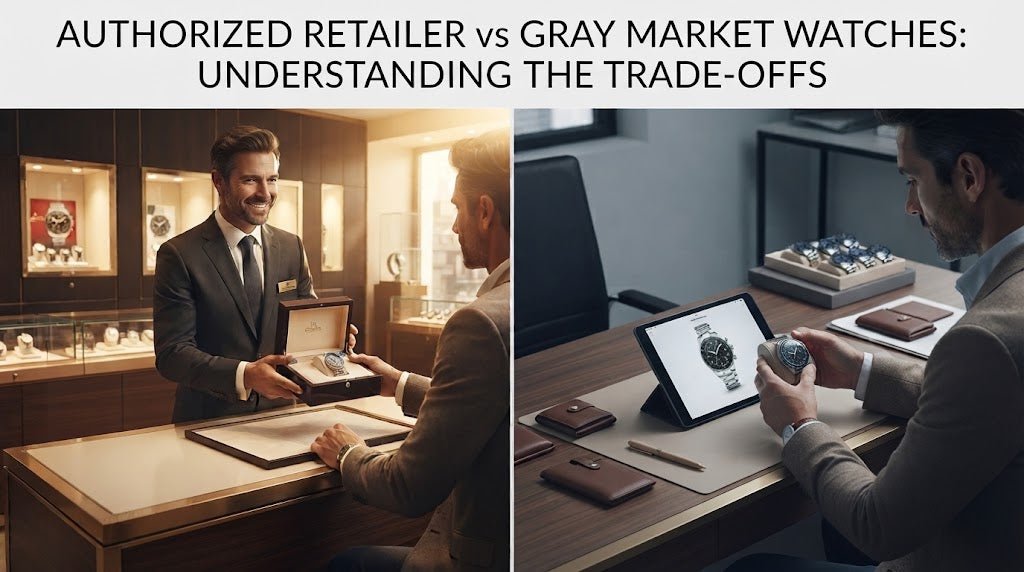
An authorized retailer sells watches with the brand's approval. That means the retailer sources directly from the brand or an official distributor, follows the brand's sales standards, and provides the official manufacturer warranty. In other words, authorized dealers and authorized retailers operate through official distribution channels. The watch is intended for that sales channel. Its paperwork, packaging, and after-sales support should align with the brand's standards.
A gray market seller offers genuine branded goods without that official relationship. The grey market refers to sellers operating outside official channels. The watches are usually not counterfeit. They are often real products that entered the market through unofficial channels, overstock liquidation, parallel import routes, or through grey market dealers, secondary sellers, and market dealers sourcing from excess inventory or surplus stock outside the brand's approved network.
That distinction matters more than many buyers expect. A gray market watch can still be authentic, but authenticity is only one part of the purchase. The bigger question is whether the watch arrives with verified origin, full factory backing, and reliable support after checkout, so buyers should understand the key differences between watches sold through official channels and those sold outside them.
Why gray market luxury watch prices look so tempting
The gray market exists because price-sensitive shoppers respond to lower prices. If a watch is listed hundreds below retail price, the value proposition feels obvious, and for most buyers that can look like a good deal compared with an authorized retailer selling at full price.
Authorized dealers typically sell watches at full retail price and usually follow fixed retail pricing, so buyers rarely find discounts through that channel.
But discounts in watches are rarely magic. They usually come from a compromise somewhere in the chain. Sometimes the watch was originally intended for another market. Sometimes the packaging is incomplete. Sometimes the manufacturer warranty is missing, replaced by a seller warranty that sounds similar but is not equivalent. Sometimes inventory has sat longer than expected or changed hands multiple times before reaching the final listing. Those attractive prices only make sense when you understand what has been removed from the package.
None of this automatically makes a gray market watch a bad buy. It does mean the lower price should be read as a different buying model, not a simple win. Market pricing also shifts with demand, scarcity, and sales channel, which is why gray market and authorized pricing often diverge.
Warranty is where the difference becomes real
This is usually the deciding factor.
When you buy from an authorized retailer, you usually get the brand’s official warranty with full warranty protection from day one. If a movement issue appears, if a crown fails, or if something arrives with a manufacturing defect, you are generally covered through the brand's service structure. That gives you a cleaner path to repair, replacement, or inspection.
With gray market watches, the official manufacturer warranty is often missing or invalid. Instead, the seller may provide its own warranties or an independent warranty. That can range from decent to nearly useless. Some sellers honor repairs responsibly. Others make claims difficult, slow, or conditional, so review the warranty terms carefully before buying. And because they are not part of the brand's official network, genuine watches bought outside authorized channels may still be eligible for manufacturer service, but not warranty coverage.
For buyers who see a watch as more than a short-term accessory, official warranty coverage is not a minor detail. It is part of the product.
Authenticity is not the only trust issue
People often frame this as fake versus real. That is too narrow.
In the authorized retailer vs gray market watches comparison, authenticity matters, but so do condition, completeness, and provenance, because even authentic watches can raise trust issues when origin or what is included is unclear. Was the watch stored properly? Are the serials intact? Is the box original? Is the manual correct for that region? Has anything been swapped, polished, or handled more than expected? Is the model configured exactly as the brand intended for your market? Original factory paperwork can also support stronger resale value later.
A trusted authorized retailer reduces those questions because the sourcing path is clean and documented. You are not trying to reverse-engineer a product's journey after it lands on your doorstep.
That matters even more for style-led buyers. If you care about the object as a complete design piece, packaging, paperwork, and condition are not extras. They are part of the ownership experience and part of the peace of mind that comes from documented origin and completeness.
The trade-off is simple, but not always small
If you buy gray market, you may pay less upfront. If you buy authorized, you usually get stronger support, clearer sourcing, and official warranty protection. That is the broad trade-off.
The nuance is in your tolerance for risk.
If you are buying an affordable everyday watch, understand the seller well, and accept limited after-sales support, gray market might feel acceptable. If you are buying a gift, a collectible design piece, or something you plan to wear for years, the savings may stop looking meaningful once uncertainty enters the picture.
This is especially true when the watch carries emotional value. A birthday gift, a graduation piece, a first mechanical watch, a design-driven daily wearer - these purchases are rarely just about the invoice total.
Who should buy from authorized dealers?
The best candidate is not necessarily the most cautious buyer. It is the buyer who wants the full product experience. That matters even more with sought after models, since buying through an authorized source can help build a stronger relationship with the brand.
That includes anyone who values manufacturer warranty, clean sourcing, proper packaging, and a straightforward service path. Buying through authorized dealers can also strengthen brand loyalty and, over time, improve future access to hard to get references. It also includes people who do not want to spend hours verifying whether a deal is too good, whether the papers are valid, or whether the seller will still answer emails six months later. For in demand models, this route is often the smarter way to avoid long waiting lists later on.
An authorized retailer is also the better fit for gift buyers. When you are buying for someone else, confidence matters. You want the item to arrive right, feel complete, and carry the credibility of official distribution.
For curated lifestyle shoppers, this route simply aligns better with the product itself. A watch is part utility, part design object, part personal statement. Buying it through an official channel keeps the experience consistent with that intent, and some buyers are also happy to pay retail now because it can position them better for a future dream watch purchase.
Who still buys gray market watches?
Plenty of people do, for understandable reasons.
Some are experienced collectors who know the references, know the seller landscape, and are comfortable trading warranty protection for a sharper price in the luxury watch world. Others are chasing a model that is hard to find through standard channels. Grey market dealers often offer immediate availability for rare models and limited editions, especially when an authorized dealer has limited stock, limited availability, and buyers may be waiting months for in demand pieces such as a Rolex Daytona. Some simply want the lowest possible cost and are willing to handle the downside themselves.
That approach can work if you are informed, realistic, and selective. But it works best when the buyer knows exactly what they are giving up. Problems usually begin when shoppers assume gray market is basically the same thing as authorized retail, just cheaper. It is not. Some watch lovers accept those trade-offs to secure their next timepiece faster.
A better way to judge value
Price is easy to compare. Value is harder.
A better question is this: what are you paying for besides the watch itself?
With an authorized retailer, you are paying for verified sourcing, official brand relationship, warranty coverage, and a more reliable ownership experience. With gray market, you are often paying less because some of those layers have been removed.
That does not mean authorized is always right for every buyer or every budget. It does mean the extra cost has a purpose. In categories where craftsmanship, brand integrity, and long-term ownership matter, that purpose is not cosmetic.
For many shoppers, especially those buying design-led watches from brands they genuinely care about, the safer purchase is also the more satisfying one. The object feels better when the buying experience feels clean.
What to check before you buy
Before you purchase watches from any seller, especially outside official channels, do some due diligence and ask a few direct questions. Is the seller an authorized retailer for that specific brand? Does the watch include the official manufacturer warranty? What warranty terms apply, and is the seller offering an independent warranty? Is the source of inventory transparent? Is the seller one of the reputable sellers in this space, and how do they handle selling watches after the sale if issues arise? Are the packaging and papers original and complete? What happens if the watch has a defect after delivery?
If those answers are vague, the low price is probably asking you to absorb the uncertainty.
For a watch buyer considering a used watch, certified pre owned or pre owned options can be a middle ground with more verification than an independent seller offers.
For retailers that position themselves around trust and curation, this is where the difference becomes visible. An authorized retailer like Bang On is not just offering a watch. It is offering confidence that the brand relationship, product origin, and after-sales support are exactly what they should be.
And that tends to age better than a discount.
The right watch should feel considered from the first click to the first wear. If a lower price introduces doubt, friction, or missing support, it is worth asking whether the deal still fits the kind of ownership experience you actually want.
Share
Camera and film still offer something phones can't - texture, ritual, and presence. Here's how to choose the right setup for your style.
Choosing film camera film shapes color, grain, and mood. Find the right stock for portraits, street shots, travel, and everyday analog shooting.