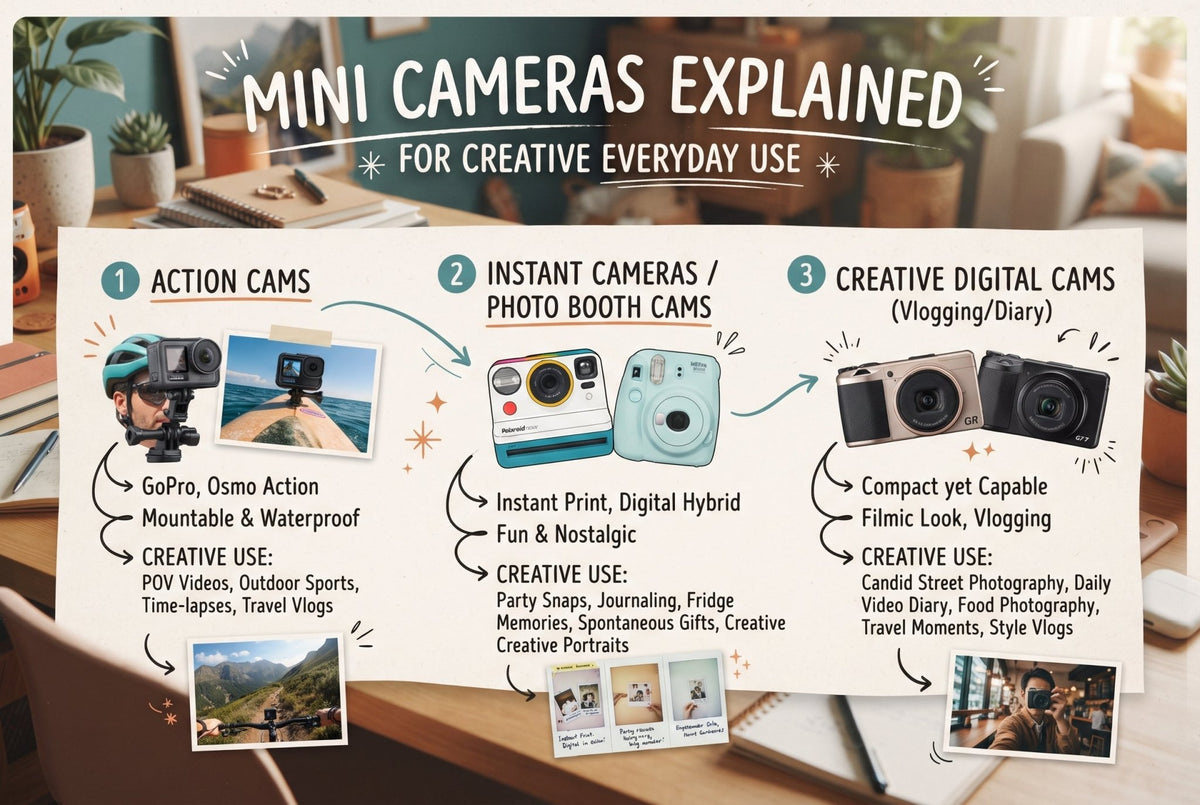
Mini Cameras Explained for Creative Everyday Use
A camera that fits in a pocket changes the kind of photographs you take. It comes along to dinner, rides in a tote, appears at a party, and catches the small visual details a larger camera often misses. Mini cameras explained is less about chasing technical perfection and more about understanding a format built for spontaneity, style, and keeping creativity close at hand.
Mini cameras explained: what makes compact cameras mini?
A mini camera is defined first by its footprint. These compact cameras are designed to be carried almost without thought, often with a playful form factor, simple controls, and an intentionally low barrier to taking a photo. Some are tiny digital cameras with built-in storage or memory card support. Others are collectible-style cameras that create a lo-fi image with flash, filters, or a distinctive color response, while tiny cameras can also include keychain models, wearable recorders, and pocket digital options with very different sensors, lenses, and controls.
The category is broad, which is part of its appeal. A mini camera can be a design object, a casual party camera, a travel companion, or an easy entry point for someone who wants to step away from the phone screen for a moment and get a fresh perspective on what they notice and photograph. It is not necessarily trying to replace a mirrorless camera or a flagship smartphone. It offers a different photographic experience, and a miniature camera may be perfectly fine for short clips or daylight snapshots even if battery life, recording time, and low-light results are more limited.
That difference matters. A phone is always optimized for convenience and clean, shareable results. A mini camera often embraces a little friction: framing without an oversized display, working with limited settings, and accepting an occasional imperfect shot. This also reflects how small cameras shape everyday use: easier to carry, easier to position, but often more constrained by screens, focus, exposure, and recording limits. The result can feel more personal because it is less controlled. In that sense, small cameras are often chosen for portability and a less intimidating way to shoot, even if they offer fewer controls than larger systems.
Mini camera vs. instant camera
Mini cameras and instant cameras are often grouped together because both are compact, social, and giftable. They serve different creative instincts.
An instant camera produces a physical print shortly after the shutter is pressed. The photograph becomes part of the moment: passed around the table, tucked into a journal, or pinned to a wall. Some tiny cameras even resemble miniature versions of traditional cameras, with small displays and buttons rather than bare recording modules. Film cost and the one-shot nature of each frame encourage a more deliberate approach.
A mini digital camera captures files electronically. Within the broader group of tiny cameras, one miniature camera may differ a lot from another in controls or output. Small cameras can look similar while offering very different capabilities. Depending on the model, you may review images later, transfer them, edit them, or keep the original low-fi look intact. This makes it a more flexible choice for everyday experimentation, especially when you want to photograph freely without counting every exposure.
Choose instant when the print itself is the point. Choose a mini digital camera when you want the charm of a dedicated camera with more room to play. It offers a different photographic experience. How small cameras handle depends on the model: a bridge camera uses a fixed lens and a broad zoom range for more reach, while simpler options stay pocketable. Plenty of creative people keep both: one for tangible keepsakes and one for unplanned daily documentation.
Why image quality is not the only question
It is reasonable to ask whether a mini camera takes good photos. The better question is: good for what? They serve different creative instincts. Mini digital models sit within a broader market that includes compact, mirrorless, DSLR, and bridge options.
If you need crisp night scenes, fast-moving action, large prints, or highly detailed product imagery, a compact mini camera may not be the right tool. Small sensors and simple lenses have real limits: the tiny image sensor and overall sensor size affect how much light is captured, so low light scenes can show noise, and avoiding motion blur is harder without stabilisation or a faster shutter. Indoor shots can show noise, flash can be more noticeable, and fine detail will not match larger sensors, a full frame body, or even some compact cameras built for great image quality. More megapixels do not automatically mean high quality images if the camera's sensor and lens cannot hold little detail, and while some files respond well to post processing, you should not expect excellent image quality from a format that prioritizes size. Unlike a bridge camera, many mini models favor portability over a long zoom range, while bridge models pair a fixed lens with more reach than most pocket options.
But technical limits can also shape the mood. Direct flash, softened edges, slightly unexpected color, and a lower-resolution file can give an image the casual character associated with disposable cameras and early digital snapshots, which sets them apart from more traditional cameras built around reusable digital files or interchangeable systems. For a birthday, a weekend trip, a studio visit, or a night out, that character can be more memorable than flawless sharpness.
A mini camera is at its best when you let it be itself. Use it to capture atmosphere rather than treating it as a substitute for every camera you own.
The details worth checking before you buy
Mini cameras are simple by design, but the details still determine whether one will earn a place in your everyday carry. Start with how it saves images. Internal storage is convenient for casual use, while a memory card slot offers more capacity and an easier path for transferring photos.
Next, consider power. Rechargeable cameras are practical for regular use, especially if charging uses a cable you already carry. On modular options with an action pod, you may also get extra battery life and a live preview without making the core camera much bigger. Battery-operated models can suit occasional use but require a little more planning before a trip or event.
A screen can be useful for framing and reviewing photos, though some people prefer a more stripped-back experience. It also makes camera settings and changing settings quicker than relying on phone menus alone. Look at the flash behavior as well. A built-in flash is valuable indoors and after dark, but it will create a more direct, candid look than the balanced lighting of a larger camera setup, and white balance matters under mixed lighting conditions. Even so, these small models can still deliver good image quality for casual shooting in decent light. If a model includes digital stabilisation, it can help cut blur from hand shake, though fast movement can still produce softness.
Finally, pay attention to the physical design. Tiny controls should still feel usable, especially around the shutter release. Check how the camera lens sits on the body and whether the grip keeps your fingers clear. A camera that looks great but is awkward to hold may stay on a shelf. The strongest designs balance visual personality with a shape you will actually reach for, and some of the final look can be refined later in post processing.
How to choose a mini camera for everyday photography that fits your life
Start with the setting, not a specification sheet. If you want a camera for concerts, dinners, and weekends with friends, prioritize portability, simple flash use, and a form you are happy to bring everywhere. If you want travel documentation or everyday photography, look for reliable battery life, easy image transfer, and memory card support; for video or continuous recording, consider only high-capacity microSD cards. Mini cameras are often a lightweight camera choice for spontaneous moments, but they also tend to use smaller batteries, so recording time can be limited. If you expect more complete control, mirrorless models with interchangeable lenses open up wider creative possibilities, though a traditional DSLR may still suit someone who wants a familiar system despite the extra bulk. An entry level mirrorless body can also be a practical way to save money without jumping straight into expensive gear.
For creative projects, consider what kind of visual texture you enjoy. Some people want clean digital files they can crop and edit, while others may care more about focal length, a wide angle view for street photography, or flexibility when capturing landscapes and distant subjects with optical zoom. Others want images that already feel like a memory: bright flash, imperfect exposure, and a little unpredictability. Neither preference is more serious. They simply produce different kinds of photographs. A compact size can be just that for daily carry if you want something easy to pack, and a flip-out screen or separate live preview setup can make composition easier for vlogging across different lighting conditions. Check audio quality too, including built-in mics with wind-reduction for outdoor vlogging. Look for advanced digital stabilisation to keep footage steady, plus useful extras like face detection or panorama mode.
Gift buyers should think about confidence, too. A mini camera works especially well when the recipient is style-conscious but does not want to study a manual. A recognizable, well-made design with clear controls feels generous because it is immediately usable. Physical buttons around the shutter release also make changing settings and accessing basic camera settings easier than awkward touch-only controls, especially when adjusting exposure settings or shutter speed. It also has presence as an object, which matters when the camera is part accessory, part creative prompt. If someone may later want an electronic viewfinder, that usually points them toward a larger camera category rather than a tiny point-and-shoot.
Authenticity matters in this category. A camera may look like a small novelty purchase, but official sourcing and warranty coverage still make a difference. At Bang On, the appeal of a selective camera edit is not more choice for its own sake. It is the confidence that the design, brand story, and everyday function belong together.
Make the small camera part of the ritual
The best way to use a mini camera is to stop saving it for major occasions. Keep it near your keys or in the pocket of your bag. Photograph your coffee shop table, your friend mid-laugh, a strange sign, the view from a train, or the color of late afternoon on a building. It is great for concerts and weekends, but a lightweight camera may suit broader everyday photography if you want better handling for spontaneous moments. A mini camera can be perfect for just that, while a larger system opens more creative possibilities across focal lengths. For travel, a wide angle view helps with capturing landscapes, while more reach or optical zoom matters more if you often shoot distant subjects. Mirrorless cameras are more compact than a traditional DSLR and offer interchangeable lenses for versatility, while DSLR cameras use a mirror system to show the actual scene through the lens. An entry level mirrorless or DSLR is a sensible step up if you want more complete control over exposure, and some also add continuous shooting for rapid sequences. An electronic viewfinder can also help preview exposure and composition if you want more than a mini camera offers.
This is where compact cameras earn their character. They turn photography from a polished task into a habit of noticing, opening a whole new world in ordinary scenes. Try different angles to find new perspectives in reflections, windows, or street corners. One of the top tips for building photography skills is to practise with everyday objects, because product photography setups with simple props can teach you how focus, deep shadows, and tiny details change a frame. Exposure settings and shutter speed shape whether those images feel clean or intentionally imperfect. If you are curious about miniature photography, even casual experiments can translate well to social media.
You may not post every frame. You may not even keep every frame. The value is in building a record that feels less like content and more like a life actually lived.
A mini camera will not make every image perfect. It can make more images possible - and sometimes, that is exactly the point. It also suits people who want creativity without expensive gear, while a used entry-level camera can save money if you want to grow beyond a fixed-lens mini model.