Mini Camera Versus Instant Camera: Which Fits?
A camera can change the mood of a night out before you take a single photo. The real choice in the mini camera versus instant camera debate is not simply digital versus film. It is whether you want a small creative object that keeps up with every moment, or a camera that turns one moment into something you can hand to someone before the song ends.
Both belong comfortably in a bag, a jacket pocket, or on a weekend table beside your keys. Both are built for people who want more personality than a phone camera provides. But they create very different habits. One rewards volume, experimentation, and the pleasure of looking back. The other asks you to slow down, commit to a frame, and enjoy the physical result.
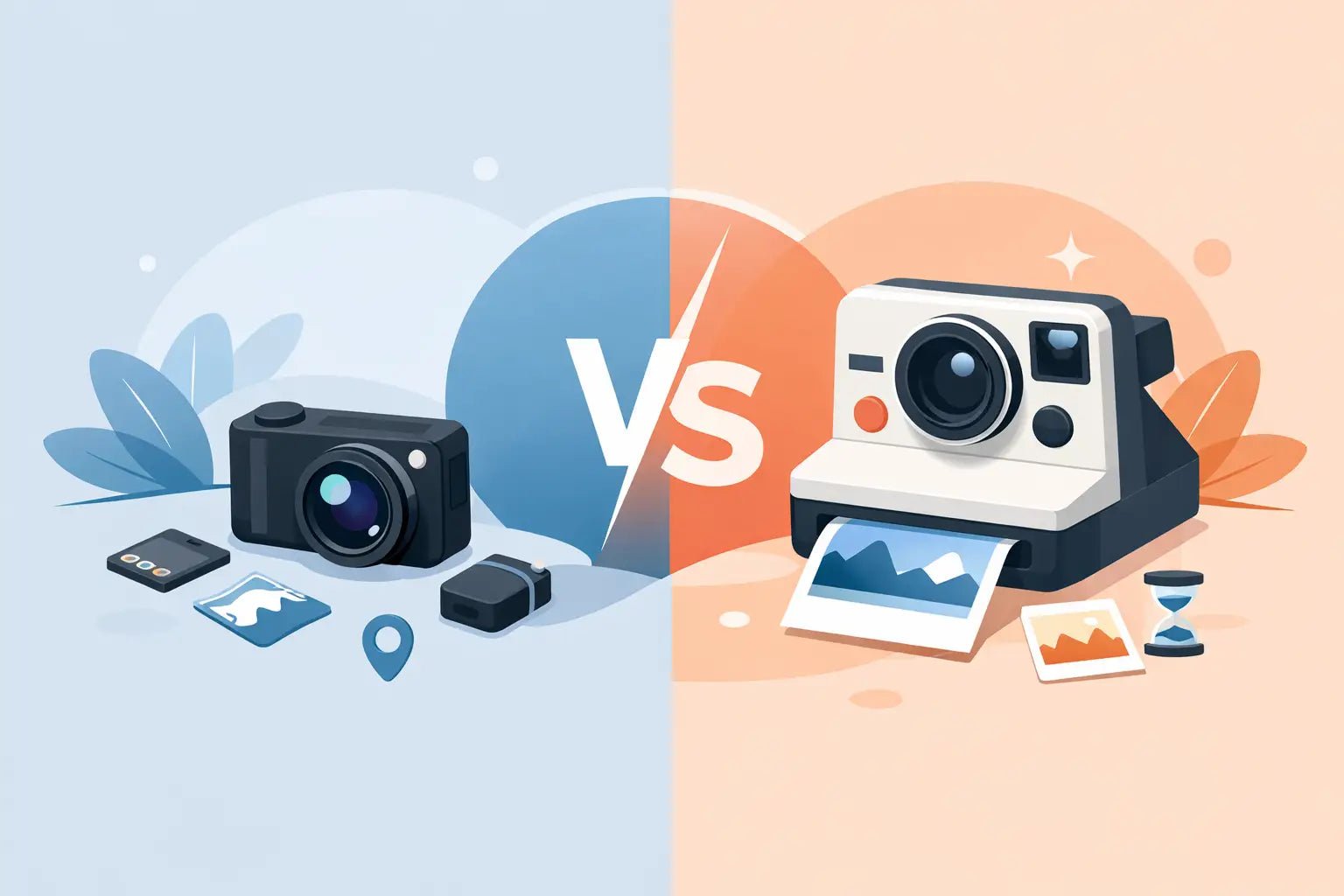
Mini Camera Versus Instant Camera: The Core Difference
A mini camera is typically a compact digital camera designed to be carried everywhere. Think small-format digital cameras with simple controls, playful color options, and a deliberately casual point-and-shoot experience. Some collectible models lean into lo-fi character, flash-forward snapshots, or retro design rather than the technical perfection of a larger mirrorless camera.
An instant camera captures an image and produces a physical print using instant film. The experience is tactile from start to finish: compose the shot, press the shutter, watch the film eject, and wait for the image to appear. A Polaroid image is not only a record of a scene. It becomes part of the scene itself, passed across a dinner table, taped to a wall, or slipped into a card.
Neither format is automatically better. A mini camera is generally more flexible and lower-cost per shot. An instant camera is more deliberate, more physical, and often more emotionally immediate. Your best choice comes down to how you want photography to fit into your life.
Choose a Mini Camera for Everyday Freedom
The mini camera makes sense when you want a camera you will actually bring with you. Its strength is low friction. You can take 30 photos at a gallery opening, a road trip, or a friend’s birthday without calculating the cost of every shutter press. If a photo misses, take another. If the light is strange, try the flash. If the result is unexpectedly great, you can keep it, share it, or print it later.
That flexibility matters for people who are rediscovering cameras after years of relying on a phone. A small digital camera gives you a distinct visual ritual without demanding technical knowledge. The act of choosing the camera, turning it on, and framing through its screen can create enough distance from your phone to make a moment feel more intentional.
Mini cameras also fit naturally into travel and everyday carry. They are lighter than serious camera gear and less precious than a device that requires a dedicated case and careful setup. For urban creatives, that often means more photos from ordinary days: coffee shop windows, subway platforms, Sunday light in the apartment, a friend caught mid-laugh.
There is another practical advantage: storage. Digital files can be saved, edited, backed up, and shared. You can send a favorite shot from a weekend away to everyone who was there. You can create a photo book months later rather than deciding at the exact moment of capture whether an image deserves a print.
The trade-off is that a mini camera may not feel dramatically different from phone photography unless its design, color rendering, or shooting experience gives you a reason to reach for it. It offers a change of tool, not necessarily a full break from the digital cycle of shooting, reviewing, and sharing.
Choose an Instant Camera for Analog Joy
An instant camera is for the person who wants the photograph to leave the screen entirely. It puts a boundary around each frame. You get one image, one exposure, and one physical object at the end. That limitation is not a flaw. It is the point.
Instant film makes everyday images feel more ceremonial. A blurry portrait from a house party may be technically imperfect, but it can become the photo someone keeps in a wallet for years. The soft focus, flash falloff, rich color shifts, and white frame give the image a presence that a polished phone photo rarely has.
This makes an instant camera especially strong for gatherings, gifts, dates, weddings, and creative projects. It gives people something to do together. Guests pose differently when they know a print is coming out. A quick portrait becomes a memento. A guestbook becomes more personal when every message sits beside a one-of-one photo.
Polaroid-style photography also suits people who appreciate objects with character. The camera can be a design piece in its own right, and the prints can live in the real world instead of disappearing into an album of thousands. For a desk, studio wall, or scrapbook, instant film has a visual language that needs very little styling.
The cost of that magic is real. Film packs add an ongoing expense, and each shot has more consequence. Instant cameras can also be less forgiving in difficult lighting. The best results often come from learning how your camera responds to bright daylight, flash range, close subjects, and background light. That learning curve is part of the appeal for some people and a barrier for others.
Compare Cost Beyond the Camera Price
A mini camera usually has a higher upfront price than a basic instant camera, although that depends on the model. Once you own it, however, the cost of taking photos is minimal. A memory card can hold hundreds or thousands of images, making a digital mini camera the easier choice for long trips, frequent use, and spontaneous shooting.
With an instant camera, the camera is only the beginning. Film is an ongoing creative material, much like sketchbook paper or vinyl records. That recurring cost encourages restraint. Some buyers love that every frame feels earned; others find it makes them hesitate when they should be enjoying themselves.
If you are shopping for a gift, consider the full experience. An instant camera feels complete when paired with film because it can be used immediately. A mini camera is a strong choice for someone who loves documenting life and wants freedom to shoot often without keeping an eye on the remaining frames.
Think About the Image You Want to Keep
A digital mini camera gives you files. That means you can crop, adjust color, create prints, or post a photo whenever you like. The original is safe as long as you back it up. This is practical, especially for travel and family moments you do not want to lose.
An instant camera gives you an original print. It may not be perfectly exposed, and there is no identical backup waiting on a memory card. But that singularity is what makes it meaningful. The photograph has texture, scale, and a small vulnerability. It can fade a little, pick up a fingerprint, or become part of someone else’s home.
For many people, the strongest setup is not an either-or decision. A mini camera documents the whole night. An instant camera marks the few moments worth turning into objects. One is your visual notebook; the other is your keepsake maker.
What Fits Your Style of Photography?
Choose a mini camera if you want to shoot frequently, travel light, save every image, and share photos easily. It is the better fit for casual documenting, creative experimentation, and anyone who values a compact camera without the recurring price of film.
Choose an instant camera if you value the ritual of a print, enjoy imperfect images with personality, and want photography to be social and tangible. It is ideal for celebrations, thoughtful gifts, and spaces where photos should be seen rather than stored.
There is also a style question. A mini digital camera often feels playful, contemporary, and quietly nostalgic. An instant camera feels expressive, physical, and unmistakably analog. Neither choice needs to be justified by megapixels alone. The right camera is the one that invites you to notice more, carry it more, and make a few images worth keeping close.
For a selective camera collection, Bang On favors that kind of choice: a tool with a clear point of view, useful enough for real life and distinctive enough to become part of it.