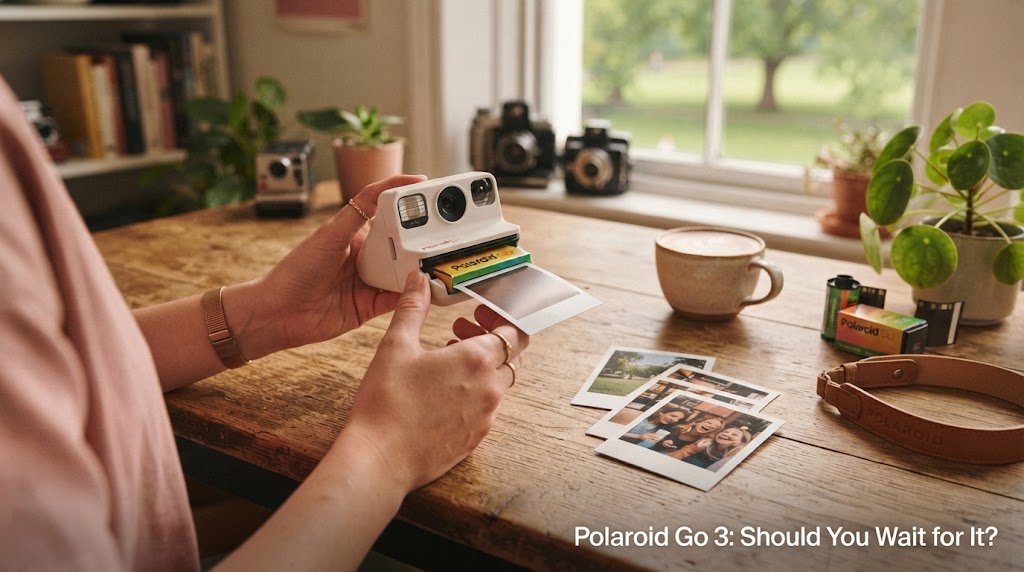
Polaroid Go 3: Should You Wait for It?
Small instant cameras live or die on one thing: whether you actually want to carry them. So if you are asking “polaroid go 3 should you wait for it,” the short answer is yes if you want a more refined Go with better exposure consistency, closer-focus performance, stronger battery life, and subtle design cleanups; if you want to start shooting now or need a gift soon, the current Go is already a good buy. That is why the idea of a polaroid go 3 is interesting before it is even official. If Polaroid pushes its smallest camera into a third generation, the real question will not be raw specs alone. It will be whether the next version keeps the charm of the Go format while fixing the friction points that matter in daily use.
For design-minded photographers, casual shooters, urban creative professionals, and gift buyers, that distinction matters. A camera this compact is not competing with a mirrorless body, and it is not trying to. It sits in a different lane - more personal object than technical instrument, more memory-maker than image machine. So this is a practical buying guide to what a future Go 3 could improve, when waiting makes sense, when buying now makes more sense, what gives the Go line its appeal, and how a compact instant camera fits into everyday style and creative use. When people start searching for a Polaroid Go 3, they are usually asking something more practical underneath: should I buy the current Go, wait for a possible update, or choose a different instant camera altogether?
What a Polaroid Go 3 would need to get right
The appeal of the Go series has always been clear. It gives you the Polaroid experience in a format that feels easier to slip into a bag, jacket pocket, or weekend setup, and a Polaroid Go 3 would likely continue that position as the world's smallest instant camera. It is playful, highly giftable, and visually strong in a way many compact gadgets are not. That part is already working.
Where a polaroid go 3 should you wait for it could make a real impact is in refinement. Instant cameras are simple by design, but simple does not mean basic. People still notice improved focus reliability, stronger flash behavior, battery life, exposure consistency, and how expensive every missed frame feels. For go gen 3, that would matter even more because missed shots feel harder to justify when every frame costs money. When film costs are part of the equation, every improvement in hit rate matters more than it does on a digital camera.
A third-generation Go would ideally feel less like a novelty and more like a polished everyday creative tool. That does not mean turning it into a feature-heavy device. In fact, too much complexity would work against the line. The better move would be to improve the fundamentals while keeping the form factor clean and approachable. Its appeal also depends on staying playful and approachable while delivering stronger battery life.
Why the Polaroid Go instant camera line still has a place
There is a reason small-format instant cameras keep finding an audience. They are social in a way phone photography is not. You take a shot, hand over each photograph, pin it to a wall, or tuck it into a notebook, and the small prints are charming and easy to share. The object matters as much as the image.
The Go format amplifies that feeling because the camera itself feels personal. Its small size makes it less intimidating at parties, easier to carry during travel, and more likely to encourage spontaneous social use on normal days. That last point is easy to underestimate. The best camera for spontaneous memories is often the one that did not feel annoying to bring.
For urban creatives, the Go line also works as an aesthetic object. It looks intentional. It belongs next to a well-designed watch, a compact bag, or a desk setup with some character. That design value is not superficial. It changes whether a product gets used or left on a shelf, and helps explain why it feels so cute and giftable.
Polaroid Go 3 rumors versus real buying logic
With products like this, speculation can run ahead of common sense. A possible Polaroid Go 3 sounds exciting because people naturally imagine cleaner results, better handling, and smarter features. Some of that may happen. Some may not.
If you are trying to decide whether to wait, it helps to separate wish-list thinking from actual use. Ask yourself what would truly change your experience. If your main concern is portability and the current Go already delivers that, waiting may not transform much. If your frustration is exposure inconsistency and you want better exposure consistency, easier close-up shooting, or stronger battery performance, then a future update could be more meaningful.
This is where buying logic gets personal. Not everyone needs the latest release. For budget buyers, the Instax Mini 12 may make more sense because Instax Mini film is cheaper and easier to find. Others simply want a stylish instant camera that works now, especially if it is for a trip, an event, or a gift. If that sounds like you, the current Polaroid Go still delivers a fun instant film experience today. Waiting only makes sense if the expected improvements match the way you shoot, while instax may be easier to recommend if low running costs matter most.
What upgrades would actually matter most
Better exposure consistency and double exposure mode
This is probably the biggest one. Instant photography has charm because it is imperfect, but there is a difference between analog character and unpredictable results. A Polaroid Go 3 would benefit from smarter metering that handles mixed indoor light, harsh daylight, and flash scenes with more confidence, and a stronger flash plus a 1/500-second maximum shutter speed would help in low light and bright light alike. A brighter viewfinder than the previous generation would also be a significant improvement for framing shots more confidently.
That kind of improvement would not make the camera less fun. It would just make it easier to trust.
Improved close-up performance and selfie mirror
A compact instant camera invites intimate photos - table settings, portraits across a café, small objects, travel details. If Polaroid improves focus behavior with a new lens, it could deliver clearer shots with better contrast and more reliable focus at close range, which would be a meaningful step forward for everyday users.
This matters even more for people buying the camera as a lifestyle object. A selfie mirror and a lens design that creates less glare would make group selfies with up to three friends easier. They are often photographing friends, interiors, outfits, and moments with a strong sense of atmosphere. Missed focus breaks that mood fast.
Stronger battery life and charging convenience
A small camera should be easy to live with. Better battery performance, clearer charging indicators, and dependable USB-C handling would all make a difference. None of that is glamorous, but it shapes ownership more than marketing language ever does.
Small design refinements
The Go already succeeds visually, so a third-generation version would not need dramatic redesign. The best changes would be subtle: improved grip, more intuitive controls through a simple three-button layout, a better shutter feel, or details that make loading go film and shooting with easy one-handed use feel more natural, especially since its small size means a smaller film format than i-Type.
Good design often looks like restraint.
Who should wait for the Polaroid Go 3
If you already like the idea of the Go but have held back because you want a more refined camera, if the polaroid go generation 3 is available its 251.9g weight keeps the wait focused on portability as well as refinement. The same applies if you are the kind of buyer who keeps products for years and prefers buying at a more mature point in a product cycle. A future third-generation model could be worth it if reliability is your top priority.
Waiting also makes sense if this is not an urgent purchase. If you are buying for curiosity rather than a specific occasion, there is little harm in seeing what Polaroid does next. If this article is being updated after launch, the model arrived in June 2026 and still fits the appeal of a tiny camera.
That said, waiting is less useful if what you really want is the instant-photo ritual itself. The current options already deliver that. The tactile process, the social aspect, the compact size - those are not hypothetical benefits. They exist now.
Who should buy now instead
If you have a trip coming up, want a memorable gift, or know you are drawn to instant photography for the experience more than technical perfection, buying now is easy to justify. Small instant cameras are about participation. They work best when they become part of your routine instead of a purchase you keep postponing.
This is especially true for first-time instant camera buyers. The gap between generations can matter less than people think. If you are still learning how Polaroid film reacts to light, flash distance, and composition, much of the value comes from practice and experimentation. Your first few packs of film will teach you more than a rumor cycle. Go film comes in 8-shot film packs, and a 16-shot pack costs $21.99.
For design-conscious shoppers, there is also a practical truth here. Availability, color options, and bundle value often shape the better buy just as much as future hardware updates. Buying a trusted, authentic product from an authorized retailer can be the smarter move than chasing an unconfirmed release date.
The bigger question behind Polaroid Go 3
A Polaroid Go 3 would not matter because it is new. It would matter if it makes instant photography feel easier to love on ordinary days. That is the standard.
The best instant cameras are not the ones with the longest feature sheet. They are the ones you actually carry, actually use, and actually trust with moments that would otherwise stay on your phone forever. If Polaroid understands that, a third-generation Go could be a very strong release.
If not, the current appeal of the format still stands. Small Polaroids are fun because they are imperfect, physical, and immediate. They ask less from you than most cameras and give back something your camera roll rarely does: a finished object with presence, even if a go print is smaller than a standard i-Type print, and its 47 x 46 mm frame is part of the charm. That trade-off also makes it clear that image quality is not really the point, and these little photos feel more personal than display-worthy.
That is why this category keeps its grip. In a market crowded with faster, sharper, smarter devices, instant photography still wins on feeling. And if a Polaroid Go 3 arrives with better instincts rather than just more features, it could be exactly the kind of upgrade worth waiting for.
If you are choosing with taste as much as logic, trust the version of the product that fits how you live - not just the one that sounds best on paper.
Share
Learn how to choose a statement watch that fits your style, wrist, and routine - with smart advice on size, color, movement, and wearability.