Instant Camera Versus Smartphone Prints
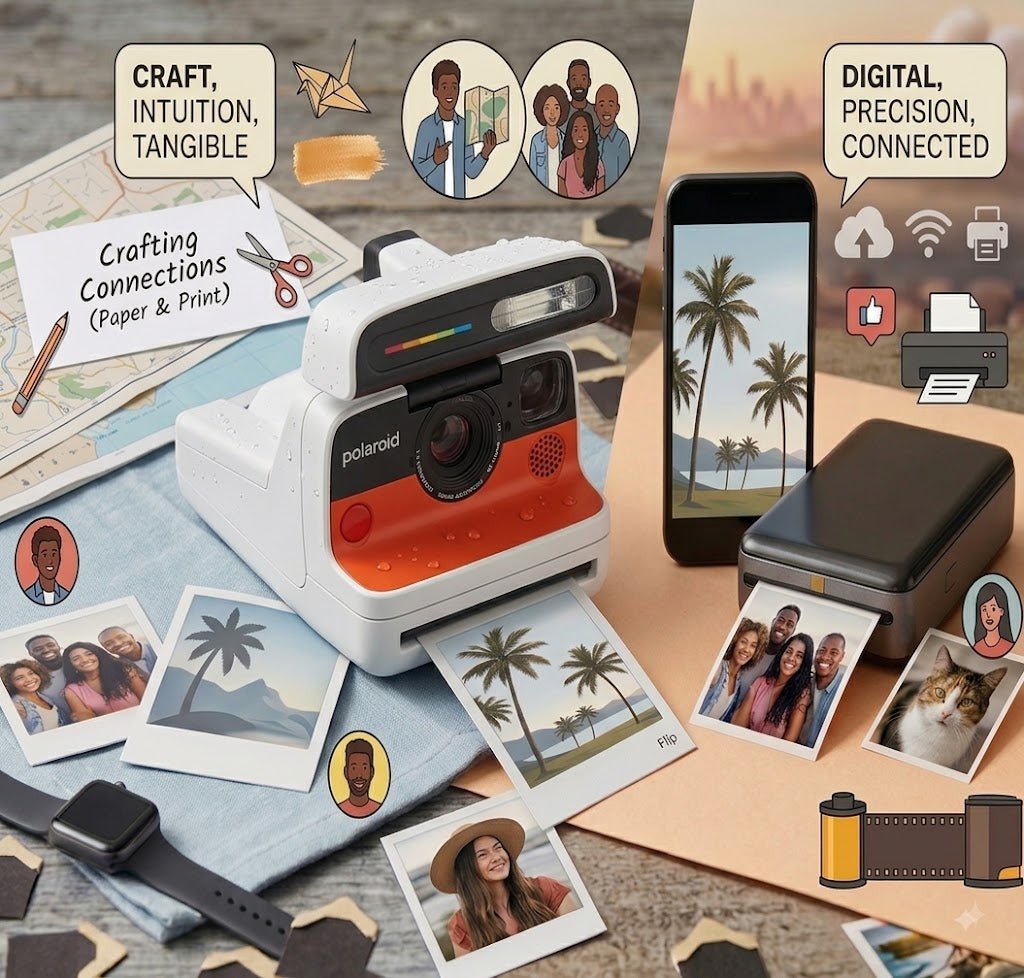
A photo of dinner, a packed dance floor, or a friend caught mid-laugh can live on a phone for years without being seen again. The real choice in instant camera versus smartphone prints is not simply analog versus digital. It depends on what you want from the photo: a spontaneous, tangible print with its own character and social presence, or a polished image from your camera roll that you can edit, refine, and print with more control.
For urban creative professionals and design-conscious shoppers who care how everyday objects look, feel, and function, both have a place in a creative life. One makes the moment feel more intentional as it happens; the other gives your existing camera roll a second life. Below, we compare social impact, image quality, creative control, printing costs, usability, and the occasions where each option makes more sense, so you can choose the format that fits your style and the way you want to keep and share memories.
Instant Camera Versus Smartphone Prints: The Real Difference
An instant camera turns photography into an event. You frame a shot with a limited number of exposures, press the shutter, and watch the image emerge. There is no endless review screen, no quick deletion, and usually no second attempt at exactly the same moment. That constraint is part of the appeal.
A smartphone print begins with abundance. Your phone is already in your pocket, capable of taking photos and capturing a hundred versions of a scene, often with impressive low-light performance and computational detail. From there, you can edit, crop, adjust color, choose a paper finish, and print only the images that earn a place on your desk, wall, or gift bag.
Neither format is automatically more meaningful. Instant photography gives the present moment a physical edge. Smartphone printing lets you rescue the best moments from the digital backlog. Think of an instant camera as a creative instrument and a phone printer as a tool built around digital control.
What an Instant Camera Does Better
It changes how people behave around a camera
When an instant camera comes out at a party or on a weekend trip, people notice. It slows the room down for a few seconds. Friends gather closer, pose with more purpose, then linger to see the result, and the whole process feels fun. The photograph becomes part of the experience rather than a byproduct of it.
That social quality is difficult to replicate with a smartphone. Phone photos are fast and familiar, which is useful, but they can disappear into the same stream as messages, work alerts, and screenshots. An instant print has presence immediately, including the appeal of sharing physical photos on the spot. It can be passed around, signed, tucked into a wallet, or pinned to a wall before the night is over.
It gives imperfect images a point of view
Instant camera photos have recognizable character: softer detail, tonal shifts, occasional flare, and colors that can feel warmer or more unpredictable than a phone image. Those traits are not technical flaws to be corrected. They are part of the visual language.
For design-minded photographers, this is the difference between an image that is clean and an image that feels alive, with visual texture that makes it feel handled rather than processed. A slightly off-center portrait or an overexposed window can make a print feel more like a memory than a file. With Polaroid cameras and Polaroid photos, especially, the bordered print leaves room around the image for a handwritten date or a small note. The frame is built into the object.
It creates a natural limit
Film costs money, and each exposure is finite. That makes an instant camera less suited to documenting every course of a meal or every angle of a trip. But it can be better for choosing the one frame worth keeping to preserve memories, not just record everything.
This limit is especially welcome when photography has started to feel automatic, because capturing memories often works better when you are more selective. You do not need to turn every outing into a film project. Bring an instant camera to the moments with built-in atmosphere: birthdays, road trips, housewarmings, weddings, gallery openings, and slow Sundays with friends.
Where Smartphone Prints Win
Your phone usually captures the stronger image quality
Modern smartphones are exceptionally capable. They focus quickly, manage difficult lighting, stabilize handheld shots, and let you shoot from wide scenes to close details without carrying additional gear across iPhone and Android devices. If image sharpness, exposure control, and the ability to capture a fleeting moment are your priorities, the phone has a clear advantage.
That matters for travel, children, pets, concerts, and quick pictures in anything happening fast. An instant camera may produce a charming result, but instant prints typically take about 90 seconds to develop, and FUJIFILM instant cameras develop film in roughly 90 seconds, which affects overall speed. It can also miss focus or struggle in low light. With a phone, you can get the shot first and decide later whether it deserves paper.
You control the final look
A smartphone printer separates capture from printing. You can select an image days, months, or years after taking it, then adjust the crop and color and apply filters to suit the print size. That makes it ideal for making a small gallery wall, refreshing a desk display, or assembling a thoughtful gift from a shared trip.
Control also makes smartphone prints more consistent. If you are creating a set for a scrapbook or a visual diary, matching exposure and color can make the collection feel more considered than the less predictable output of most instant cameras rather than random. The process is still tactile, but it starts with choice instead of chance.
It makes your camera roll useful again
Most people already have thousands of photos worth revisiting and print photos only rarely. The problem is not a lack of photographs. It is that the best ones remain buried between receipts, memes, and duplicate portraits.
A compact printer creates a small reason to curate. Print one image after a weekend away. Build a row of seasonal favorites. Make a set for a friend who moved cities. This is where smartphone printing feels less like a technical accessory and more like a habit, with a photo printer giving digital memories a physical home.
Cost, Convenience, and the Details That Matter
The ongoing cost of instant photography is its clearest trade-off. Film packs make every frame more precious, and the cost per print is typically higher than printing selected images from a phone. If you expect to make dozens of prints from a vacation, an event, or a year's worth of photos, a smartphone printer can be the more practical route.
Convenience cuts both ways. An instant camera is wonderfully self-contained: camera, print, and keepsake in one object. There is no app, no editing session, and no decision fatigue, while smartphone printers offer different styles of output depending on the paper and finish you choose. A smartphone printer needs your phone, a charged printer, and a few moments to select and prepare an image. In return, it gives you a much deeper archive to work from.
Print size and longevity deserve attention, too. Instant film has a distinctive scale and a physical surface that people associate with analog photography. Portable smartphone printers often produce compact prints with adhesive backs or modern borderless finishes, which makes them useful in different ways than instant photos, depending on the model and paper system. They are excellent for journals, planners, and casual displays, but they do not always mimic the material feel of traditional instant film.
If permanence matters, protect either type of print from direct sunlight, heat, and damp storage. The best photo is still vulnerable if it spends a year taped to a sunny window.
Choose by Occasion, Not by a Single Winner
An instant camera is the stronger choice when the act of taking the picture is the point. It suits hosts, travelers, collectors, photography enthusiasts, and anyone who wants a camera to create connection in real time. It also makes an unusually good gift because it invites use immediately, without asking someone to learn a complicated system.
A smartphone printer is the stronger choice when you want flexibility. It is for the person with a great camera roll, who likes to edit photos before printing, and who prefers to print only the frames that hold up. It works beautifully for memory books, mood boards, gifts, and compact displays that change with the season.
There is also a compelling case for owning both. Use your phone for the images you cannot afford to miss. Use an instant camera for the images you want to feel different from the moment they are taken, especially when part of the appeal is watching a photo develop. Bang On's curated approach to photography gear makes that distinction easier: choose a piece that matches the way you actually move through the city, travel, host, and create.
The next time you reach for your phone, ask a more useful question than which format is better: will this image be stronger because it is perfectly captured, or because it helps preserve special moments in physical photos?
Find the best bags for daily commute with a design-first guide to fit, weather protection, organization, and polished everyday city style for city work.