How to Spot Fake Luxury Watches
A luxury watch can change the feel of an outfit in one second. It can also reveal, just as quickly, when something is off. If you're learning how to spot fake luxury watches, start with the basics: check whether the price makes sense, whether the seller is credible, whether the photos and paperwork hold up, and then inspect the watch itself for telltale flaws in weight, dial printing, hands, crown, crystal, movement, engravings, bracelet, and caseback. The goal is not to become paranoid. It's to train your eye so you can recognize quality, understand risk, and buy with more confidence.
The fake watch market has become more convincing. Counterfeits are no longer limited to obviously bad logos and flimsy bracelets. Some copies now imitate dial layouts, packaging, and even serial engravings well enough to fool first-time buyers, especially style-conscious buyers and urban creative professionals who want authentic, well-designed pieces that match their standards. That is exactly why the details matter. Real luxury watches are built with consistency, restraint, and finishing that feels intentional at every angle.
This guide shows you what to assess before you buy, from seller reliability and pricing to fine craftsmanship details and movement checks, and why buying from authorized or carefully curated retailers reduces the risk of ending up with a fake. Knowing how to verify authenticity protects your money, your style, and your trust in what you're wearing.
How to spot fake luxury watches before you buy
The first tell usually appears before the watch ever reaches your wrist. Price, seller behavior, product photos, and paperwork often reveal more than the watch listing wants you to notice.
If a watch is dramatically under market value, treat that as a warning, not a win. Discounts exist, especially in pre-owned markets, but luxury watches rarely sell far below their normal range without a reason. Sometimes that reason is condition. Sometimes it's missing papers. Sometimes it's a fake. The point is simple: when the price feels unrealistic, slow down.
Seller quality matters just as much. An authorized retailer, a respected specialty dealer, or a reputable pre-owned platform has more to lose by selling a counterfeit. A random social account with vague captions, low-resolution images, and pressure to pay quickly does not. Trust is part of the product.
Photos should be clean, consistent, and specific. Ask yourself whether the listing shows the actual watch or only borrowed brand images. Look for sharp close-ups of the dial, crown, clasp, caseback, movement if visible, and serial markings if appropriate. Blurry photos protect bad details. Strong sellers do not need to hide them.
Documentation helps, but it should never be your only proof. Boxes, cards, booklets, and receipts can be faked too. Papers should support authenticity, not replace a proper inspection.
The physical signs that separate real from fake
Luxury watches tend to feel resolved. The proportions are balanced, the surfaces are deliberate, and nothing looks approximate. Fakes often get close, but not close enough.
Weight and material feel
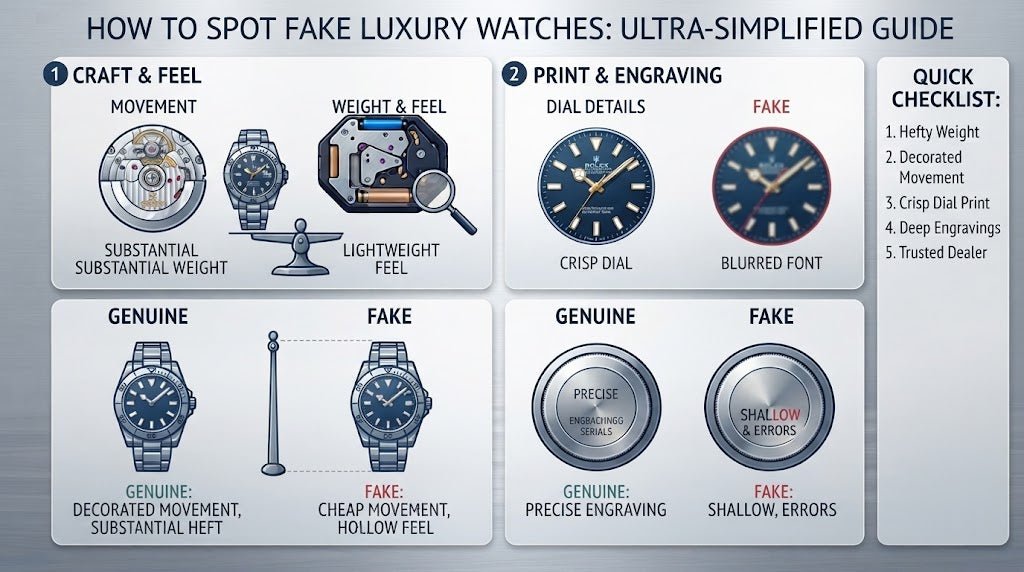
One of the fastest clues is weight. Many fake luxury watches use cheaper metals, hollow links, lightweight clasps, or mineral glass where sapphire should be, while authentic models often rely on high quality materials like 316L or 904L steel. Rolex, for example, uses 904L stainless steel for durability and added heft, whereas counterfeits often cut costs with inferior materials. That can make the watch feel insubstantial in hand and affect weight holding. Not every authentic watch is heavy, so this is not a standalone test, but a luxury piece usually has a density that feels considered rather than flimsy.
Run your fingers across the case and bracelet. Edges should feel clean, not sharp in a crude way, and the watch should have a sense of solid construction in the hand. Brushed and polished surfaces should transition neatly. If the finishing feels rough, uneven, or oddly thin, quality is already in question.
Dial printing and logo accuracy
The dial is where counterfeiters often lose precision. On an authentic luxury watch, text should be crisp, evenly spaced, and properly aligned, and the hour markers should be cleanly placed and consistent. Logos should look exact, not almost exact. The difference can be tiny, but tiny is the whole point.
Inspect the minute markers, date window, subdials, and brand name. Misaligned markers, inconsistent font thickness, crooked printing, or a date that sits awkwardly in the aperture are all red flags. On genuine watches, the dial usually looks composed under magnification, but spotting these flaws takes a keen eye and careful paying attention. On a fake, the details can start to wobble.
Lume is another clue. Premium watches tend to apply luminous material evenly and cleanly, and real luxury watches usually have high-quality luminescence that lasts longer in darkness. Counterfeits may show messy lume plots, mismatched color, or weak glow. Again, it depends on the model, but poor execution on the dial is rarely a good sign.
Hands, crown, and crystal
Watch hands should be straight, balanced, and finished cleanly. If the hands look too short, slightly bent, poorly polished, or loosely fitted, be suspicious. The crown should operate with confidence. On mechanical watches especially, winding and setting should feel controlled, not gritty or loose.
The crystal matters too. Many luxury watches use sapphire crystal because it resists scratches and maintains clarity. Some fakes swap in lower-grade glass that reflects differently or scratches too easily. On an authentic Rolex, the cyclops lens magnifies the date 2.5x, and if the date needs a second glance to read clearly or the lens looks flat, that is a strong indicator something is wrong. On some models, a tiny Rolex crown micro-etching in the crystal is another detail counterfeiters often get wrong.
Movement tells the truth
If the outside looks convincing, the movement usually tells the more honest story.
Quartz watches will tick once per second, so a visible tick is not automatically suspicious. Mechanical luxury watches, on the other hand, often have a smoother seconds-hand sweep due to higher beat rates. A jerky, uneven motion on a watch that should sweep is a warning sign. In a Rolex, a visible quartz movement is usually a red flag, because only a handful of models ever used that setup.
The sound can also help. Cheap counterfeit movements may produce a louder, thinner tick or feel crude when setting the time. An authentic automatic movement generally feels more refined in operation. This is subtle, but if you've handled enough watches, the difference becomes obvious.
If the caseback is transparent, inspect the movement finishing. A real Rolex is known for beautiful jewels and engravings, and other real luxury brands usually decorate bridges, rotors, screws, or plates with care. Counterfeits may imitate this decoration, but often in a superficial way. You might see generic movement architecture, sloppy engraving, or finishing that looks stamped rather than executed with intent.
A closed caseback makes this harder, which is why model research matters. Know what movement the watch is supposed to have. Super clones and fake Rolex watches can imitate movement layouts, making expert checks extremely difficult without tools. If the seller cannot answer basic questions about caliber, service history, or operating behavior, that tells you something too.
How to spot fake luxury watches in the fine details
The best replicas can mimic the broad strokes. The fine details are where they start to break.
Engravings and serial numbers
Authentic engravings are usually sharp, consistent, and properly placed, and Rolex engraves serial numbers deeply into the metal. Fake engravings may look too shallow, too heavy, or oddly spaced. High-end luxury watches also use a unique serial number that can be verified, not just checked for format. Serial and model numbers should also align with any accompanying paperwork if paperwork is included.
That said, serial numbers are not a magic answer. Some counterfeiters clone real ones. Think of serials as one data point among many when checking a watch's authenticity, not the final verdict for a genuine timepiece.
Bracelet and clasp construction
Bracelets often expose shortcuts. Luxury bracelets feel fluid but secure, and on authentic Rolex models they often feel more substantial because of meticulous assembly and the use of the finest materials. Links articulate smoothly. The clasp closes with precision. Any engraved branding should be clean and proportional, which is a standard shared by premium timepieces.
On a fake, the bracelet may rattle too much, feel light, pinch unexpectedly, or show poor machining inside the clasp. On a genuine Rolex, the clasp action and finishing should feel exact, while a replica may feel light or poorly machined. Even when the exterior looks decent, the underside often reveals cost cutting.
Caseback mistakes
Casebacks are another frequent problem area. Some replica makers add transparent casebacks to attract attention, even on models that should have solid backs, or engrave text that does not belong on that reference. This is one way a fake Rolex or other replica piece can fall short of the real thing. Font choice, spacing, medallions, and water-resistance markings all need to match the exact model, whether that reference is a Submariner or Sea-Dweller.
This is where comparison helps. If you can place seller photos beside confirmed images of the same reference, inconsistencies become easier to catch.
Context matters as much as craftsmanship
A fake watch is not always exposed by one dramatic flaw. Often it's the accumulation of smaller things: top tips include checking whether an authentic Rolex box is dark green with sharp edges, whether a missing tag should be present, whether a seller story keeps changing, and whether a reference number matches the dial color being offered.
That is why buying luxury watches requires a little editing discipline. Look at the full picture. Does the watch, the documentation, the seller, and the price all make sense together? The genuine article should also come with Rolex papers that include the model reference and serial number, and the warranty card should be filled out correctly, since incomplete or inconsistent cards are red flags. If one part feels out of sync, do not talk yourself into it just because the watch photographs well.
For style-conscious buyers, this matters beyond resale value. A watch is a design object. Its appeal comes from proportion, engineering, heritage, and finish working together. A counterfeit only copies the surface. It misses the intelligence behind the piece.
The safest way to buy
The easiest way to reduce risk is to buy from sources that prioritize authenticity as part of their business model. In the wider watch industry, the safest route for authentic luxury watches is still direct brand channels or vetted specialists. Authorized retailers are the cleanest option because inventory comes directly from brands and includes official warranty coverage. Reputable specialists can also be excellent, especially for discontinued or pre-owned pieces, but their standards should be clear and verifiable. They should be able to show brand names, certification, and documentation that support an authentic Rolex watch or other Swiss brands.
This is where curation matters. A selective retailer is often a stronger signal than a marketplace trying to be everything for everyone. Bang On, for example, is built around direct brand sourcing and official authenticity rather than gray-market volume, which reflects the same authentication standards buyers would expect when assessing a Rolex watch or other genuine pieces. That kind of restraint is useful. It helps buyers spend less time decoding risk and more time choosing a piece they actually want to live with.
If you're ever unsure, pause the purchase. Ask for more photos. Ask for movement details. Ask why the price is what it is. A genuine seller will not be offended by careful questions.
The best luxury watch purchases feel calm, not rushed. If a watch is real, its quality holds up under scrutiny. And if it doesn't, walking away is not missing out. It's good taste doing its job. Also remember that many fake watches circulate through unregulated channels, so seeing the piece in person when possible can help you spot a fake before you buy.
Share
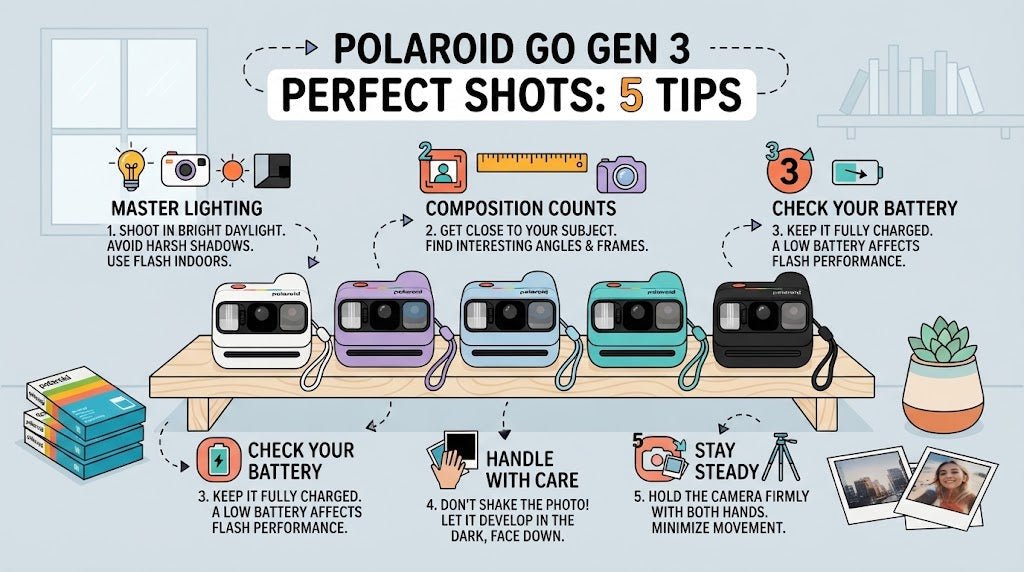
Learn how to get perfect shots with your Polaroid Go Gen 3: 5 essential tips for better light, framing, focus, timing, and instant film results.
The perfect gift for creatives: why everyone wants the Polaroid Go Gen 3 this year, from its design appeal to the instant charm people keep reaching for.