How to Authenticate Luxury Watches Before You Buy
To authenticate luxury watches before you buy, start by confirming the exact reference number against official brand details, then inspect the dial, case, bracelet, crown, and functions for inconsistencies, review the papers carefully, and weigh the seller’s sourcing and credibility before you commit. A luxury watch can look convincing from across a room, or in a carefully lit product photo. Authentication happens closer in: in the typography, the fit of the bracelet, the behavior of the crown, the movement when a qualified professional can check it, and the paper trail behind the piece.
For first-time buyers and seasoned collectors alike, the goal is not to become a watchmaker overnight. It is to recognize what deserves a closer look, spot warning signs of counterfeit or misrepresented watches, know when expert authentication is worth it, and buy through channels that make authenticity easier to verify. Getting this right protects more than your budget; it protects your investment and the pleasure of owning a genuinely crafted timepiece.
Start With the Exact Reference and Serial Number
The most useful authentication tool is not a magnifying loupe. It is the correct model reference. A brand may produce several versions of a watch that appear nearly identical while differing in dial layout, hand shape, case material, movement, bracelet, or production year.
Before inspecting the watch, identify the precise reference number and, when relevant, the approximate production period. Every luxury watch has a unique serial number, so cross reference it with the reference and official brand records where possible. Compare it with official product imagery, catalog details, and known specifications for that version. Do not rely on a generic search for a model name. Counterfeiters often combine details from multiple references, creating a watch that feels plausible but was never actually made.
A reference should align with the visible specifications, and the watch's serial number should also be cleanly engraved, precise, and consistent with the brand’s format. If a listing describes a steel case but the reference corresponds to a gold-tone model, or if the dial color was never offered with that bracelet, pause before moving forward. Small inconsistencies are often more revealing than one dramatic flaw.
How to Authenticate Luxury Watches by Looking Closer
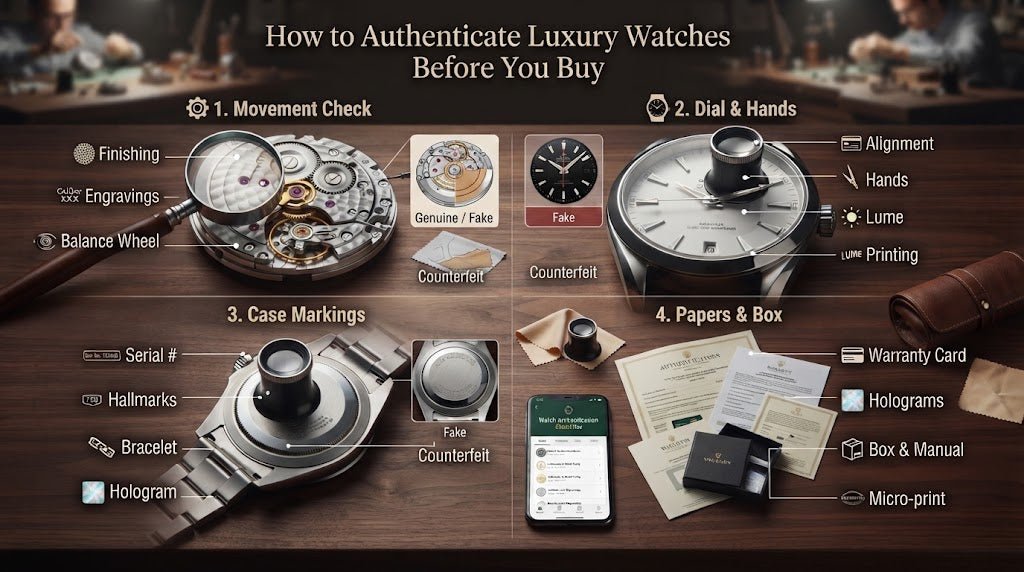
A convincing watch is usually defeated by cumulative detail, especially because even super clones can look convincing at a glance and deceive buyers. One imperfection may be a service replacement or a production variation. Several mismatched details across the finer details point to a bigger problem. A proper authentication process often relies on magnified inspection, because authentic pieces show impeccable craftsmanship under 10x magnification.
Read the dial like a designer
The dial carries a brand's visual language in its most concentrated form. Look for sharp printing, balanced spacing, aligned indices, consistent spacing, and clean edges around logos and minute tracks. On a genuine luxury watch, lettering should feel deliberate rather than thick, fuzzy, crowded, or unevenly placed.
Check the hands, too. Their lengths, finishes, and proportions should match the correct reference. A seconds hand that misses its markers, a date window that sits off-center, or applied indices with visible glue residue can signal poor construction. Macro photography is useful here, but photos can conceal flaws, while genuine watches often reveal subtle differences in dial text, logo placement, and finishing that counterfeits struggle to copy cleanly. Ask for clear, unfiltered close-ups taken from multiple angles.
Inspect the case, crystal, and bracelet
Luxury watch cases are defined by precision in places that are easy to overlook. Examine the transition between brushed and polished surfaces, the shape of the lugs, the engraved caseback, and the fit around the crystal. Poorly finished edges, shallow engraving, or uneven gaps are warning signs, and sloppy, shallow engravings are common on fake cases and bracelets.
The bracelet should articulate smoothly without feeling loose or sharp. Its clasp should close with confidence, and the branding inside it should be crisp. This does not mean every authentic watch feels heavy. Material, design, and intended use all affect weight, and genuine luxury watches often use premium materials such as 316L stainless steel. A lightweight titanium watch, for example, may be completely correct. Still, authentic pieces may weigh 20–30% more than counterfeit versions, while counterfeit watches often weigh 20–30% less. Treat weight as supporting evidence, not a final verdict.
Test the functions without forcing them
Operate the crown, date change, chronograph pushers, or other complications carefully. The action should feel controlled and consistent. A rough winding feel, a crown that sits incorrectly against the case, or pushers with excessive play deserves attention.
Function alone cannot prove authenticity. Some counterfeit watches use automatic movements and working chronographs. High-end movements are the most challenging part for counterfeiters to replicate accurately, especially in mechanical watches. Many genuine Swiss automatic movements sweep at roughly 8 or more beats per second, so the movement should match the model’s expected behavior rather than simply appear active. Still, incorrect function can expose a mismatch quickly. If the genuine model has a specific complication layout or a particular method for setting the date, the watch in hand should behave accordingly.
The Movement Is Evidence, Not a Weekend Project
The movement can provide decisive evidence for confirming whether a watch is authentic, but opening a case is not a casual buyer inspection. It can compromise water resistance, damage gaskets, and create disputes about the watch's condition. For a meaningful purchase, have a qualified watchmaker or authorized service professional inspect it.
They can confirm whether the caliber matches the reference, assess finishing and component quality, check for swapped parts, and test timekeeping. This matters because a timepiece can have an authentic case and dial but still contain an incorrect movement or a mix of replacement components.
That distinction is worth understanding. A watch with legitimate service parts is not automatically fake. Vintage pieces especially may have replacement hands, crystals, crowns, or bracelets from decades of repair. The question becomes whether those changes are disclosed, appropriate for the model, and reflected in the price. Originality and authenticity are related, but they are not identical.
Documentation Helps, but It Is Not Proof
Original boxes, cards, receipts, manuals, and hang tags add value and context. Explicitly, warranty cards can help support provenance, especially with vintage watches, but they can also be copied, altered, or paired with the wrong watch. Never treat packaging as a substitute for examining the watch itself.
When documentation is available, compare the serial number and reference against the case and the seller's description. Check that the dates, retailer information, and formatting make sense for the brand and era. Paperwork should support the watch's authenticity rather than establish it by itself, so a warranty card with a mismatched reference or an implausible purchase date should prompt more questions.
For pre-owned watches, service records can be especially useful. They establish a maintenance history and may clarify replaced components. But even a polished set of documents should support an already credible watch, not rescue a suspicious one.
Evaluate the Reputable Seller Before the Watch
Authenticity is not only a product question. It is a sourcing question. An authorized retailer receives inventory through official brand channels and provides the manufacturer's warranty. That structure removes many of the risks that appear in the secondary market and the pre owned market, where buying from a reputable dealer or trusted dealer reduces counterfeit risk significantly compared with peer-to-peer marketplaces, social listings, and unusually low-priced offers.
For a pre-owned seller, look for a clear return policy, detailed condition reporting, high-resolution images of the actual watch, and a willingness to answer specific reference-based questions. A reputable seller or trusted seller should also have positive customer reviews and a solid track record in the business. A serious seller should be comfortable discussing provenance, service history, modifications, and what is included when they sell the watch.
Price is part of the evidence as well. A rare or sought-after luxury watch offered far below prevailing market value is not necessarily a hidden opportunity. If a deal on a pre owned watch looks too good to be true—especially for Rolex or other top brands—it usually deserves extra scrutiny, as Rolex is one of the most commonly counterfeited luxury brands. It may be incomplete, heavily altered, damaged, stolen, or counterfeit. The best value is a watch whose condition, provenance, and price tell the same story.
Bang On's approach is intentionally simpler for buyers who prefer contemporary, design-led watches: curated selections, direct brand sourcing, and official warranty coverage offer an easier route to an authenticated luxury watch and remove the need to decode a questionable listing before you can enjoy the design.
Warning Signs That Deserve a Pause When Buying a Pre Owned Watch
No single item on this list proves a watch is counterfeit. Together, they create a clear case for stepping back or seeking professional verification.
-
The seller will not share the reference number, serial information, or fresh photos of the actual watch.
-
The price is dramatically lower than comparable examples without a credible explanation.
-
The dial printing, logo placement, date display, or hand set does not match the specific reference.
-
The watch is described with vague phrases such as “luxury style” or “factory original” instead of clear provenance.
-
The box and papers look convincing, but their numbers or dates do not correspond to the watch.
-
The seller pressures you to pay outside a protected platform or discourages inspection and returns.
Trust your eye when something feels visually off, but back that instinct with facts. A sharp-looking listing is not the same as a transparent one.
When to Bring in an Expert for Professional Authentication
Professional authentication is a sensible cost when a watch is a significant investment, especially if it is expensive, vintage, rare, or being sold with limited history. It is also wise if the watch has been modified, restored, or assembled from period-correct parts. These situations demand expertise because the answer may not be a simple authentic-or-fake verdict.
Ask an independent watchmaker, an authorized service center, specialist dealers, or a respected specialist with experience in that brand and era. Experienced collectors can sometimes spot issues in finer details, but an authentication service or professional authentication is still the best way to make a final call. Provide the reference, serial details where appropriate, high-resolution images, documentation, and the seller's description. The more complete the context, the more useful the assessment.
Buyers seeking authentic luxury watches should use expert help to make informed purchasing decisions when documentation, condition, or provenance is unclear.
A genuine watch should reward close attention. Buy from a source that is clear about where it came from, inspect it with the exact reference in mind, and let qualified expertise handle the details beyond your view. Buying from reputable dealers reduces counterfeit risks significantly. Then the watch on your wrist can be what it should be: a well-chosen piece of design with a story you can trust.