
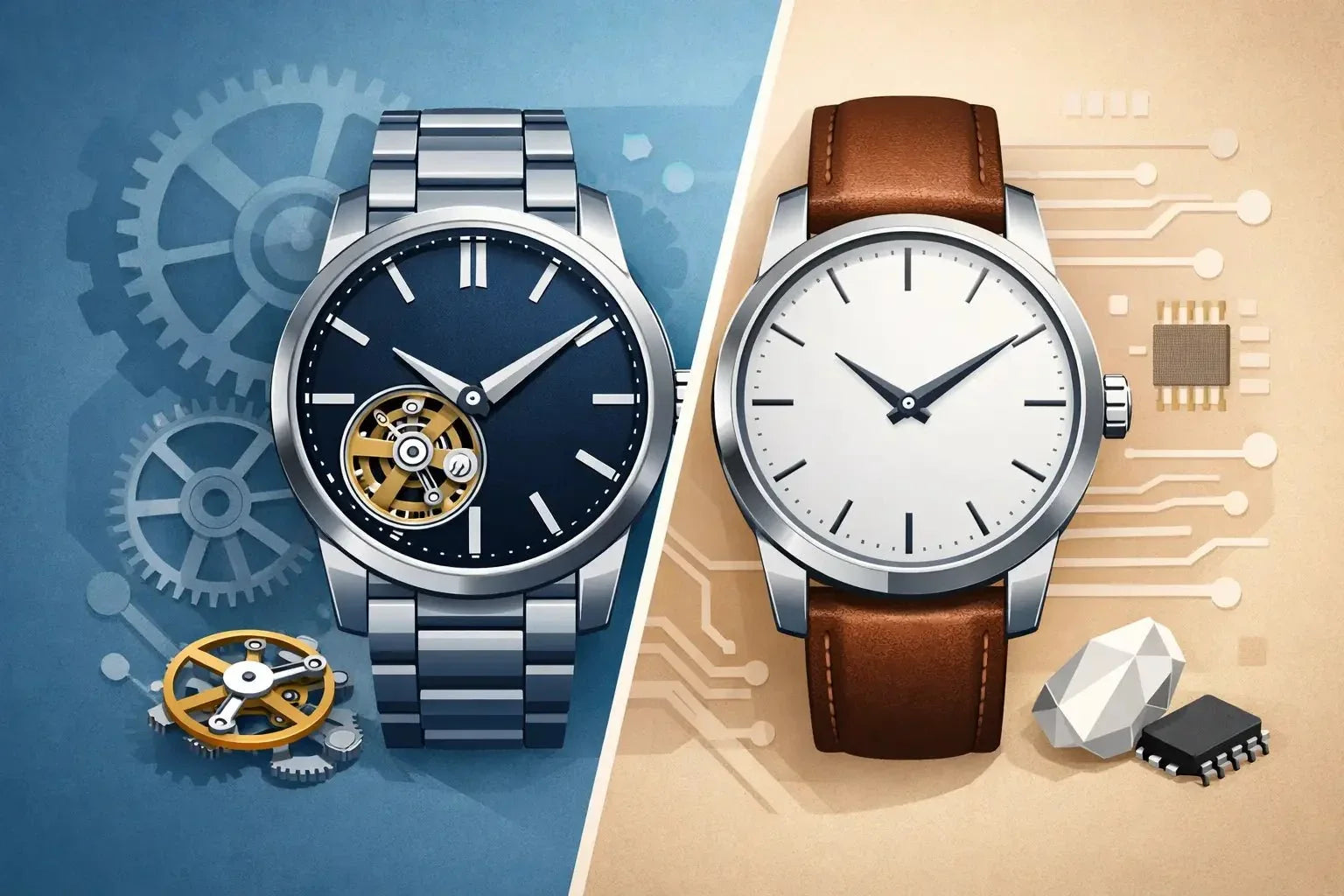
Automatic vs Quartz Designer Watches
A designer watch can change the whole read of an outfit. Not because it shouts, but because it says you notice details. In automatic vs quartz designer watches, the real difference is the movement: automatic watches are mechanical, powered by wrist motion, and prized for their sweeping seconds hand and craft, while quartz watches run on a battery and quartz crystal, offering better accuracy, lower cost, and easier upkeep. You are not just choosing a movement. You are choosing how you want a watch to live with you.
For some people, the answer is immediate. They want the romance of mechanics, the sweep of the seconds hand, and the sense that a watch is a small machine on the wrist. Others want accuracy, ease, and a piece that looks sharp every day without asking for much in return. If you are a design-conscious wearer building a watch rotation around personal style, daily function, and authentic, well-made pieces, this is the choice that shapes both how the watch wears and how much attention it asks from you.
What follows looks at the key differences between automatic and quartz designer watches, from design feel and ownership experience to maintenance, price, and everyday lifestyle fit, so you can decide which movement suits your aesthetic, routine, and expectations.
Automatic vs quartz designer watches: what actually changes?
At a glance, two designer watches can look almost identical. The case finishing, dial layout, and strap might tell the same aesthetic story. What changes underneath is the watch movement.
An automatic watch is powered by motion. As you wear it, the automatic movement uses a rotor to wind the mainspring and keep the watch running. Like other mechanical movements, it relies on coordinated mechanical parts rather than electronics. That is part of the appeal. There is craft in it, and wrist motion from the wearer's wrist powers a self winding system. For many collectors or design-minded buyers, that craft has emotional weight.
A quartz watch runs on a battery, and in a quartz movement, a small quartz crystal vibrates at a constant frequency inside an electronic circuit to regulate time. It is typically more accurate, more affordable, and easier to live with. Quartz watches are incredibly accurate—around half a second per day, or only a few seconds per month. In design-led categories, quartz also gives brands more flexibility with case dimensions and pricing, which is one reason so many strong-looking everyday watches use it.
So when people compare automatic vs quartz designer watches, they are often really comparing two different ideas of ownership, shaped in part by quartz vs automatic history after quartz movements were introduced by Seiko in 1969 and changed the watch industry. One is more tactile and traditional, with a smoother sweep, while most quartz models tick. The other is more practical and direct.
The case for automatic movement watches
Automatic watches carry presence differently. Even before you know what movement is inside, you often feel it in the weight, the balance, and the way the second hand moves with a smoother sweep, which shapes how the watch feels and draws attention to the intricate detail of the movement’s visible craftsmanship. There is an object quality to an automatic that resonates with people who appreciate industrial design, analog tools, and things built to be admired as much as used.
That matters in the designer watch space. A well-chosen automatic feels intentional, especially for watch enthusiasts drawn to mechanical watches and the heritage of mechanical watchmaking. It suits someone who likes the backstory of a product, who notices finishing, and who enjoys owning fewer things that say more. If your style leans toward textured materials, tailored silhouettes, leather goods with character, or camera gear with mechanical charm, an automatic watch often fits naturally.
There is also the ritual. Some automatic watches may need resetting if they sit unworn for a couple of days. When the wrist moves, the rotor winds the movement; if you do not wear the watch daily or watch regularly, some automatic ones may stop and need to be manually wound. For one buyer, that is inconvenience. For another, it is part of the pleasure. Setting the time, winding the crown, feeling the movement engage - these are small interactions, but they create attachment.
The trade-off is straightforward. Automatic watches are usually less accurate than quartz, and even a regulated movement can vary by about 4–6 seconds per day because the balance wheel needs careful adjustment. They also tend to cost more, especially once you compare finishing and movement quality at similar design levels. Service intervals matter too. A well maintained automatic watch usually needs servicing every 4–6 years and can last for generations.
Why quartz movement still makes sense in designer watches
Quartz is sometimes treated like the less romantic option, which misses the point. In a designer watch, quartz can be exactly the right choice. It gives you astonishing accuracy, reliability, and minimal maintenance in a package that still delivers strong visual identity, and quartz offers performance that can lose only a few seconds each year.
That is especially useful if your watch is part of a larger wardrobe strategy. You want to grab it, put it on, and know it is ready. No resetting after a weekend off. No concern about whether it has enough power reserve. Just clean design and dependable performance, since most quartz watches keep accurate time with little effort and suit people who rotate multiple watches.
Quartz also opens up more room for expressive styling at accessible price points. A brand can invest in dial color, case shape, and material choices without pushing the final cost into a different category. quartz powered watches are also more shock resistant than automatic watches, which suits everyday designer use. If you are shopping for a statement piece, a gift, or a watch that rotates with other accessories, quartz often gives you more freedom.
For urban creatives, this matters. Not every good watch purchase needs to be a forever mechanical heirloom. Sometimes the smartest choice is the watch that fits your day, your pace, and your actual habits. Quartz excels there. Quartz watches typically need occasional battery replacement every 2–5 years, usually a simple $10–20 battery replacement.
Design, not doctrine
The mistake is treating movement type like a personality test. It is not that simple.
A minimalist Japanese-inspired watch with quartz can feel more refined than a bulky automatic that tries too hard. An automatic with thoughtful proportions and a strong dial can feel far more elevated than a quartz watch with no point of view. Movement matters, but design still leads the conversation in this category.
That is where curation becomes useful. When the assortment is selective, the decision gets clearer. You are not sorting through endless generic options. You are looking at watches that already meet a certain standard for design, brand integrity, and everyday wearability. At Bang On, that design-first approach is part of the value. The question is not just what movement is better in theory, because these are simply different movement types and watch types shaped by personal preference. Even luxury brands make quartz and automatic designer pieces, so choosing between them is not a shortcut for judging taste in luxury watches. It is which watch deserves wrist time in real life.
Which type of watch fits your lifestyle?
If you wear the same watch most days, regular wrist motion keeps an automatic watch running, so it can make a lot of sense. It will stay wound through regular use, and the ongoing relationship with the watch tends to feel more rewarding. This is the person who enjoys ownership, not just utility. The watch becomes part of the routine.
If you rotate between watches, switch styles often, or want something that works instantly, quartz is usually the easier fit. It is often the right watch for a new watch buyer who wants reliability without routine adjustments. It is especially strong for people who see watches as part of styling rather than as a hobby on its own. You still care about quality. You just want less friction.
There is also the question of travel and work rhythm. If you move fast, pack light, and rely on accessories to be functional as well as expressive, quartz brings peace of mind. If your pace leaves room for ritual, and if you like products that feel mechanical and alive, automatic has a deeper pull.
Neither answer is more sophisticated. Sophistication is knowing which one suits your life. These are among the most notable comparison points, and the best choice depends on personal preference.
Price, maintenance, pros and cons, and long-term value
Value looks different depending on what you expect from a watch.
Automatic watches often feel more substantial because of the movement inside. That can make them emotionally satisfying purchases, especially if you want a piece with visible craftsmanship. Over time, however, you should expect service costs, often around $150–250. A mechanical movement is a machine, and machines need care.
Quartz watches usually cost less to maintain. Quartz watches typically need battery changes every 3–5 years because their power source is battery-based and relies on electronic components. That battery replacement issue is usually minor compared with automatic servicing costs. If your priority is cost-to-wear, quartz performs extremely well. You buy it, wear it often, and think about it less.
Long-term value is not only resale. In designer watches, long-term value often means relevance. Will you still want to wear it in three years? Will the design still feel sharp with your wardrobe? Will it still make sense with the rest of your everyday carry? A well-designed quartz watch can absolutely win that test. So can an automatic. The stronger factor is whether the watch has lasting visual character, though properly cared for, automatic watches can last for generations and may retain value better over time.
So which should you buy?
Buy automatic if you want the movement to be part of the story. If you like the idea of a mechanical instrument on the wrist, automatic watches remain models of traditional craft for buyers who want the movement to matter; if you tend to wear one watch consistently, and if a little maintenance feels acceptable, automatic offers depth that quartz cannot replicate.
Buy quartz if you want design without extra ceremony. If accuracy matters, in terms quartz buyers usually care about most - accuracy and ease - or if you switch watches often, or if you simply want a beautiful piece that works every time you reach for it, quartz is hard to argue against.
For many people, the best answer is not either-or forever. It is one of each, chosen with purpose. Many automatic watches appeal to collectors, but automatic and quartz watches both have a place depending on use. An automatic for the days when you want substance and presence. A quartz for daily ease, travel, and styling flexibility.
The right designer watch should feel like an extension of your taste, not a lesson in watch culture. Choose the movement that supports the way you actually live, matching the power source and ownership style to the wrist time it deserves, and the watch will do what the best accessories always do - make your style feel more like your own.
Share
Find the best waterproof bags for commuters, with design-forward picks, key features, and smart trade-offs for work, transit, and daily carry.
Y2k keychain digicam is back: tiny cameras, flash-lit photos, and low-fi charm are winning over a new generation of style-minded shooters.