Urban Everyday Carry Guide for Creative City Life
A city day can change course three times before lunch. A client meeting turns into a gallery opening, a rain shower catches you between subway stops, and a walk home becomes the kind of moment worth photographing. An urban everyday carry guide for creative city life should help you choose a few essential, well-designed pieces that make a changing day feel purposeful and considered, balancing function, personal style, and compactness. For design-savvy city professionals who want stylish gear that works as hard as they do, that means building a carry around real urban needs rather than packing for every possible scenario.
The best everyday carry is not a survival kit, nor is it a pile of status objects. It is a small personal system: useful enough to remove friction, distinctive enough to feel like yours, and, for urban creatives, expressive enough to reflect personal style while still earning its place, compact enough that you will actually bring it. A well-curated kit also builds day-to-day self-reliance and confidence.
This guide looks at how to choose that system across the items that shape daily city use most—watches, bags, cameras, and the small essentials around them—while also covering personalization, upkeep, and how to prioritize authenticity and usability over clutter and trend overload.
Start With the City Life You Actually Live
Carry culture often gets distracted by gear for hypothetical problems. The better question is simpler: what do you reach for every day, and where does your day take you? Good urban EDC should reflect everyday challenges, not imagined ones.
A commuter who works from a laptop needs a different setup than an office worker or a photographer who spends weekends walking unfamiliar neighborhoods. Someone who rides a bike has a stronger case for a weather-resistant backpack than someone who moves mostly by car. A compact crossbody can be perfect for a museum afternoon and completely inadequate for a workday with a notebook, charger, and jacket.
Start by mapping your daily transitions. Think about your commute, your workspace, where you spend time, the way you pay, what you need to document, and whether your bag sits on the floor of a coffee shop or under an airplane seat. Your EDC setup should answer those real conditions and carry only what fits your daily life, without turning your shoulders or pockets into storage units.
Build Your Urban EDC Kit Around Four Roles
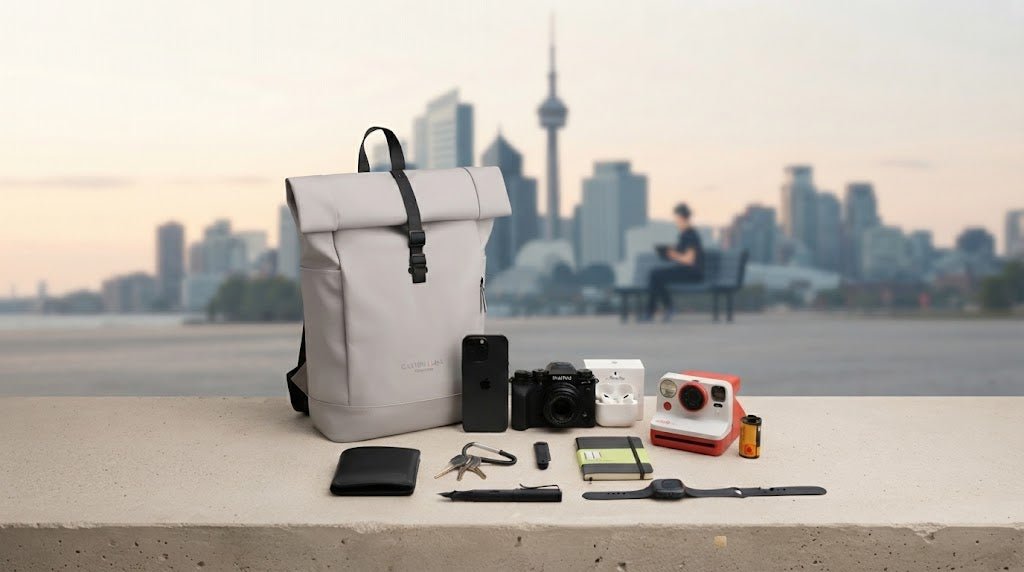
A refined setup usually has four jobs to cover: keep time, carry essentials, capture a moment, and support the small tasks that keep a day moving. The exact products vary, but the roles remain useful because they keep purchases intentional.
-
A watch creates an immediate, analog point of reference and adds personality without taking up bag space.
-
A bag organizes the objects you need while protecting them from weather, crowds, and daily impact.
-
A camera or instant camera gives ordinary scenes a reason to become keepsakes rather than another forgotten camera-roll image.
-
Small essentials such as a cardholder, charging cable, keys, sunglasses, a notebook, core wallet essentials, and a water bottle solve repeated problems with minimal bulk.
An EDC kit works best when it covers essential tools for repeated everyday tasks without overloading the bag.
The goal is not to carry every category at maximum capacity. Choose the version of each that earns its place, start with one tool, and add tools only when real use proves they belong. If your phone already handles navigation and quick notes, a full-size notebook may stay home. If you shoot analog-style images only on weekends, a compact camera may make more sense than a larger system you leave on a shelf.
Choose a Watch That Works Beyond the Desk
A watch is one of the few everyday objects that remains visible while you use it. That makes it both functional and expressive. For city life, the strongest choice is usually not the loudest one. It is the watch that works with the clothes you already wear, handles an active schedule, and still gives your wrist a point of view.
Match the scale to your wardrobe
A slim, clean-faced watch can sharpen an office uniform, while a more graphic case or unexpected color brings energy to neutral layers. Consider proportion before price. A larger statement watch can look right with structured outerwear and wider silhouettes, but may feel oversized with a minimal shirt cuff. Smaller cases tend to be more flexible, especially if you move between professional and casual settings.
Think about the strap, too. Leather feels warm and tailored but asks for more care in wet weather. Metal bracelets offer durability and a more architectural look. Rubber and silicone are practical for active days, though their sportier character may not suit every wardrobe.
Let it say something specific
A good watch should not disappear into the category of generic accessories. Japanese craft, playful graphic design, Italian maximalism, or a custom-built dial each tell a different story. That distinction matters when your everyday carry is part of your personal style rather than a checklist.
Authenticity matters here as much as aesthetics. A properly sourced watch with official warranty coverage is a better long-term choice than a questionable bargain with an unclear history. Bang On's selective approach makes sense for shoppers who want a recognized design without spending hours sorting through uncertain listings.
Pick a Bag for Movement, Not Just Storage
The bag is the operating center of an urban carry, and the right carry method affects access, comfort, and organization. It decides whether your camera is protected, whether your laptop rides comfortably, and whether finding a charger takes two seconds or two minutes.
Water resistance is worth prioritizing in any city where weather is unpredictable. It does not mean you need an expedition pack. It means your bag should give your electronics, film, and documents a reasonable margin of safety when rain begins halfway through the walk to the train.
For a daily work setup, look for a backpack with a dedicated laptop area, a stable base, and enough internal structure to prevent everything from settling into one messy compartment. Moving bulk into organized compartments also cuts pocket clutter and keeps essentials easier to reach. Clean exterior lines are not only a style choice. They also make a bag easier to wear with tailoring, denim, or a heavier coat.
A crossbody has a different purpose. It is ideal when you need your phone, wallet, keys, compact camera, a key organizer, and a few personal items within reach. It is lighter, more social, and less cumbersome in crowded spaces. Its limitation is capacity, which is exactly why it works. A small bag forces a useful edit. The best setup also supports discretion and personal security in crowded city spaces.
Do not buy a large bag merely because it can carry more. Empty space often becomes an excuse for clutter. Buy for your most common day, then use a larger option when travel or work demands it.
Make Room for Analog Joy
Phones are excellent tools for fast documentation. They are less effective at making a moment feel deliberate. Carrying an instant camera, compact digital camera, or small photo printer changes the rhythm of how you see a day. You pause, frame, and decide what is worth keeping.
Instant photography has a social advantage, too. A print can be handed to someone at a dinner, taped inside a notebook, or saved from a trip without waiting for an album that may never get made. It is imperfect by design, and that is part of the appeal.
The trade-off is real. Film costs money, prints take space, and instant cameras are not always the right choice in low light or fast-moving scenes. If you want the ritual without carrying a camera all day, a portable printer can turn a favorite phone image into something physical later. If you want a small object with more character than a phone, a compact camera can become the better daily companion.
Choose based on the kind of memory you want to make. Technical image quality matters for some projects. For personal documentation, the emotional value of a print often matters more.
Edit for Friction, Not for Fear
The smallest items in your carry deserve the most scrutiny because, in your EDC gear, compact tools and other extras can multiply quickly within your daily carry. A cable, power bank, earbuds, multi tool, writing tool, medication, snack, and spare battery can all be reasonable. Together, they can turn a thoughtfully packed bag into dead weight.
Try a two-week audit. Each time you unpack your bag or empty your pockets, notice what you used and what stayed untouched. Keep objects that solve recurring problems, including repeated cutting tasks like opening boxes or opening packages. If you carry a blade, use a pry bar for leverage jobs like prying staples so you do not damage the knife blade. Remove objects you carry only because they seem like something a prepared person should have.
There are exceptions. A power bank is more valuable if your work keeps you away from outlets. A compact umbrella is sensible in rainy cities. A small first-aid item may be worthwhile if you travel with children or spend long days out. A small first aid kit or compact first aid kit with basic first aid supplies such as antiseptic wipes can earn its place. The point is not minimalism for its own sake. It is keeping only what earns its place without adding new clutter.
Keep the System Personal and Maintainable
Everyday carry becomes more useful when it has a reset routine. Once a week, remove receipts, refill what needs refilling, charge batteries, clean a camera lens, check that your quality pen is where it should be, and return loose essentials to their place. This takes minutes and keeps the next morning from beginning with a search. Beyond that weekly reset, review your EDC kit about once a month and refresh it every 1-2 months for seasonal changes.
A small notebook pairs well with a reliable writing instrument for quick notes when needed.
A dedicated flashlight is often more dependable than a phone light during a power outage, when your phone dies, or when you need to move through a dark parking garage or dark parking lot. A reliable flashlight is also a core urban backup tool, and many useful EDC models fall in the 300 to 1,000 lumen range. Check flashlight batteries monthly to ensure they still hold a charge.
Check local laws before carrying an EDC knife, pocket knife, folding knife, pepper spray, or other self defense tools, especially near government buildings, since rules can depend on blade length, lock type, and opening mechanism. Folding knives under 3 inches are generally legal, but local rules still vary.
For a first EDC knife, a small folding knife is usually the simplest urban option; blade steel, budget steels, edge retention, corrosion resistance, and handle material matter more than hype, and while a true fixed blade may offer faster deployment, a compact folder usually fits city use and compliance better, especially because a dull knife requires more pressure to cut safely. Wipe the knife blade clean after each use and apply oil to knife pivots every few months. A compact first-aid kit can handle most minor injuries.
Visual coherence helps, but it does not require matching everything. A black technical backpack can sit comfortably beside a warm leather strap. A colorful instant camera can be the one playful note in an otherwise restrained setup. The best combinations have a shared sensibility, not a forced uniform.
Your urban carry will change with your work, your city, and your interests. Let it. The right setup is not a finished collection. It is a small, evolving set of objects that makes room for a better day - and leaves enough space to notice it.
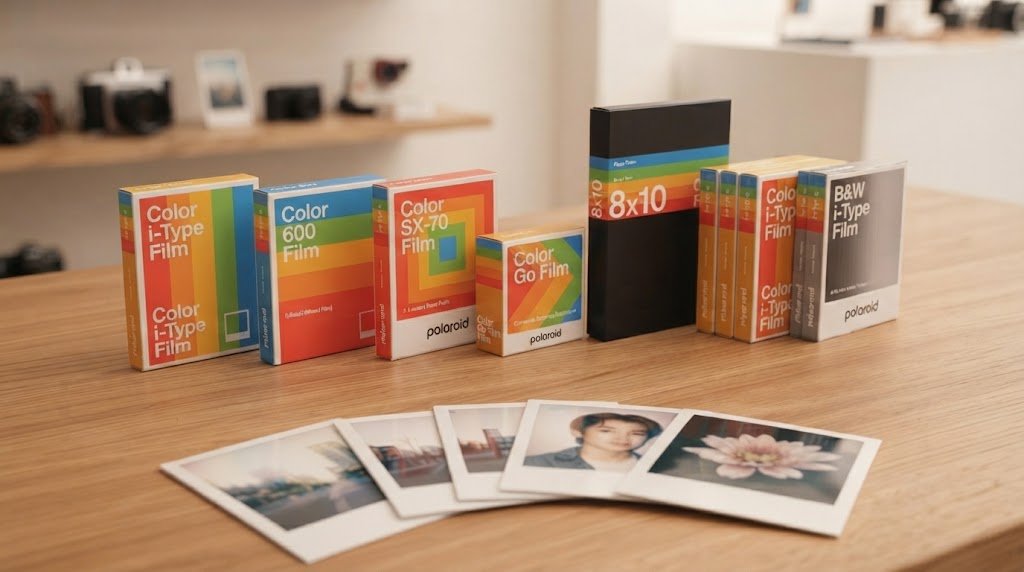
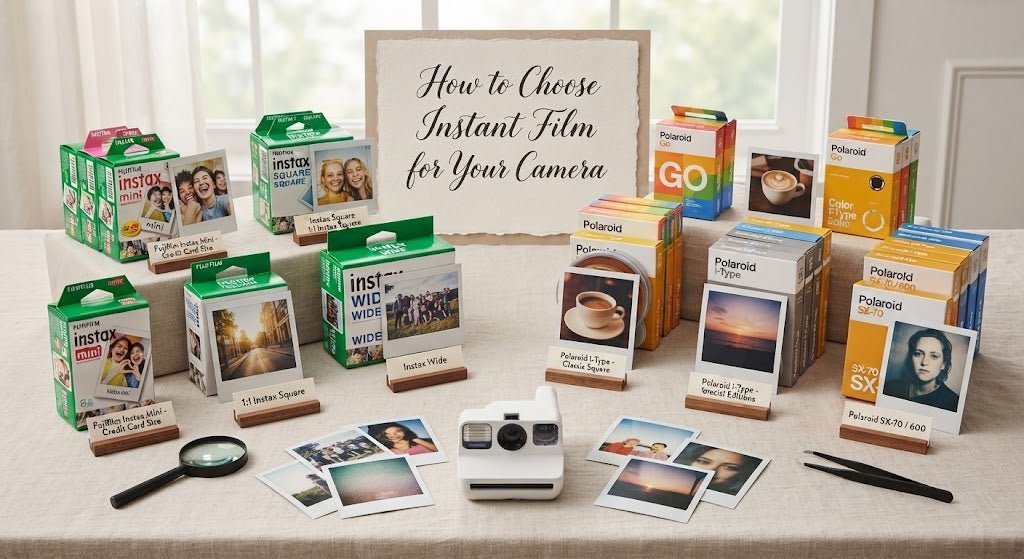
Know where to buy authentic Polaroid film, spot reliable stock, and choose the right format, freshness, and storage for better instant photos every time.