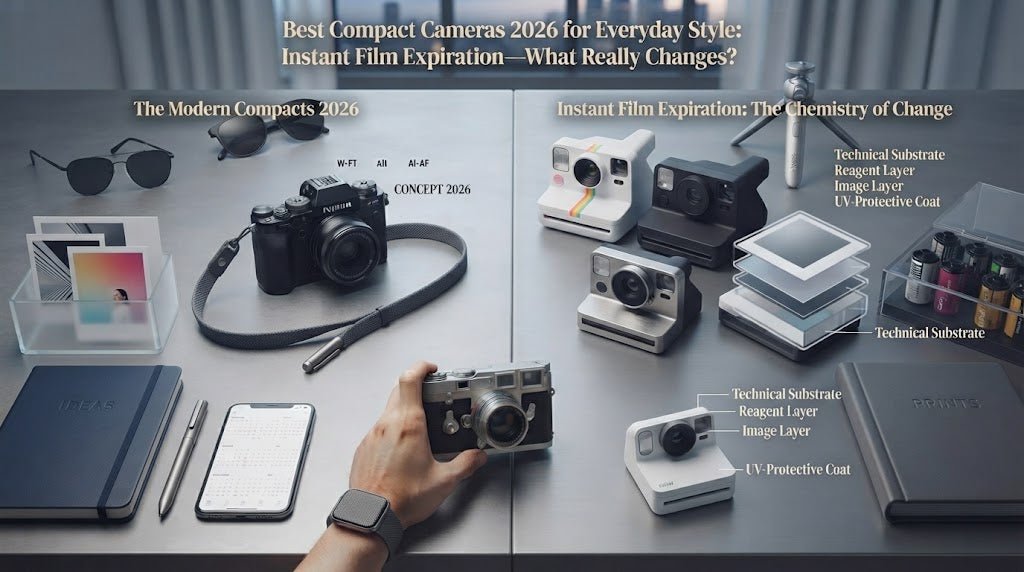
Best Compact Cameras 2026 for Everyday Style: Instant Film Expiration—What Really Changes?
The best compact cameras for everyday style in 2026 are the ones that balance design-led function with dependable image quality and the creative character of instant film, which is exactly where Bang On’s curated camera and film picks stand out for design-savvy everyday shooters. If you want a compact camera that fits an urban lifestyle and still leaves room for personal expression, understanding instant film expiration is part of making the right choice.
That little date stamped on a film box can feel more final than it is. Instant film expiration matters, but it is not a switch that flips from perfect to unusable at midnight. It is a practical guide to how the chemistry inside each frame is expected to perform and, for photographers who enjoy a little unpredictability, an invitation to make something less polished and more personal.
For the cleanest color, strongest contrast, and most dependable development, fresh film is the right choice. But an expired pack that has been stored well may still produce images worth keeping. Below, you will see how expiration changes image quality, how to store and handle fresh and expired film, when to choose one over the other, and how to get better results from a compact instant camera without losing the analog charm that makes everyday shooting worth carrying.
What the expiration date on instant film means
Instant film contains a tightly engineered combination of light-sensitive layers and developer chemicals. When a photo ejects from the camera, rollers spread the chemical pod across the frame to begin development. Those chemicals are designed to perform within a stated period, usually around a year from the manufacturing date for modern Polaroid film.
After that date, performance becomes less predictable. The film may still develop, but its color balance, contrast, brightness, and evenness can shift. Think of the expiration date as a manufacturer's confidence window, not a guaranteed end point.
This distinction matters when choosing film for a specific purpose. If you are documenting a wedding weekend, giving an instant camera as a gift, or making images you cannot recreate, use in-date film from an authorized retailer. You are buying consistency as much as you are buying a pack of frames.
If you are shooting for a personal visual diary, testing light, or leaning into analog texture, a carefully stored expired pack can be an interesting creative variable. The surprise is part of the medium, but it should be a choice rather than an accident.
How expired instant film can affect image quality
There is no single expired-film effect. Two packs with the same date can look completely different if one spent months in a hot car and the other lived in a refrigerator. Still, age often leaves a recognizable signature.
Colors may fade, skew warmer, or take on an unexpected green, yellow, or magenta cast. Contrast can fall away, leaving shadows less defined and highlights more muted. Some frames develop unevenly, with patches, streaks, or soft areas near an edge. In more extreme cases, the image may be very faint or fail to appear.
These shifts are not always flaws. A sun-faded palette can suit a quiet portrait, a late-summer street scene, or a table full of half-finished coffee and sketchbook pages. But if you want the saturated color and graphic clarity associated with fresh Polaroid images, expired film is a gamble.
Film age also does not create a reliable vintage filter. Every pack has its own history. A five-year-old pack stored cold may look closer to fresh film than a one-year-old pack exposed to repeated heat. The date tells you where to start asking questions, not exactly what will appear in the white border.
Storage decides more than the date
Heat is the main enemy of instant film. High temperatures speed up chemical deterioration, and temperature swings add another layer of uncertainty. Film left in a sunny room, near a radiator, or in a car during summer may age badly long before its printed expiration date.
For unopened packs, cool and stable storage is the best practice. Many instant photographers keep film in a refrigerator, not a freezer, ideally at a moderate refrigerator temperature. Leave each pack sealed in its original foil packaging until you are ready to shoot.
Before loading cold film into a camera, let it return to room temperature for at least an hour or two. Loading it while still cold can affect development and may create avoidable defects. The goal is controlled handling, not treating every pack like a laboratory specimen.
Once a film pack is inside a camera, it is more exposed to everyday conditions. Shoot it within a reasonable time, avoid storing the camera in heat, and do not leave it in direct sun. If you move between air-conditioned interiors and hot outdoor streets, keep the camera protected in a bag when you are not shooting.
Fresh film deserves the same care
A current date is not a free pass. Fresh film stored poorly can become disappointing film. If dependable results matter, buy from a trusted source that handles stock responsibly, then store it well at home. Authenticity and proper supply conditions are part of image quality, even if they are less visible than the camera itself.
Should you buy expired instant film for your film camera?
It depends on what you want from the photograph: unlike expired instant film experiments, a good camera gives you more dependable everyday results, whether you prefer instant shooting or a digital camera. Expired instant film can be a smart experiment when the price reflects the risk, the storage history is known, and you are comfortable with variable results. It is less smart when the film's past is unclear or when every frame needs to count.
Be especially cautious with listings that only say “expired” without explaining how the film was kept. There is a meaningful difference between a pack that was refrigerated from purchase and one that sat in an unknown warehouse or attic. Low price alone does not make mystery stock a good value, particularly when each exposure is limited. A compact travel camera or pocket camera can offer better image quality than smartphones while still being easy to carry as a travel camera.
For most people, the strongest approach is simple: keep fresh film for important moments and save expired packs for play. That balance preserves the spontaneity of instant photography without making your camera feel unreliable.
Tips for shooting expired instant film with point and shoot cameras
Start with a test frame in ordinary daylight. This gives you a quick sense of how the pack is behaving before you use it for a scene you care about, since results usually vary more in low light. Bright, even light is usually more forgiving than dark interiors, where aging film may struggle to render detail. If you want a simple point-and-shoot approach, a fully automatic mode is often the easiest way to keep results consistent.
Keep expectations flexible around exposure. If a frame comes out faint, a slightly brighter scene may help on the next shot. Larger sensors and a wide-aperture lens generally give better low light performance and better photo quality in a compact camera. If the colors lean heavily toward one cast, work with it rather than trying to force a neutral result. Strong graphic subjects, close portraits, bright signage, and layered city textures often hold up well when the palette gets strange. Image stabilization also matters for low-light candid shooting, because it helps reduce blur when you are working handheld.
Protect the image as it develops. Modern Polaroid film benefits from being shielded from strong light immediately after ejection, especially in the first moments of development. Slide the photo under a jacket, place it face down, or use the camera's film shield if it has one. Do not shake it. Shaking will not speed development and can make handling less controlled.
Give the image time. Development may be slower or less even with older film, and the final look can continue settling for several minutes. Resist the urge to judge a frame too early. Unlike expired film, digital compacts with built in flash and film simulations give you more repeatable color, and built-in film simulations can make the photographic experience more appealing with richer color straight out of camera.
When to use fresh film instead
Fresh film is the clear choice for once-only events, client work, travel highlights, gifts, and for comparing a fixed lens compact with other cameras for travel photography or everyday carry. Many compact camera buyers also choose between fixed lens models and mirrorless cameras with interchangeable lenses. It is also better for photographers learning a new camera, since predictable film makes it easier to understand exposure, flash behavior, and composition without guessing whether a failed frame came from technique or chemistry. If you are cross-shopping digital options, the Fujifilm X100VI is an expensive camera with a large sensor, a 40MP APS-C sensor, a bright f/2 lens, and strong JPEG output straight from the camera. Its focal length and direct handling also make it popular among street photographers. The sony rx100 vii is a small camera and a great compact camera, pairing a 24-200mm zoom lens with a 20MP 1-inch sensor, fast autofocus with subject tracking, 4K video at 30fps, roughly 260-shot battery life, and a 302-gram body. The rx100 vii is genuinely impressive for zoom capability and distant subjects, but low-light performance is limited by that smaller sensor. The ricoh gr iii is a pocketable camera built for a thoughtful shooting style and street photography, with a fixed 28mm equivalent lens, an f/2.8 maximum aperture, and a 257-gram body, though autofocus is a weak point with fast-moving subjects and its battery life usually means carrying spare batteries. The Ricoh GR IIIx uses a tighter focal length, offering a 40mm equivalent view that changes the shooting experience compared with the GR III. Ricoh GR IV is the best pocketable camera in 2026, with excellent image quality in a compact body that fits in a jeans pocket, improved in body image stabilization, improved autofocus, a unique Snap Focus mode, and better battery life for all-day shooting even if real-world use averages around 150 shots. If you want more zoom range from a zoom lens, the Panasonic TZ200 reaches 24-360mm and the Canon PowerShot SX740 HS stretches to 24-960mm for landscape photography or distant subjects.
Fresh packs also deliver the experience most people expect from instant photography: a tangible photograph with rich color, recognizable skin tones, crisp images, and a result that feels immediate without feeling disposable. That reliability is part of the appeal.
At Bang On, a selective approach makes sense here. Choose current film when you want the camera to perform as designed, then treat older stock as an intentional side project rather than a substitute. Analog joy is more satisfying when the unpredictability is in the picture, not in the purchase.
The date on a film box should not make you afraid to shoot. It should help you decide what kind of image you want to make: precise and dependable, or slightly unruly in the best possible way.