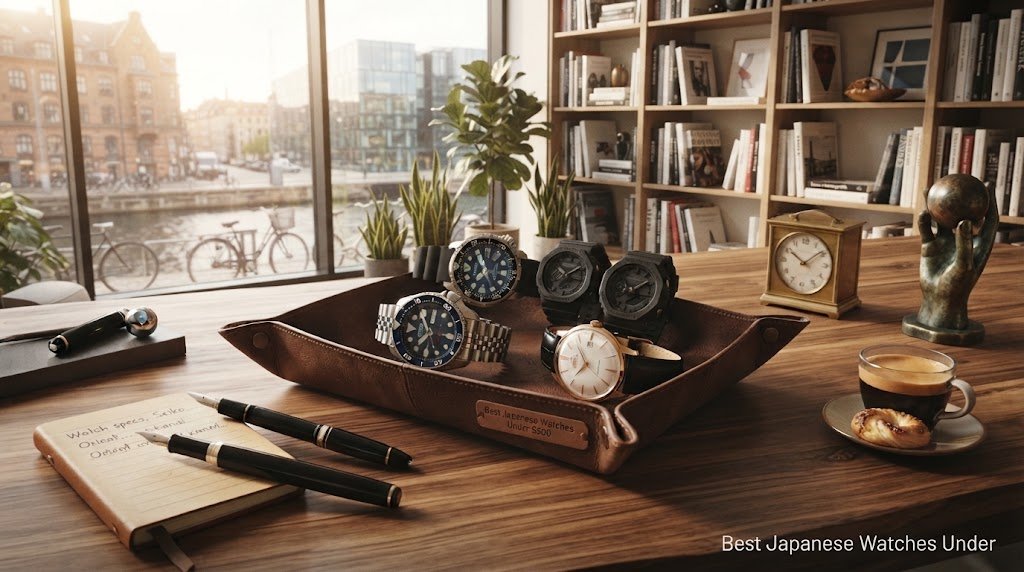
Best Japanese Watches Under 500
The best japanese watches under 500 are the ones that feel considered, not compromised - pieces that balance design discipline, reliable movements, and everyday wearability better than almost anything else in the price range. For style-conscious buyers, whether you are buying your first serious watch or looking for a versatile daily piece that works with relaxed tailoring, technical outerwear, denim, knitwear, sneakers, or loafers, Japanese watchmaking offers a rare middle ground between luxury pricing and throwaway fashion.
This part of the market is crowded, but not confusing once you know what matters. Japanese watchmaking has long had an edge in practical precision, consistent quality, and durable design, which is exactly why this category remains so relevant for anyone who wants sharp style without overspending. Below, you will find what makes these watches strong value, the key features to check before buying, the main style directions worth considering, common mistakes to avoid, and how to choose the right watch for your wardrobe and daily use.
Why japanese watches under 500 still stand out
The strongest argument for Japanese watches is not hype. It is consistency. Brands from Japan have spent decades refining the fundamentals: dependable calibers, sensible case sizing, strong dial legibility, and finishing that often punches above the price.
At under $500, those fundamentals matter more than luxury signaling, and you often get a lot for the dollar. You are buying something that should hold up to daily use, look intentional on the wrist, and avoid the shortcuts that make cheaper fashion watches feel disposable after six months.
There is also real range across major watch brands like Seiko, Citizen, Orient, and Casio. You can go minimal and architectural, rugged and sport-driven, vintage-inspired, or quietly dressy. Some pieces lean tool watch, others feel almost graphic in their restraint. That versatility is part of the appeal. Japanese brands tend to be very good at making watches that work in real life rather than only in product photography.
What to look for before you buy
Price alone does not tell you much. Two watches can sit at $400 and offer very different experiences on the wrist.
Start with movement. In this bracket, quartz is not a compromise if accuracy and low maintenance matter to you, and a digital option can also make sense if convenience and functionality are the priority. A good quartz watch is often slimmer, tougher, and easier to live with, making it a good watch for daily wear. Automatic movements bring mechanical character, a smoother seconds hand, and that satisfying sense of old-school engineering; on some models, Seiko’s 4R35 adds hacking and hand-winding, while Orient designs and builds many calibers in-house, but they are usually thicker and less precise day to day. If you rotate watches often, power reserve matters more because an automatic may need resetting more frequently. That applies whether you are comparing dressier pieces, a classic field watch, or even a Casio G-Shock if utility is the main goal.
Case size is the next filter. Many buyers still default to numbers that are too large. For most wrists, 36mm to 40mm is the sweet spot, especially if you want the watch to age well stylistically. Japanese brands are often better than their peers at keeping proportions balanced. Lug-to-lug length matters as much as diameter, and while a larger version of the same model may suit some buyers, a compact watch usually wears more polished.
Then there is finishing. Look at the dial first. Crisp printing, clean markers, well-shaped hands, and thoughtful color use, along with details like how the crown is sized and integrated—and whether it uses a screw down crown rather than a push/pull crown for better water resistance and security—do more for perceived quality than a long feature list. A sharp dial can make a $300 watch feel elevated. A messy one can make a $500 watch feel generic.
Strap and bracelet quality also deserve attention, with one caveat: a mediocre strap is fixable. A weak case design is not. If the watch itself is strong, you can always change the strap and shift the mood completely.
The best styles to consider in japanese watches under 500
If your wardrobe leans clean and modern, dress watch styles are where Japanese design really shines. These are the pieces with slim bezels, simple indices, balanced negative space, and just enough detail to avoid looking plain. They work with a button-down, a fine knit, or a white tee under a chore jacket. They do not ask for attention, but they get it.
If you want one watch to do most things, the everyday sport category is the safest choice. Think field watch designs, streamlined divers that rank among the best affordable divers in this range, or versatile steel watches with enough water resistance for travel and weekend wear. These usually offer the best value because they are built for durability without becoming bulky.
Chronographs are a little trickier under $500. There are good options, especially in quartz, but this is where design discipline matters most. Many affordable chronographs try to do too much. The better ones keep the dial layout clean and the case profile wearable.
Then there are design-led pieces, which matter if you care as much about visual identity as specs. This is where a curated retailer has an advantage. Not every compelling timepiece wins on the spec sheet. Some are compelling because they feel graphic, modern, or quietly offbeat.
Where the value really comes from
The phrase "value" gets flattened too often into discount logic. With watches, value is more interesting than that. It is the point where quality, design, reliability, and longevity feel aligned.
Japanese watches do this well because many of the brands build from a manufacturing culture centered on repeatable excellence rather than inflated positioning. You often get a better movement, cleaner execution, and more honest pricing, which can be a pretty impressive use of money at this price point, than similarly styled alternatives from trend-led labels.
That does not mean every Japanese watch under $500 is automatically good. Some are too safe. Some rely on heritage without enough design edge. Some are technically solid but aesthetically forgettable. The best value comes from buying the watch you will still enjoy wearing three years from now, not just the one that looks like a bargain today.
Design matters more than specs alone
For style-conscious buyers, a spec sheet only goes so far. Sapphire crystal, 100 meters of water resistance, automatic movement - those are useful, but they do not create presence. The watch still has to feel right.
That usually comes down to proportion and restraint. A well-resolved Japanese watch often feels calm. The case is not overworked, with details like a polished bezel used sparingly. The dial has breathing room. The branding is controlled. Nothing fights for attention. That kind of confidence is hard to fake, and it is one reason many buyers associate Japanese design with Grand Seiko as the finishing benchmark.
If you are buying for personal style rather than collection-building, maybe the more useful question is whether it feels like a personal favorite and sharpens the way you already dress. A great under-$500 watch should slip into your life easily. It should make a black overshirt look cleaner, a navy blazer feel less formal, or a simple gold accent make a weekend fit look more intentional.
A few smart buying paths
If this is your first serious watch, go versatile. A clean steel case, neutral dial, and modest size will carry you further than something overly specialized. You want a piece that works Monday through Sunday, not only with one outfit type.
If you already own a smartwatch or a basic daily beater, this is where you can afford to be more expressive. A textured dial, vintage-toned face, integrated bracelet look, or design-forward case shape can add character without pushing into collector-only territory.
If you are shopping for a gift, reliability and ease of wear matter most. Quartz often makes more sense than automatic here, and a solar quartz model is an especially easy option if the recipient values style but may not want the ritual of winding and setting a mechanical watch. With Eco-Drive, the watch recharges from light sources as ordinary as a phone screen, so the wearer does not need to crack open the case for battery changes. The right gift watch should feel personal, not demanding.
And if authenticity is part of your decision, buy from an authorized retailer. That is especially relevant in watches, where warranty coverage, brand sourcing, and confidence in what you are getting matter just as much as the product page, and a full review from an authorized retailer can also help confirm fit and expectations before buying. A curated store like Bang On earns its place by removing the noise and keeping the selection intentional.
Common mistakes to avoid
The first mistake is buying too much watch for the budget. Extra subdials, a huge case, flashy finishing, and borrowed luxury cues often age badly, and case size is one of the easiest budget mistakes to regret. Simpler tends to look more expensive over time.
The second is ignoring wrist comfort. A watch can look excellent in photos and feel wrong within an hour if it is too tall, too heavy, or too long across the lugs. Everyday wearability is part of quality.
The third is shopping only by movement type. Mechanical watches are romantic, yes, but romance should not override fit, design, and how you actually live; not every rugged buyer needs a Casio G-Shock, even if the lineup is famously durable, and the real point is choosing the right movement for the use case, while a quartz tool watch makes more sense if you care about shock resistance. A beautifully designed quartz watch you wear constantly is a better buy than an automatic you admire from a drawer.
The sweet spot is still real
There is a reason that in recent years this category has become even more compelling for design-aware buyers. The best Japanese watches under $500 are not trying to be entry-level luxury or disposable fashion. They occupy a more appealing middle ground: well-made, visually resolved, and built for daily life.
That makes them easy to recommend, but not all for the same person. Some buyers want a clean, understated watch that disappears into a minimalist wardrobe. Others want a watch with more original design and a little tension and personality, sometimes even a bolder dial choice like purple. The good news is that this budget gives you room to choose with taste, not just compromise.
Pick the watch that feels clear in its intent. When the design is honest and the build is right, you do not need a bigger price tag to make it feel like a smart choice, and the best choice often appears when you let the rest of the noise fall away and focus on intent.
Share