Watch Collection Ideas for a Personal Rotation
A good watch collection does not need a safe full of near-identical pieces. The best watch collection ideas begin with a simpler question: what do you actually want your watch to do for your life and your style? A daily companion, a creative statement, a travel-ready tool, or a small mechanical ritual can all earn a place.
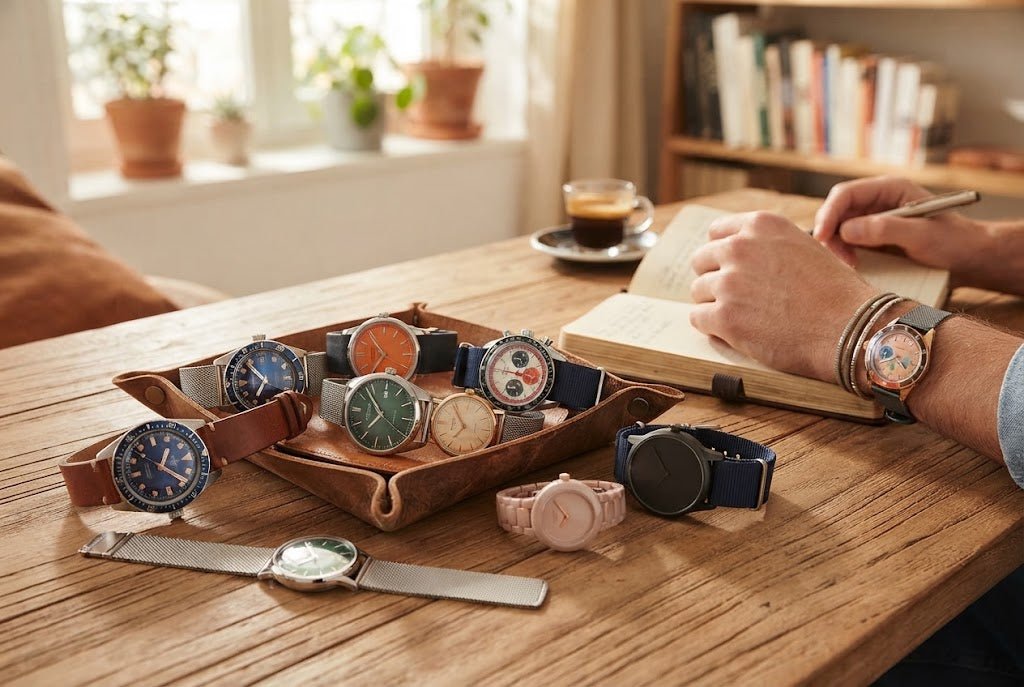
For most people, the strongest collection is not about chasing every category. It is about creating contrast. A compact field watch makes a different kind of sense than a sculptural Italian statement piece. A slim dress watch changes the tone of an outfit that a rugged diver cannot. Build around those shifts, and every watch feels intentional rather than redundant.
Watch Collection Ideas That Start With Your Real Routine
Before choosing a first or next watch, think about watch collecting through the week you already have. Consider what you wear to work, how often you travel, whether you spend weekends outdoors, and the occasions that call for something sharper than an everyday sneaker-and-denim uniform.
A collection should have range, but it should not pretend you live someone else's life. If formal events happen twice a year, a single refined option from a trusted watch brand is enough, much like a practical one watch collection or even just one watch for someone with simpler needs. If you bike through the city, work with your hands, or want one piece that handles rain without anxiety, prioritize durability and water resistance over a delicate leather-strap piece, since a solid tool watch often suits everyday life better and a personal watch collection worn in regular rotation can enhance enjoyment of horology.
The practical foundation is a watch you can wear without thinking too hard. This is usually one of those versatile sports watches, a field model, or clean everyday mechanical watches with an easy-to-read dial. For a watch enthusiast building around own style, that same slot can be an entry level pick, one of the slimmer dress watches, or another reliable option that earns its place through routine use. Keep the size comfortable, especially if you plan to wear it from morning meetings through late dinners. A watch that looks great in product photography but feels too large, too heavy, or too precious will spend more time in a drawer than on your wrist.
The Everyday Anchor
An everyday anchor is the piece that makes getting dressed easier, acting as an Everyday or GADA watch that bridges casual and smart-casual wear. Look for neutral colors, useful water resistance, and a design with enough personality to avoid feeling generic. Black, navy, silver, cream, and deep green are all flexible dial colors, but the best choice depends on what you wear most.
This is also where a well-designed quartz watch deserves respect. Mechanical movements have romance, but quartz is accurate, low-maintenance, and ideal for a grab-and-go routine, though many people also choose mechanical watches for this role. A thoughtful collection is not a purity test. It is a set of objects that work.
The Watch That Changes the Outfit
Your second category should introduce a point of view. This can be a bold case shape, an unexpected dial texture, a playful complication, or an expressive color. It is the watch you choose when your outfit needs one decisive detail rather than more layers.
Italian-inspired statement watches, including the maximalist spirit associated with Gagà Milano, work especially well here. They are not designed to disappear under a cuff. That is the point. A strong statement watch can carry a minimal black outfit, elevate a plain white tee, or add character to a tailored look without making it feel overly formal.
The trade-off is versatility. A watch with a dramatic dial or oversized numerals may not be the one you reach for every day. Give it a distinct role instead of expecting it to do everything.
Build Contrast, Not Just Categories
The classic collection checklist often goes: dress watch, diver, chronograph, field watch, GMT. It is a useful reference, but it can become a shopping list with no personal point of view. Two people can own the same five categories and have collections that feel entirely different.
Some collections are also shaped by a chronological story that showcases design history, not just by category labels.
Think in terms of visual and functional contrast within the wider watch world. If your daily watch has a black dial and steel bracelet, your next timepiece might have a warm cream dial on leather. If you own several round, conservative cases, try a cushion case, a square profile, or a more graphic design language. If every watch is automatic, add quartz for ease. If every piece is modern, consider a vintage-inspired model with restrained proportions and strong historical design cues.
A considered rotation often includes these distinct roles:
-
an everyday watch built for repeat wear
-
a statement piece with a stronger design signature
-
a refined watch for dinners, weddings, and sharper tailoring
-
a durable sport or water-ready watch for active days
-
a personal wild card, chosen purely because it makes you look twice
You do not need all five at once. Three watches with clearly different jobs will feel more complete than six versions of the same idea, especially when your choices reflect your place in the wider world.
The Refined Dress Watch Option
A dressier watch does not have to mean a tiny, traditional gold case. For a modern wardrobe, refinement can look like a slim profile, a clean dial, polished details, and a leather strap in black, brown, or textured suede, since dress watches usually rely on a slim case and minimal complications.
Pay attention to thickness. A watch meant for tailoring should slide under a jacket cuff comfortably, and that simplicity and sophistication are what make dress watches work for formal occasions. Simple two- or three-hand designs usually work best because they let proportion and finishing do the talking. A Seiko Presage is a popular choice for dressier wear, and the SPB465 adds a 40.2mm case, 100 meters of water resistance, and a neatly integrated date window that makes it more versatile than many pure dress pieces. This is the place for quiet confidence, not a crowded dial.
The Capable Sport Watch
A sport watch earns its place when it can take a little pressure, and that can mean a dive model, a field piece, or even a pilot watch depending on how you actually wear it. A screw-down crown, stronger water resistance, luminous hands, and a bracelet or rubber strap all make sense for travel, pool days, and unpredictable weather, especially if you want a capable tool watch in regular rotation.
A dive watch is the familiar choice, but it is not the only one: field watches are designed for durability and legibility, chronographs combine timekeeping with stopwatch functionality, GMT watches track multiple time zones for travelers, and the Rolex Explorer is a good example of a more understated adventure-ready option. GMTs became tied to travel during the golden age of jet-setting, when crossing time zones became part of modern life. The Hamilton Khaki Field Auto Date is water resistant to 100 meters and comes in 38mm and 42mm, the Seiko Prospex Alpinist has 200 meters of water resistance and is inspired by a 1959 tool watch, the Certina DS Action Extreme reaches 300 meters, the Bulova Lunar Pilot is rated to 50 meters, and the Tudor Pelagos offers 500 meters with titanium construction to cut weight without giving up toughness. For a premium travel reference, the Rolex GMT Master II is the model most people picture, and the rolex gmt is prized for globetrotting practicality as much as its movement specs and useful power reserve. The gmt master ii remains one of the clearest examples of a luxury dual-time watch, while the rolex gmt master ii shows why that format still appeals to frequent flyers. Professional dive watches are expected to meet ISO 6425 standards, and the Rolex Submariner helped define the category after its 1953 debut. Choose the format you will actually wear. A rotating bezel is only useful if you enjoy it, not because a collection is supposed to have one. For active use, a g shock can also make sense as a durable digital watch choice.
Let Straps Multiply the Possibilities
Straps are one of the smartest ways to make a collection feel larger without buying more watches. A steel bracelet gives a watch a crisp, architectural feel. Leather makes the same case more tailored. Rubber adds a casual, athletic edge, while a woven fabric strap can make a polished watch feel more relaxed.
Do not treat straps as an afterthought. They change the whole visual weight of a watch. A cream-dial piece on brown leather can become a weekend favorite on olive fabric. A black-dial sport watch that feels too serious on steel may become an easy summer choice on textured rubber.
There are limits. Make sure the strap width fits correctly, and avoid forcing a formal watch into a role its proportions cannot support. The goal is flexibility, not costume.
Choose One Watch for the Story, Not the Spec Sheet
Every memorable collection has a piece that is harder to justify on paper and easy to justify on the wrist. Maybe it marks a promotion, a trip, a creative project, or simply the moment you decided to buy something less expected.
This is where custom and design-forward watches can be especially compelling. A brand such as UNDONE appeals to collectors who want details that feel less standardized, while Japanese watchmaking often offers a different balance of restraint, craftsmanship, and everyday usability than heritage-led luxury watches. In the watch world, a watch enthusiast or watch collector may also value a story watch for its place in the wider world, as with the Omega Speedmaster, a timepiece worn during the Apollo 11 moon landing in 1969. More broadly, omega watches also include story-rich icons such as the Omega Seamaster. A Cartier Santos de Cartier is another strong example, and the Santos de Cartier version arrived in the late 1970s; the Cartier Tank offers a similarly enduring narrative. The right choice is not about collecting nationalities or logos at first glance. It is about choosing an object with a visual language you want to keep returning to, which is often why watch lovers keep certain pieces longest.
Buying only for resale value can flatten the experience. Value retention matters if you trade frequently, but most watches are worn more happily when they are chosen for proportion, comfort, and the feeling they create when you check the time.
Avoid the Fast, Expensive Mistakes
The most common early mistake is buying too many watches too quickly. After a few weeks, the differences between them become clearer, and you may realize that three pieces occupy the same lane. Give a new watch enough wrist time before adding another one.
Another mistake is ignoring fit. Case diameter is only one measurement, and for many people 38–40mm is the sweet spot for versatility. A reasonable price only helps if the watch actually fits well and fills a real role in your rotation. Lug-to-lug length, thickness, bracelet taper, and case shape can matter more, particularly on smaller wrists. If possible, compare dimensions to watches you already own and love.
Finally, buy from sources that stand behind what they sell. Authenticity, official warranty coverage, and direct brand sourcing, plus questions around in-house production or whether a brand uses a true house movement, are worth considering, but they should not outweigh fit and actual use. Bang On approaches watches as part of a wider design-led lifestyle, which is a useful lens: choose pieces that make sense alongside the way you carry a bag, shoot a camera, and move through the city.
Let your collection grow slowly enough that each watch has a reason to stay, and keep it stored properly in a watch box as it expands. The right next piece is not the one everyone says you need. It is the one that makes the rest of your rotation feel more like you. Think of this as a comprehensive guide to building a personal rotation with more intention.

Choosing an analog camera versus digital camera comes down to pace, process, look, and purpose. Find the format that fits your creative routine today.