A Guide to Watch Case Sizes for Better Fit
A 40mm watch can look crisp and perfectly proportioned on one wrist, then feel oversized on another. That is why a guide to watch case sizes for better fit has to go beyond a single diameter number: the best choice depends on case diameter, visual weight, lug-to-lug length, thickness, and your own style, so the watch sits well on your wrist and works with the way you dress and move through the day.
For urban creatives and design-savvy buyers who want a watch to feel as good as it looks, size is rarely a purely technical detail. A watch is part tool, part design object, part personal signature, and getting the case size right affects comfort, balance, and how naturally it fits with your wardrobe and daily routine. Below, we break down how to measure your wrist, read diameter, lug-to-lug, and thickness, match case size to purpose and style, judge fit when shopping online, and choose a well-sized watch for yourself or as a gift.
A Guide to Watch Case Sizes Starts With Proportion
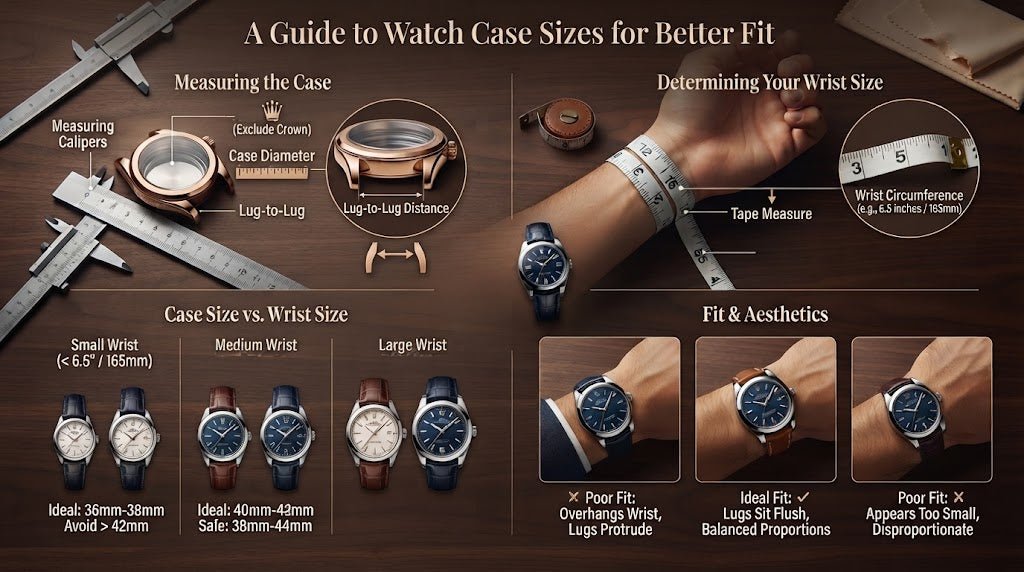
Watch sizing is often reduced to case diameter, measured in millimeters across the watch face without the crown. Diameter matters, but it is only the first number to consider. A watch with a wide bezel may wear smaller than its stated diameter, while a slim-bezel design can make the same measurement feel larger. Dial color, markers, and case shape also change the impression.
As a useful starting point, 34mm to 36mm cases tend to feel compact and classic. They suit smaller wrists, tailored looks, and anyone who prefers an understated profile. Cases from 37mm to 39mm are a flexible middle ground with vintage appeal and modern everyday versatility. The 40mm to 42mm range is a familiar choice for sports, chronograph, and contemporary casual watches. Above 43mm, a watch becomes more of a statement, especially when paired with a deep case or oversized dial.
These ranges are reference points, not rules. A 38mm square case has more wrist presence than a 38mm round case. A 42mm dive watch can feel balanced because its bezel contains the dial, while a 42mm minimalist watch may read much larger. Design always has the final say.
Diameter Is the First Impression
Think of diameter as the watch's visual volume from across the room. Smaller diameters tend to feel considered, versatile, and quietly confident. Larger diameters feel sporty, expressive, and more prominent against casual layers. Neither is inherently better. It depends on whether you want the watch to complete an outfit or lead it.
If you typically wear clean silhouettes, cropped jackets, fitted shirts, or minimal jewelry, a 36mm to 40mm watch often creates an easy balance. If your style leans toward utility wear, heavy outerwear, graphic tees, or bolder accessories, a 40mm to 44mm case may feel more at home. Statement-focused designs, including certain Italian-inspired silhouettes, are meant to occupy space. Trying to make every watch disappear under a cuff misses the point.
Lug-to-Lug Often Decides the Fit
Lug-to-lug is the measurement from the tip of one set of lugs to the other, also called the lug to lug distance: the distance from the outer tip of one lug to the outer tip of the other. Lugs are the extensions where the strap or bracelet attaches. This number is one of the most useful indicators of whether a watch will sit well on your wrist.
A case can have a modest diameter but long, straight lugs that hang over the edges of a smaller wrist, which can throw off proportion on one's wrist. Conversely, a larger case with short, curved lugs can wear surprisingly neatly. As a general guide, aim for lugs that stay within the flat top surface of your wrist rather than extending beyond it.
For many people, a lug-to-lug measurement between 44mm and 48mm is comfortable for everyday wear. Around 50mm can still work well on broader wrists or with curved lugs. Once a watch reaches 52mm or more, fit becomes more dependent on wrist shape, strap flexibility, and personal taste. Check this dimension before ordering a larger watch online. It can save you from a size that looked right in product photos but feels awkward in real life.
Thickness Changes How a Watch Wears
Case thickness is measured from the middle of the caseback to the top center of the watch's crystal. It affects comfort, profile, and whether a watch slides easily under a sleeve. A slim 7mm to 10mm watch feels refined and light, and ultra thin cases create a flatter, sleeker profile, especially on leather or mesh. It works naturally with button-downs, blazers, and restrained evening looks.
Cases around 11mm to 13mm are common for versatile everyday watches. They offer enough presence for casual wear without feeling overly tall. Chronographs, dive watches, and automatic designs may run 14mm or thicker because their movements and water-resistance construction need more room.
Thickness is not a flaw in a tool-oriented watch. A substantial case can feel purposeful and durable. The trade-off is that a tall watch may catch on cuffs, sit higher when typing, or feel top-heavy on a narrow strap. If comfort is your priority, compare thickness alongside diameter rather than treating it as a minor detail.
Measure Your Wrist Before You Choose
Use a flexible tape measure around the point where you normally wear your watch, just above the wrist bone. If you do not have one, use string, mark the overlap, then measure it with a ruler. Measuring your wrist helps determine the right watch size and strap length. Wrist circumference gives you a useful baseline, but wrist width is equally valuable.
A wrist can be broad and relatively flat or narrow and rounded, even at the same circumference. Flat wrists tend to accommodate larger lug-to-lug dimensions. Rounded wrists usually benefit from shorter, more curved lugs that follow the contour of the arm.
If your wrist measurements come in under 6 inches, compact 34mm to 36mm cases and shorter lugs are a reliable place to begin. Between 6.25 and 7 inches, medium wrists comfortably fit case diameters from 38mm to 42mm. Above 7 inches, larger wrists can often accommodate 42mm to 46mm or larger cases, though a smaller watch can still look sharp by choice. Proportion is personal, and a deliberately smaller watch can be as stylish as an oversized one.
Match Case Size to the Watch's Purpose
A dress watch is designed to keep a low profile. Slim cases, restrained dials, and diameters around 36mm to 40mm usually deliver the right kind of polish. The watch should feel like a finishing detail, not compete with the rest of the look.
Field and everyday watches live in the middle. Their practical dials and durable straps make 38mm to 41mm especially adaptable, a common range in men's watches. This is the range for someone who wants one dependable watch that works with denim, office basics, and a weekend camera bag.
Diver-style and sport watches often need more visual strength. Their rotating bezels, heavier construction, and luminous dials can support 40mm to 43mm without looking excessive. Still, a compact dive watch has its own appeal, particularly if you value vintage proportions over maximum wrist presence.
Chronographs usually wear larger than their diameter suggests. Subdials, pushers, and thicker movements add visual and physical mass, which changes the overall appearance on the wrist. For example, a 40mm watch with chunky pushers may feel more like 42mm. If you are deciding between a 40mm chronograph and a 40mm three-hand watch, expect the chronograph to feel larger. A smaller chronograph can be the smarter choice if your wrist is narrow or your style is more minimal.
Square, rectangular, cushion, and tonneau cases deserve their own judgment. Their dimensions do not translate directly to round watches. Look at the full height and width of the case, not just the listed width. Shape is part of the personality, and unusual cases are often chosen precisely because they break from standard proportions.
How to Judge Fit When Shopping Online
Product photography can make almost any watch look balanced. Use the specifications as your anchor. Compare diameter, lug-to-lug, and thickness with a watch you already own and like wearing. When trying one on, check it in a full-length mirror to judge proportion more accurately. Even a difference of 2mm can be noticeable, especially in lug-to-lug length.
A simple paper template also helps. Draw the stated case diameter on paper, cut it out, and place it on your wrist. It will not replicate the depth or curvature of the case, but it quickly reveals whether the footprint feels too small or too dominant.
Pay attention to strap width as well. A 20mm strap on a 38mm case often feels classic and balanced. Your lug width determines which strap or watch band will fit, so the right band helps create a more comfortable fit. Wider straps create a more muscular look, while tapered straps can make a larger case wear lighter. Metal bracelets often feel heavier than leather straps or a fabric strap, which can change the perceived overall size and comfort. Bracelet designs add weight and visual density, whereas leather, nylon, and rubber can soften the overall presence.
At Bang On, the point of a curated watch selection is not to force every style into one safe size. It is to make distinctive design easier to choose. Read the dimensions, consider the silhouette, and let the watch's character guide the decision.
Choosing a Watch Case Size as a Gift
When you cannot measure the recipient's wrist, versatility is your advantage. A 38mm to 40mm round case with moderate thickness is usually the least risky choice for an everyday gift. If the gift is for a child, children's watches typically range from 23mm to 28mm. It avoids the extremes of very small and very oversized while working across many personal styles.
Consider what they already wear. Someone who favors subtle jewelry, tailored clothing, and monochrome basics may appreciate a slimmer, more compact case. Someone drawn to sneakers, vintage graphics, bold eyewear, or creative accessories may enjoy a larger or less conventional shape. For a gift, personal preference and personal style usually matter more than rigid sizing rules, so prefer the option that feels closest to the recipient for the perfect fit and the perfect watch.
The best case size is the one that makes you reach for the watch without thinking twice. Get the dimensions right, then trust your eye. A well-proportioned watch has a quiet way of making everything around it look more intentional.
Share
Our guide to buying Japanese watches helps you choose the right movement, design, size, and authorized seller for a piece you will wear for years to come.