Why Are Mechanical Watches Expensive to Make?
A mechanical watch is expensive to make because it packs dozens, sometimes hundreds, of tiny components into a movement that must be manufactured to tight tolerances, assembled by skilled hands, finished in detail, and tested for reliable performance. A mechanical watch can look deceptively simple: a dial, two or three hands, a case, and a strap. Yet behind that clean wrist presence is a compact machine built from dozens, sometimes hundreds, of precise components. That is the real answer to why are mechanical watches expensive. You are not only paying for the time on the dial. You are paying for engineering made small enough to wear.
For people drawn to design, the appeal is easy to understand. If you are a design-conscious buyer, creative professional, or anyone choosing a watch for craftsmanship as much as function, understanding that price changes how you judge value. A mechanical watch has a physical rhythm. Its movement turns stored energy into motion through springs, gears, levers, and an oscillating balance wheel. No battery is doing the work. That analog character is part of the attraction, but it is also where the cost begins.
What follows looks at the movement itself, the precision and materials involved, the labor of assembly and hand finishing, the testing and regulation needed for accuracy, the effect of production scale on cost, and why the ownership experience feels different from mass-produced alternatives.
Why Are Mechanical Watches Expensive? Start With the Mechanical Movement
A quartz movement is generally built for efficient, high-volume production, which is why quartz watches are usually more affordable. A battery sends electricity through a quartz crystal, which regulates the watch and drives the hands. It is an excellent solution for accuracy, affordability, and low maintenance.
A mechanical movement takes a different route. Whether it is hand-wound or automatic, it relies on a mainspring that stores energy. That energy moves through a gear train, escapement, and balance assembly in carefully controlled intervals. Every part has to work together with minimal friction and consistent force.
That system requires more components, tighter tolerances, and more skilled assembly than a typical quartz caliber. The balance wheel must oscillate reliably. The escapement must release energy in exact, repeating increments. Tiny synthetic ruby jewels are often used at key points to reduce wear. A watchmaker may regulate the movement to improve its daily timekeeping before the watch ever reaches a wrist.
Mechanical watches are not necessarily more accurate than quartz watches. In fact, quartz usually wins that contest. Among watch movements, mechanical ones can lose or gain a few seconds per day because external factors affect the movement. The value lies elsewhere: in the complexity of the object, the tactile ritual of winding or wearing it, and the way a visible mechanism makes time feel physical.
Precision at a Very Small Scale in Manual Winding Mechanical Watches
The smaller the machine, the less room there is for error. A mechanical watch movement may be only a few millimeters thick, but its components need to align with remarkable precision. A slightly misplaced gear, an imperfectly shaped spring, or too much lubrication can affect power reserve, accuracy, and reliability.
This is why the cost is not simply about raw material. Steel, brass, and synthetic jewels are not inherently rare. Mechanical watches are the oldest type of watch, and that long history still shapes how they are made. What matters is how those materials are machined, finished, positioned, and tested. A gear tooth that is nearly invisible to the eye still has a job to do every second of every day.
There is also a meaningful difference between mass-produced mechanical movements and highly finished or extensively hand-assembled ones, where craftsmanship becomes part of the value. A dependable entry-level automatic can offer a strong point of entry into mechanical and automatic watches ownership. At the higher end, extra labor goes into regulation, decoration, thinner construction, more complex architecture, and complications such as chronographs, calendar displays, or multiple time zones.
Labor Is Built Into the Price
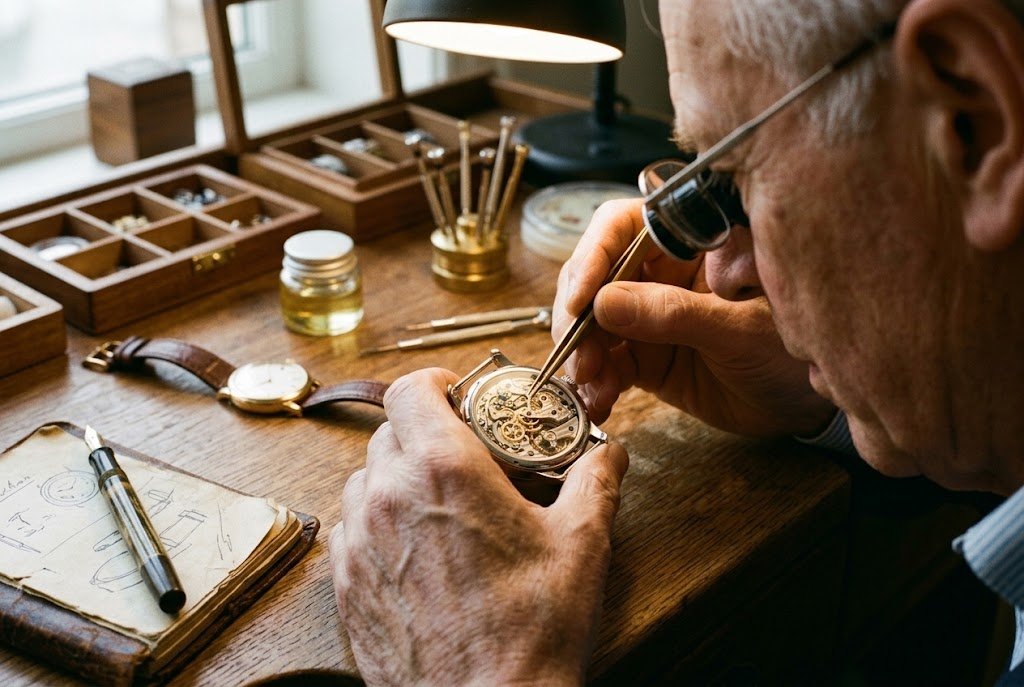
A mechanical watch is one of the few everyday accessories where traditional assembly skills remain central to the product. Automation has improved manufacturing, but mechanical watches still rely on skilled human assembly rather than removing the need for trained hands and trained eyes.
Watchmakers assemble delicate components, apply oils in minute quantities, inspect pivots, test the movement, and adjust it as needed. More ambitious movements can require significant time for assembly and quality control. When a brand uses hand finishing, the labor rises further, and that level of quality craftsmanship takes even more time. Polished bevels, striped bridges, engraved rotors, heat-blued screws, and finely finished dials are not always necessary for performance, but they change how the watch feels as an object.
That distinction matters. Some finishing is visible only through an exhibition caseback, while other details shape the daily experience: a sharply machined case, a well-balanced bracelet, cleanly printed indices, or a crown that turns with satisfying resistance. Great watch design is rarely one feature. It is the accumulated effect of many decisions made well, influencing not just feel but also the watch's charm.
Materials Matter in Entry Level Mechanical Watches, but They Are Not the Whole Story
Premium materials add cost, especially when they are used with care. Sapphire crystal is more scratch-resistant than standard mineral glass. High-grade stainless steel takes more work to shape and finish. Ceramic bezels, bronze cases, titanium, leather, and specially developed rubber straps each bring their own production demands.
Still, an expensive watch is not automatically better because it uses sapphire or steel. Those details should be read alongside the movement, construction, finishing, warranty support, and the brand's design point of view. A watch made from modest materials can be compelling if its proportions, dial layout, and mechanical character are resolved with confidence.
The case and dial deserve more credit than they often receive. Brushing and polishing a case cleanly takes time. Applying markers, printing minute tracks, creating textured surfaces, or matching color across dial components requires control. On a well-designed watch, these are not decorative afterthoughts. They are the parts you notice every time you check the time.
Testing, Regulation, and Long-Term Service
A mechanical watch has to survive more than a product photo. Brands test for water resistance, winding performance, power reserve, shock tolerance, and basic accuracy. The exact standards vary widely, which is one reason prices can differ even among watches that appear similar at first glance.
Quality control is especially expensive because rejected parts, additional adjustments, and longer inspection processes all add to the cost. An authorized retailer also contributes a different kind of value: authentic inventory, official warranty coverage, and a clear route to support if something needs attention. Many buyers also see a well-made mechanical watch as a long-term investment.
Mechanical ownership includes a trade-off. The movement will eventually need service, usually after several years depending on the watch and how it is worn, and proper care helps it stay in good condition for generations. That service is part of the category, much like maintaining a well-made camera or leather bag. For some buyers, it is an inconvenience. For others, it is proof that the watch was designed as a repairable object rather than a disposable one. That longevity is one reason these watches are often passed down.
Limited Production of Luxury Watches Changes the Equation
Scale affects price. Brands producing millions of watches can spread development, tooling, and supply-chain costs across a huge number of units. Independent makers and smaller design-focused labels often cannot. Their production runs are often much smaller than the large batches typical of quartz watches, their component orders smaller, and their finishing more hands-on.
Limited availability does not automatically justify a high price. Scarcity can be marketing, and a dramatic story cannot replace sound construction. But lower-volume production can legitimately cost more when it supports better materials, closer quality control, distinctive design, or specialized manufacturing. That also helps explain why the mechanical watch market is projected to reach USD 77,079.1 Mn by 2033.
This is also where a curated selection helps. Rather than treating every watch as interchangeable, Bang On focuses on timepieces with a clear point of view - watches that bring Italian statement styling, Japanese restraint, vintage cues, or modern custom expression to the wrist. The right choice is not always the most complicated movement. It is the one whose design and build feel worth wearing repeatedly.
What You Are Really Buying
A mechanical watch is not the logical answer if you only need the most precise, lowest-maintenance way to tell time. Your phone and a basic quartz watch handle that job with ease, with a battery as the power source in a quartz watch movement. Mechanical watches make sense because they offer a different relationship with an everyday object.
You notice the sweep of the seconds hand. You feel the rotor move in an automatic watch, which is self winding through the motion of your wrist. You wind the crown before a weekend out. The mechanism is hidden inside a case, but its presence changes the experience. It gives a watch weight beyond its function.
Price should still be considered with clear eyes. Some buyers choose mechanical or luxury watches partly for heritage and long-term value. A Rolex may hold appeal because of market recognition as much as design. An Omega often attracts buyers who want a strong mix of history and everyday wearability. Cartier can matter to someone who values watchmaking through a fashion-house lens. Patek Philippe is often discussed in terms of prestige and generational ownership. Seiko shows that brand reputation in this space is not limited to Swiss names. Choose a watch you can afford rather than stretching only for status. Look for a movement with a credible track record, a case and crystal suited to how you live, a design you will keep reaching for, and official support behind the purchase. A higher price can reflect real luxury craft, but it should also deliver a watch with personality, purpose, and staying power.