Quartz Versus Automatic: Which Watch Suits You?
A watch can be the most considered object you put on each morning. It sits between utility and personal style: part timing device, part design signal, part small daily ritual. The quartz versus automatic question — or quartz vs automatic, if you are comparing specs side by side — is not really about which movement is objectively better. Quartz suits you if you want accuracy, low maintenance, and a watch that is always ready to wear; automatic suits you if you value mechanical craftsmanship and a more tactile daily connection to what is on your wrist.
For urban creative professionals and design-conscious buyers who want a watch that feels as good in daily use as it looks on the wrist, these are two watch types with very different strengths. For some, that means precise time with no extra thought. For others, it means feeling a mechanical caliber come alive with the motion of a wrist. Both choices can look exceptional, but they differ in reliability, upkeep, price, and the kind of experience they bring to your routine. That is why this comparison looks at the essential differences between quartz and automatic movements, including maintenance, style, quality, value, and which one fits your lifestyle and taste.
Quartz movements versus automatic: the essential difference
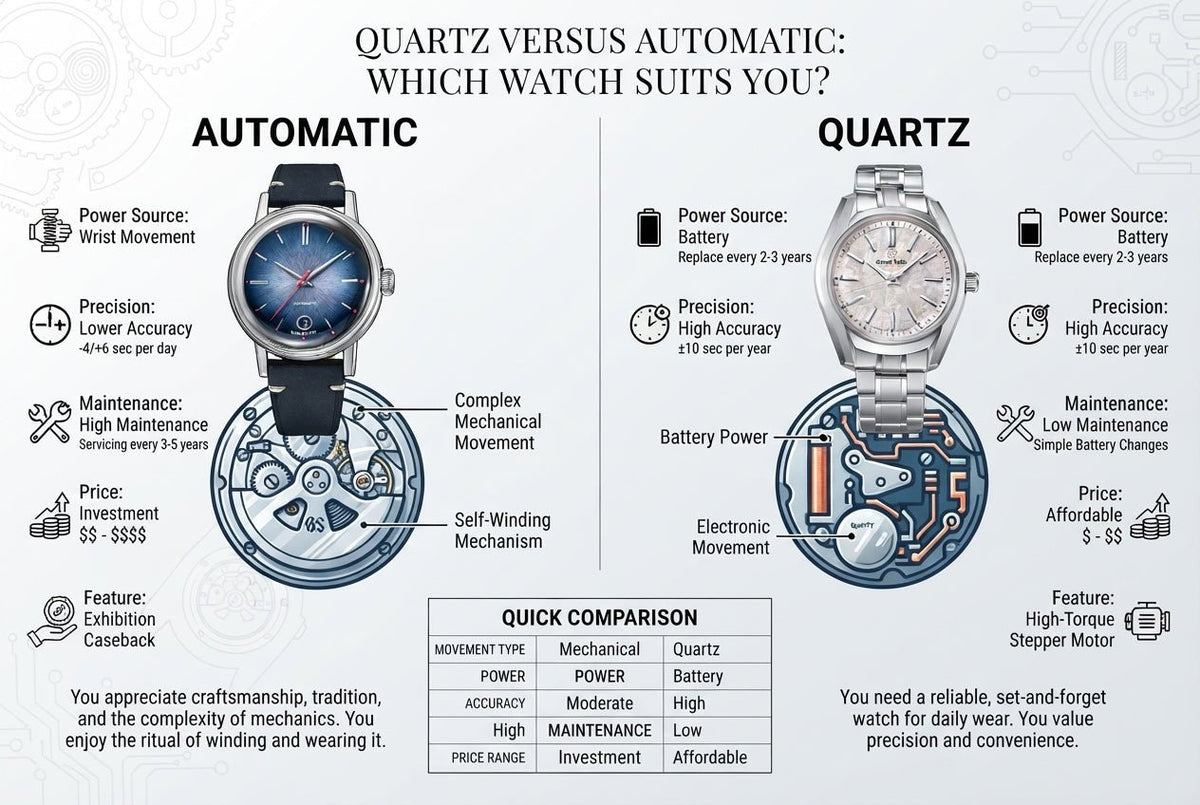
A quartz watch runs on a battery and a small quartz crystal. Electricity from the battery sends an electric current through that crystal, causing it to vibrate at a precise frequency and constant frequency; that is how a quartz watch work, driving the watch hands to keep accurate time. The seconds hand often moves in individual one-second steps, though some higher-spec quartz designs create a smoother effect.
An automatic watch is powered by an automatic movement. This watch movement is a mechanical movement inside the case, where a weighted rotor turns as you move, using wrist motion from the wearer's wrist for automatic winding to wind a mainspring that stores energy. That energy travels through a series of gears and an escapement to regulate the watch. No battery is required, but an automatic watch needs regular wear or manual winding to keep running.
The distinction is straightforward. Quartz and automatic systems use different power sources, and automatic and quartz movements reflect different priorities. Quartz is an electronic system designed for practical precision. Automatic is a miniature mechanical machine designed to turn motion into timekeeping. One is not a lesser version of the other. They simply reward different priorities.
Choose quartz when life needs low maintenance and easy battery replacement
Quartz is the easy, capable choice for a watch that needs to work without ceremony. Most quartz watches are incredibly accurate and can boast astonishing accuracy in daily use, gaining or losing only a few seconds per month, while mechanical watches commonly vary by several seconds per day. If you set your watch once and expect it to stay accurate through meetings, flights, workouts, and weekends away, quartz makes a strong case.
It is also ideal if you own multiple watches and rotate them often. Pick up a quartz watch after two weeks in a drawer and it will usually still be keeping time. An automatic may have stopped after its power reserve runs down, which means resetting the time and, depending on the design, the date.
Quartz movements are generally slimmer, too. That gives designers more freedom to create clean, low-profile cases that slip under a cuff or make a compact statement on a smaller wrist. It can also allow more budget to go toward the elements you see and feel: the case finishing, dial texture, color work, bracelet, or strap.
For a first serious watch, quartz removes friction. It is dependable, accessible, and often better suited to a fast-moving schedule. It is relatively low maintenance and needs less maintenance overall, with occasional battery replacement or battery changes requiring little effort, along with pressure testing if the watch is intended for water use.
Quartz is not short on personality
The old assumption that quartz is purely functional misses the point. Some of the most expressive modern watches use quartz precisely because it supports a specific design idea, and that includes certain luxury watches where the visual concept matters most. Think graphic dials, bold case architecture, playful color, chronograph layouts, or dress watches with almost no visual bulk, with some luxury brands choosing quartz intentionally for slimness and greater design freedom.
A quartz movement can be the right foundation for a watch that is meant to be a visual signature rather than a mechanical conversation starter. If your style changes with your outfit, camera bag, or creative project, quartz gives you the freedom to wear the watch as an accessory without adding a maintenance task.
Choose automatic movement when the mechanism is part of the appeal
Automatic watches ask a little more from their owner, and that is exactly why many people love them. The movement is powered by your day. Put it on, move through the city, reach for coffee, take a train, make photographs, and the rotor quietly winds the mainspring as your wrist moves. In other words, these are self winding watches, or self winding pieces that keep running through daily wear. There is a physical relationship between wearer and object that a battery-powered watch does not replicate.
Mechanical timekeeping is also full of visual detail. An exhibition caseback can reveal the rotor, bridges, gears, and finishing. On the dial side, a smooth sweeping seconds hand gives the watch a sense of continuous motion. These are small details, but the intricate detail of the finishing, the mechanical parts underneath, and components like the balance wheel are exactly what many people appreciate in the hand and on the wrist.
Automatic watches often appeal to people who value objects with process built in. A film camera, a leather bag that develops character, a fountain pen, an automatic watch - each asks for a little attention and returns a more tactile experience. These watches often appeal especially to watch enthusiasts, and automatic ones are valued for that tactile, mechanical character. It is not about nostalgia for its own sake. It is about choosing a daily object that feels alive.
That said, mechanical ownership comes with practical trade-offs. Automatic watches are less accurate than quartz models, and they need periodic servicing. A full service can involve cleaning, lubricating, regulating, and replacing worn components. Depending on the movement and how the watch is used, service intervals are often measured in years, not months, but it is a cost worth planning for. Quartz relies on battery power, while automatic ownership avoids the battery replacement issue.
Power reserve changes the routine
Most automatic watches run for roughly 38 to 72 hours once fully wound, although some newer movements offer days long power reserves thanks to technological advancements. An automatic works best when worn regularly or if you watch daily, so if you wear the same one every day, this may never matter. If you switch between several watches, it will.
A stopped automatic is not a problem. It simply needs to be manually wound and set again if left unworn. But buyers who want absolute grab-and-go ease should take that moment seriously. The right watch should fit your actual habits, not an imagined version of them.
Style, price, and quality are separate questions
It is tempting to treat automatic as premium and quartz as entry-level. That shortcut does not hold up. In terms quartz and automatic are separate movement choices, not shorthand for overall quality. There are refined quartz watches with excellent materials and sharply executed design, just as there are inexpensive automatic watches made with basic components. Movement type is one part of the value equation, not the whole story.
Look at the watch as a complete object. Consider the proportion of the case, the clarity of the dial, the quality of the crystal, water resistance, strap construction, and how the design works at a glance. A well-edited quartz watch can feel more elevated than an automatic model with an awkward case, crowded dial, or weak finishing.
Price also reflects the movement’s power source and what happens inside. Automatic movements have more parts and require more assembly and adjustment, which can raise the cost. Some buyers also overlook how enabled automatic improvements have made newer movements more practical than older expectations suggest. At comparable price points, quartz may offer stronger external specifications, while automatic may devote more of the budget to the movement. Neither approach is wrong. Decide whether you care more about the watch's mechanical story or its all-around feature set.
For gift buyers, quartz is often the safer choice. It can be worn immediately, requires little explanation, and suits a broad range of lifestyles. An automatic makes a more intimate gift when you know the recipient enjoys watches, design engineering, or analog objects with a ritual attached.
How to make the decision and weigh the pros and cons without overthinking it
When buying a new watch, one of the most notable comparison points is quartz vs automatic. Start with your weekday. If you want a watch that is always ready, highly accurate, and easy to rotate with other accessories, choose quartz. If you enjoy the idea of wearing a compact mechanical instrument and do not mind setting it from time to time, automatic will likely feel more rewarding, though the better choice often comes down to personal preference.
Then consider what catches your eye. If you are drawn to expressive dials, fashion-led shapes, and slim proportions, do not assume an automatic is necessary to make the watch meaningful. Many buyers deciding between the two are really choosing whether they care more about aesthetics or the movement experience. If you find yourself turning a watch over to see the movement or noticing the sweep of a seconds hand, that is useful information too.
Bang On's approach to watch selection is design first, with movement treated as part of the personality rather than a status shortcut. A distinctive Gagà Milano silhouette, the custom-minded character of an UNDONE design, or the considered restraint of a Japanese-made watch can each make a stronger impression than a specification sheet alone.
The watch you wear is the right one
Quartz offers confidence with almost no demand on your time, which is why the choice often comes down to whether quartz powered watches or automatics better match how involved you want ownership to feel. One keeps pace with a packed calendar; the other gives a small mechanical pause to it.
Choose the watch that you will reach for, not the one you think you are supposed to admire. Even if quartz suits more practical routines, automatic watches remain models many collectors still prefer because the watch on your wrist should still feel like your own.
Backpack versus messenger bag: compare comfort, access, capacity, and style to choose the everyday carry that works with your urban routine and taste.