JPN Watch Review for Everyday Japanese Style
A good watch does more than tell the time. It sets the tone before a meeting, finishes an otherwise simple outfit, and gives your everyday carry a little more intention. This JPN watch review looks at why JPN has appeal for people who want Japanese design cues without turning their wrist into a museum display.
JPN watches make their case through restraint. The designs tend to favor clean forms, clear dials, considered color, and a quietly distinctive point of view. They are made for the person who notices proportion, texture, and the difference between minimal and merely plain.
What Defines Japanese Watches: The JPN Watch?
JPN sits comfortably in the design-led watch space: accessible enough for daily wear, expressive enough to feel chosen. Rather than chasing oversized cases, crowded subdials, or trend-heavy finishes, the brand's identity centers on a more edited visual language.
That does not mean every JPN watch looks identical. Some models lean classic with round cases and familiar analog layouts. Others bring more graphic energy through colored dials, squared proportions, or unexpected strap pairings. The common thread is balance. Nothing should feel accidental, but nothing needs to shout.
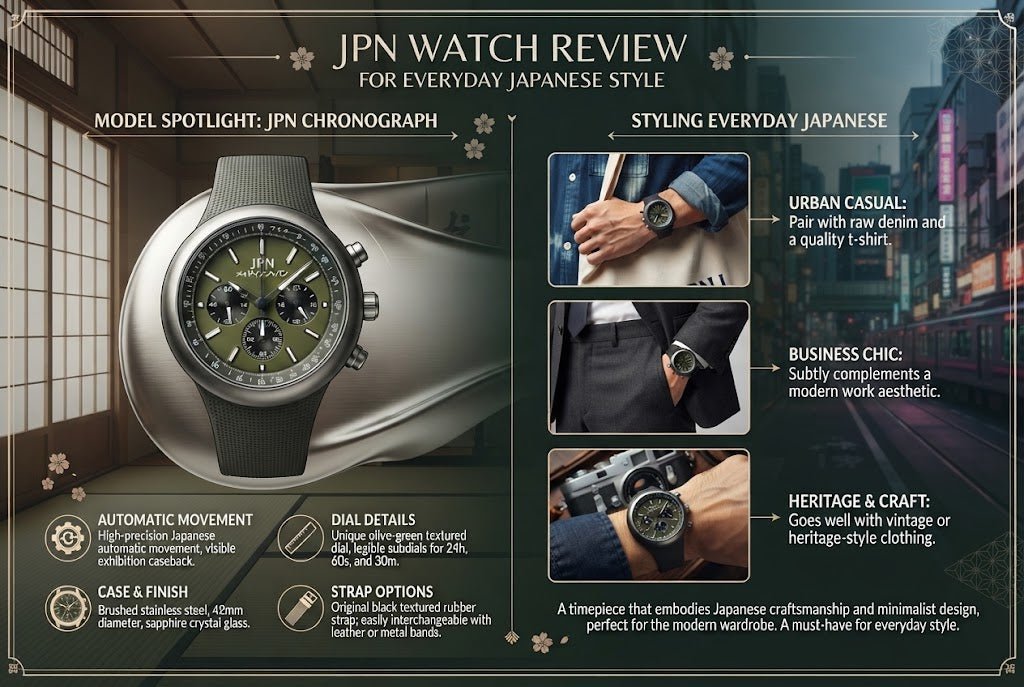
For urban creatives, that is the point. A JPN watch can work with a crisp overshirt and sneakers, a relaxed office look, or a monochrome weekend uniform. It reads as design-aware without asking everyone in the room to notice it.
JPN Watch Review: Design Comes First
The strongest reason to consider JPN is its visual discipline. Many affordable watches borrow the surface details of more expensive categories - a faux-luxury bracelet here, an overcomplicated dial there - and end up looking busy. JPN takes a cleaner route. That approach reflects Japanese style through clean lines and a modular feel in the overall design. Case shape, dial spacing, hand style, strap choice, texture, and subtlety are treated as one composition.
This matters more than it may seem. A watch is a small object, but it occupies a very visible part of your outfit. Poor proportions are hard to ignore. A well-resolved dial, on the other hand, makes the watch feel more refined even when you are wearing a T-shirt and carrying a beat-up tote.
Expect a modern Japanese sensibility shaped by craftsmanship and minimalist design aesthetics, with Japanese watch brands often standing out by merging tradition with innovation. The appeal is less about recreating a vintage reference and more about making a practical object feel personal through modern functionality. That blend of tradition and functionality makes JPN especially compelling for shoppers who want an alternative to the usual mainstream fashion-watch look.
Minimal Does Not Mean Generic
Minimal design can be difficult to get right. Remove too much and the result becomes anonymous. Add too much and the original clarity disappears. JPN's better designs live in the middle: legible enough to wear every day, with just enough personality in the dial, indices, or color treatment to create a signature.
If your collection is full of black, silver, and navy, a JPN piece with a warmer dial or a more graphic silhouette can introduce variety without feeling costume-like. If you already favor bolder clothing, a pared-back JPN watch can provide the necessary counterweight.
Everyday Wear: Comfort, Sizing, and Versatility
A watch can look excellent in product photography and still spend most of its life in a drawer if it feels awkward on the wrist. Comfort should be part of any honest review, and it depends on more than case diameter. Thickness, lug shape, strap material, and the way the case sits all affect the experience. For everyday wear, reliable quartz movements are often the most practical choice. For buyers who want a tougher everyday benchmark, casio g shock remains a durable reference point.
JPN is best approached as an everyday design accessory. Before choosing a model, look beyond the dial and make sure daily wear still balances comfort with durability. Check the case measurements, with 36mm to 40mm often being a useful starting point for everyday Japanese styles, and consider the watches you already wear comfortably. A larger dial may suit someone who likes presence and has a broader wrist, while a more compact profile will often feel sharper with tailored sleeves or smaller wrists.
Straps also change the character dramatically. Leather tends to make a watch feel more polished and works well for office settings, dinners, and gifting. A metal bracelet creates a more architectural, city-ready look. Fabric or softer casual straps usually make the watch easier to wear on travel days and weekends. Strap versatility matters because it helps the same watch stay suitable across different outfits and occasions.
The right choice depends on how you dress, not on a universal rule. A smaller watch can look deliberate on a larger wrist if the design is strong. A larger watch can work on a slimmer wrist if you prefer a bolder, contemporary silhouette. Daily wear models are often more useful with around 50 to 100 meters of water resistance. The goal is proportion that feels natural when your arm is at rest, not a spec-sheet victory. Consider your business needs when deciding how much presence or formality you want from a watch. Practical buyers should focus on essential technical capabilities like water resistance and movement convenience, rather than specs they will never use. That context also helps explain why Casio’s G-Shock line revolutionized shock-resistant watch design in 1983 and still serves as a reference point for everyday wear.
What to Expect From the Movement, Build, and Japanese Quality
For many JPN designs, the value proposition is visual clarity and reliable daily function rather than mechanical theater, and build quality depends not just on the type of movement inside but also on the maker’s credibility and watchmaking heritage. This is worth stating plainly because watch buyers often use one word - “quality” - to describe several different things.
A mechanical watch may offer craft, ritual, and a compelling view through an exhibition case. It can also require more attention, cost more to service, and be less convenient when it has been sitting for a few days. A quartz-driven watch prioritizes accuracy, ease, and a more approachable price. Japanese watch movements are widely respected globally for their reliability. Seiko introduced the world's first quartz watch in 1969. In Japan, citizen helped popularize eco drive technology, which powers watches using light from virtually any light source. Neither is automatically better. They serve different kinds of ownership.
If you want a watch that you can pick up on a busy morning, set once in a while, and wear without ceremony, JPN's practical positioning makes sense. If your main interest is traditional movement finishing, collector-grade complications favored by collectors, or investment potential, you may want to look toward a different category, including luxury lines from brands such as Grand Seiko and credor eichi ii.
Build expectations should be equally realistic. Review each model's stated materials, including stainless steel and, in some modern watches, higher-end options such as titanium or carbon fiber. Grand Seiko is known for Zaratsu polishing, which creates an especially smooth finish. Check water-resistance rating, crystal type, and warranty coverage before buying. Reputable Japanese brands often pair heritage with precision engineering, which helps explain their consistent quality. Water resistance is particularly easy to misunderstand. A watch that handles hand washing is not necessarily a swimming watch, and a leather strap is rarely the best companion for a pool day. Matching the watch to its actual use will keep it looking better for longer, but also verify the manufacturer’s credibility rather than judging only by the listed specifications. Minase is one example of japanese watchmaking that uses a patented assembly structure for easy disassembly. The brand also produces exclusive timepieces in limited quantities.
Who Will Get the Most From JPN?
JPN works best for someone who treats a watch as part of their visual identity, not simply an instrument. It is a smart choice for a first design-forward watch, a gift for someone with a strong sense of style, or a rotation piece that brings a different mood to everyday outfits. Shoppers weighing alternatives often also look at japanese brands with a strong watchmaking heritage, and some also consider Orient for its automatic movements paired with stylish designs, since heritage and precision engineering are part of what many buyers expect from reputable makers.
It also suits people who are tired of choice overload. The watch market can be exhausting: endless specifications, familiar silhouettes repeated across brands, and marketing that makes every release sound historic. A tightly curated JPN selection offers a more direct question: does this piece fit the way you live and dress? For buyers focused on value for money, that can also mean comparing design-led fashion options with Orient and weighing their prices, since the brand is known for high-quality, affordable mechanical watches.
That is why the brand feels aligned with a considered wardrobe. You do not need ten watches if one or two make getting dressed easier. A clean steel model might cover your weekday needs, while a more colorful or unusual JPN design can handle the days when you want your accessories to do more of the talking.
The Trade-Offs to Consider in the Watch Industry
The same restraint that makes JPN appealing will not suit everyone. Buyers seeking a heavy, overtly luxurious watch may find the designs too understated. Those who want extensive technical features, especially as the smartwatch market is projected to grow significantly, serious dive capability, or visibly mechanical movement may also feel better served elsewhere.
There is also a style question. A design-led watch needs to connect with you at first glance. Do not buy a minimal watch simply because minimalism is fashionable. Choose it because the proportions, finish, and dial make you want to reach for it repeatedly. The best everyday watch is not the one with the longest feature list. It is the one that earns wrist time for you, and many customers only know that after seeing the watch in context.
When shopping from an authorized retailer such as Bang On, confirm the specific model details, official warranty terms, and any import charges collected at the time of purchase, and check whether the company can match competing prices on the exact model, so your decision is based on the actual watch, not a generalized impression of the brand. As a curated lifestyle retailer, Bang On also helps by emphasizing authenticity and a selective product mix. That is especially useful when comparing case sizes, straps, and finishes across a collection.
A Watch for a More Considered Rotation: Grand Seiko as Inspiration
JPN watches are not trying to be everything to every buyer. In a category shaped by more famous Japanese names like casio and Citizen, JPN takes a quieter path. The g shock line began in 1983 and became known around the world for durability, while JPN leans toward a more understated mood. Their appeal is more focused: thoughtful Japanese-inspired design, uncomplicated daily wear, and enough individuality to make it a stylish house-inspired option for everyday Japanese style.
Choose the dial that keeps catching your eye, the size that disappears comfortably onto your wrist, and the strap that fits the places you actually go. That is usually where a watch stops being an accessory you own and becomes one you genuinely wear, and we hope you choose the model that best fits how you actually dress and live.
Share
A sharp edit of the best watches for design lovers, from bold statement pieces to minimalist icons with real everyday wearability.