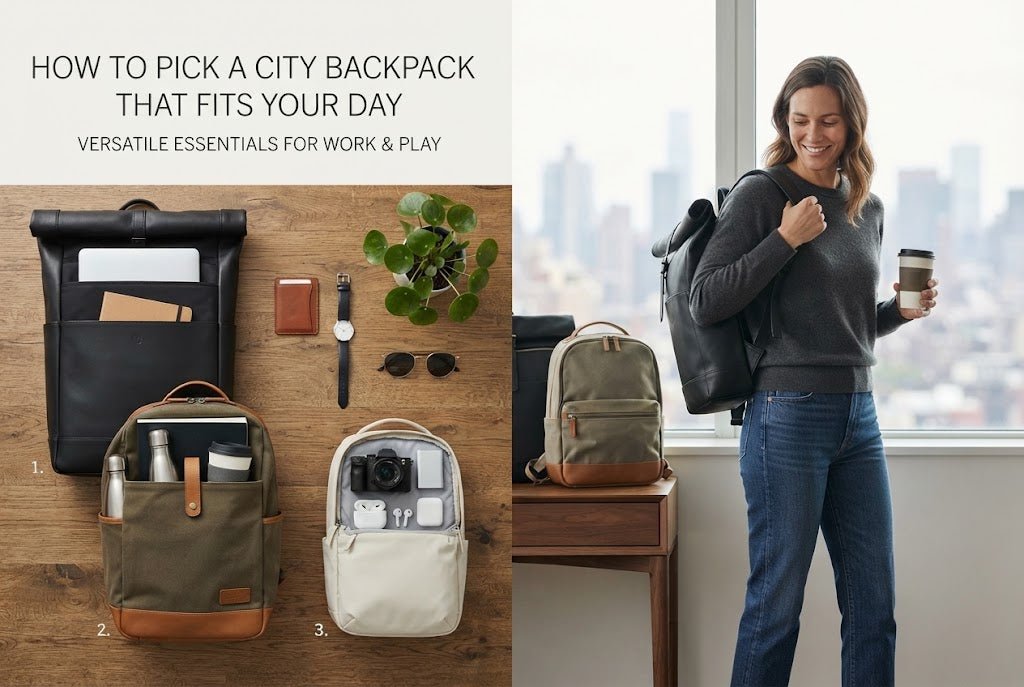
How to Pick a City Backpack That Fits Your Day
A city backpack earns its place when it fits your actual day: start by being honest about what you carry, how you commute, and how much capacity you really need—often around 15 to 20 liters for daily essentials—then choose features like a laptop sleeve, weather-resistant materials, and useful organization to match life on city streets without flattening your personal style. It carries a laptop through a crowded train, keeps a camera within reach, survives a sudden shower, and still looks right beside a good coat or clean sneakers.
For urban creative professionals and design-savvy commuters, the right bag is not the one with the most compartments or the largest capacity. It is the one that makes your routine feel lighter, more organized, and more considered while protecting the items you use every day. That is why the details matter: size and laptop fit, material choices for city weather, access and security, pocket layout, comfort and padding, how the shape works with your wardrobe, and the small things like zipper quality and warranty that decide whether a backpack still works six months in.
Start With Your Actual Route
Do not shop for an imaginary version of your life. Think about the distance from home to transit, whether you bike or walk, how often you work from a coffee shop, and what comes with you after hours, so you can choose a backpack that works on city streets, in daily transit, and through changing weather for your real routine. A compact backpack that feels perfect for a short commute can become frustrating when you add a lunch container, gym clothes, or a small camera.
For most city days, a 15- to 20-liter backpack is the sweet spot. It works well as a day pack, holding daily essentials without becoming a bulky presence on your back or under a restaurant table. If your packing style leans heavier or you regularly carry a change of clothes, over-ear headphones, a full-frame camera, or documents, moving up to roughly 20 to 25 liters can make sense for daily carry and even occasional weekend trips if you size it carefully. A smaller bag is usually easier to live with in crowded urban routines. Beyond that, the bag can start to feel more like travel gear than an everyday urban piece.
Capacity is only part of the equation. A tall, narrow bag may look refined but can make packing awkward. A wider silhouette is easier to load, though it can feel oversized in tight subway aisles. Consider the shape of the items you carry, not just the total volume, because usable space inside and room inside matter too.
Make the Laptop Fit Precisely With a Dedicated Laptop Compartment
Laptop compatibility is a detail worth getting right. Check your device's physical measurements rather than assuming every 15-inch sleeve will fit every 15-inch laptop. Screen sizes are not standardized bag dimensions, and protective cases add bulk.
Look for a suspended, padded laptop compartment with a false bottom. This keeps the device from taking the impact when you set the bag down. A separate rear compartment is especially useful for commuters because it allows quick retrieval of tech at airport security or during a workday without exposing everything else in the main compartment.
If you only carry a tablet or compact laptop, resist buying extra bulk just because a larger bag has more padding. A closer fit usually looks cleaner and carries better. Adjustable shoulder straps and other adjustable features matter because laptop-carry comfort varies across body types. Fit is also affected by torso length, especially if you are at either end of the size range.
Choose Materials for Real City Weather
A city backpack lives around wet sidewalks, train floors, coffee counters, bike racks, and crowded spaces. Material should support the way you move, not simply look good in product photos.
Recycled polyester and nylon are popular for good reason. They are lightweight, durable, and typically easy to wipe clean. A coated fabric or water-resistant finish adds practical protection for everyday rain, but it helps to separate water resistance from weather resistance in real use. That said, water-resistant does not mean waterproof. In a sustained downpour, water can still enter through zippers, seams, and openings. If you commute in all weather with electronics or camera gear, prioritize weatherproof construction, protected zippers, and a substantial coating or other waterproof material. Some people also want a rain cover, but built-in protection is usually the cleaner choice for city use.
Leather brings polish and develops character, but it asks for more care. It can be an excellent choice for a short commute or office-first routine, especially when paired with a protected laptop sleeve. For a bike-heavy, weather-exposed schedule, technical fabrics are usually the smarter investment.
Also examine the base panel. A reinforced or coated bottom matters more than many shoppers realize, and an extra layer there can improve durability in wet or dirty conditions. It is the part that meets wet pavement, dusty floors, and café corners. A beautiful bag that cannot be set down without concern will eventually become a bag you leave at home.
How to Pick a City Travel Backpack With Better Access
In a crowded city, easy access is part of security. You should be able to retrieve your transit card, keys, phone, or camera without turning your bag into a public display.
A top-loading main compartment gives a clean silhouette and works well for larger items. A full-zip opening makes packing easier and offers a clearer view of what is inside. Neither is automatically better. Top loading favors a more minimal profile, while a wider opening suits people who carry varied gear and dislike digging through a vertical stack of belongings. For materials, choose durable fabrics like ballistic nylon or waxed canvas if you want a city backpack that handles daily wear without looking overly technical.
External pockets deserve a measured approach. One quick access front pocket for keys, a phone, or other frequently used items is useful. A hidden back pocket can be ideal for a passport, wallet, or transit pass when traveling, and hidden pockets add protection for valuables in crowded urban settings. A reliable bag closer also matters, because secure fastening helps prevent accidental opening while you move through stations, sidewalks, or airports. Too many exterior pockets can make a backpack look busy and can dilute the visual confidence of a simpler design.
Side pockets are another personal preference. A water bottle pocket is the cleaner city-friendly version of side storage for long days, especially when it is well placed for easy access to hydration, but an open mesh pocket can interrupt an otherwise polished silhouette. If you rarely carry a water bottle, a clean side profile may be the better choice. If hydration is nonnegotiable, choose a pocket that holds the bottle firmly instead of letting it swing against your hip.
If you expect unpredictable weather, look for a PU-coated or DWR-treated exterior rather than relying on fabric alone. Water-resistant does not mean waterproof, but water-resistant backpacks can withstand light rain and spills. If you need stronger weather protection, choose a more substantial coating or waterproof material, since a DWR coating helps repel water and prevent soaking.
Prioritize Organization, Not a Compartment Maze
Good organization is one of the key features that should make daily use simpler, not busier. Over-organization creates friction.
Your bag should give essential items a logical home: laptop, charger, notebook, wallet, keys, headphones, and perhaps a compact camera or instant camera. Everything else can usually share the main compartment. Think of internal organization as a way to protect and locate valuables, not as an excuse to assign every cable its own tiny pocket.
Creative professionals often need flexibility. A removable pouch can hold camera batteries, film packs, memory cards, or charging accessories during the week, then come out when the bag shifts to a weekend role. This is more useful than permanent dividers if your daily load changes often, and often works better with packing cubes than with too many fixed sections. A simple interior also allows easy packing when your setup changes from workday to workday.
Pay attention to the lining, too. A lighter interior makes small objects easier to find. Dark linings can look sophisticated, but they turn black cables, lens caps, and earbuds into a small daily scavenger hunt, and even a spacious main compartment with ample space is only helpful if you can actually see and use it.
Comfort and Padded Shoulder Straps Are Design Features
A slim backpack can still be comfortable, and that matters even more if you ever carry heavy loads for part of the day, but only if the straps, back panel, and weight distribution are well judged. Try the bag on with some weight inside whenever possible. A backpack that looks right empty may pull away from your back once loaded with a laptop and charger.
Shoulder straps should be shaped, adjustable, and built with padded shoulder straps and enough thick padding to prevent pressure points without looking like expedition gear. The upper attachment points matter: straps set too wide can rub the neck, while straps set too narrowly can feel unstable. A breathable back panel helps in warm weather, and suspended mesh is one option if you want more airflow without turning to a fully technical-looking bag.
A hip belt or waist belt is usually unnecessary for city use unless you carry heavier gear often.
For frequent walkers and cyclists, a sternum strap can improve stability. Load lifter straps are more common on larger bags and are rarely essential for an everyday city backpack. For office-to-dinner use, you may prefer a removable version that preserves a cleaner profile when you do not need it. This is the recurring trade-off in city bags: more features can improve performance, but restraint usually improves versatility.
Let the Design Work Across Your Wardrobe
The best city backpacks are adaptable, not anonymous. They should complement your wardrobe without competing with it.
Neutral black, charcoal, navy, and muted earth tones are easy to wear and tend to age well. They also make sense for a bag that will move between work, travel, and weekends. But neutral does not have to mean generic. Texture, hardware, proportion, and a distinctive silhouette can give a restrained bag its identity.
If your style leans more expressive, a considered color can become the focal point of an otherwise simple outfit. Just make sure the bag still serves its primary role. A statement color is memorable; an impractical shape is memorable for the wrong reason.
Minimal branding often gives a backpack more range, especially if you wear it in professional settings. On the other hand, recognizable design language can be part of the appeal when it comes from a brand with a clear point of view. The goal is not to erase personality. It is to choose a bag whose personality aligns with yours.
Check the Small Details Like a Water Bottle Pocket Before You Commit
The difference between a bag you use for years and one you abandon in a closet often comes down to extra features that genuinely affect daily use. Run the zippers several times. They should move smoothly and feel substantial, especially around laptop compartments. Check whether zipper pulls are easy to use with one hand and whether the bag stands upright when set down.
Inspect the handle. You will use it more than expected when getting on a train, moving through an airport, or lifting the bag from the floor, especially in busy train stations. A reinforced top handle makes a meaningful difference. If travel is part of your routine, a travel backpack that can also work as a carry on may be worth considering, and a luggage pass-through can help if the bag still suits your day-to-day use. It should also be easy to manage in tight spaces and fit an overhead bin when needed. Before buying, check airline carry on restrictions if you plan to fly with the same bag.
Finally, consider the product's source and warranty. An authorized retailer such as Bang On helps ensure the materials, construction, and after-sales support match what the brand intended. With an everyday item that protects expensive tech and follows you everywhere, authenticity is practical, not just reassuring. And all the features are not worth much if the bag feels awkward in the routine you actually have.
Choose the backpack that supports your real rhythm, then let its design say something quiet and certain about how you move through the city.