
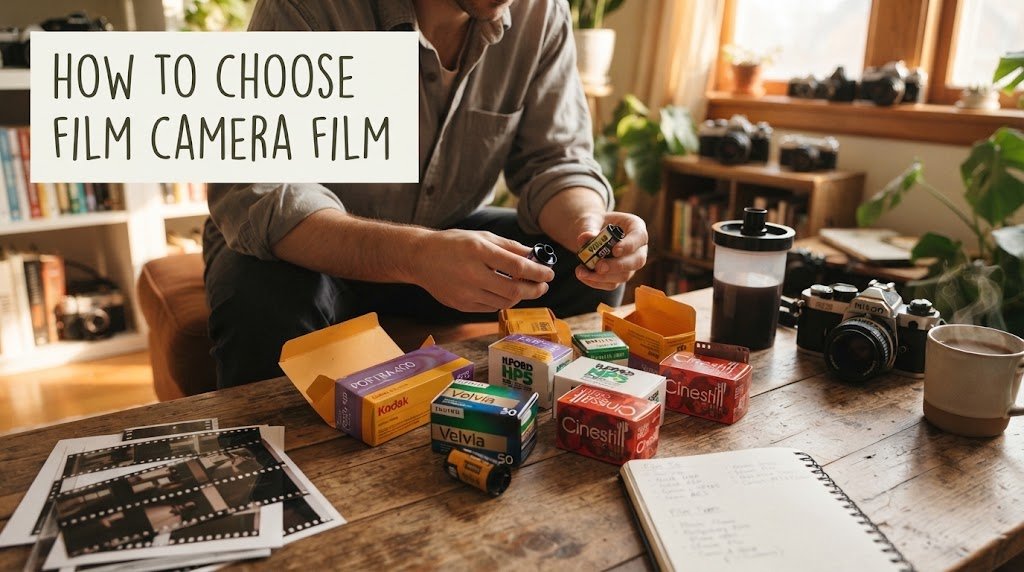
How to Choose Film Camera Film
That first roll sets the tone. To choose film camera film, start with the look you want, the light you usually shoot in, the camera you have, and the film’s own traits - color tones, grain, and ISO speed all change the result. Load the wrong film camera film into a camera you love, and the results can feel flat, muddy, or just off. Load the right one, and suddenly the whole point of shooting analog clicks into place - color has character, grain feels intentional, and every frame carries a distinct mood.
For a lot of people, film is less about nostalgia and more about taste. If you shoot film as part of a design-conscious, urban creative life, the film stock is where much of the look lives. It decides whether skin tones feel warm or neutral, whether city lights glow softly or punch hard, and whether a gray afternoon looks cinematic or lifeless. Below, we’ll break down film types - from color negative and black and white to slide and instant - how ISO affects grain and flexibility, how to match film to different cameras and shooting situations, the buying mistakes that lead to disappointing results, and how to build a personal film style that feels considered rather than random.
Why film camera film matters more than people expect
Digital shooters often think of film as one aesthetic. It is not. Different stocks behave like different visual languages. Some films render saturated reds and warm highlights that flatter travel scenes and casual portraits. Others lean cooler, softer, and more restrained, which can be ideal for architecture, overcast street photography, or a cleaner editorial look.
Speed changes things too. A low ISO film, like 100 or 200, usually gives you finer grain and better detail in bright light. Faster film, like 400 or 800, gives you more flexibility when the light drops, but you trade some smoothness for texture. That trade-off is often the point. Grain is not always a flaw. In the right setting, it adds atmosphere that digital filters rarely get right.
There is also the simple reality of cost. Film, processing, and scanning turn every roll into a commitment. That makes selection worth thinking about. You do not need to obsess over every spec, but you do want a stock that fits how and where you actually shoot.
Start with the look you want
The easiest way to choose film is to ignore technical jargon for a moment and ask a more useful question: what do you want your photos to feel like?
If you want clean daylight color, look toward lower ISO color negative film. This is a strong fit for weekend walks, travel, outdoor portraits, and design details where you want crisp edges and controlled grain. These films usually reward good light and a slower pace.
If you want flexibility, color negative 400 is the default for a reason. It handles mixed situations well, from sunny streets to indoor cafés near a window. For many shooters, especially anyone still learning exposure, a 400-speed roll is the smartest place to start. It offers room to move without feeling too clinical.
If your taste leans moodier, black and white can be the better choice. It strips a scene down to shape, contrast, and light. That works beautifully in urban environments where concrete, shadows, reflections, and facial expressions do the heavy lifting. It also makes ordinary moments feel more deliberate.
Then there is instant film, which plays by slightly different rules. You are choosing not just a look but an object. The print becomes part of the experience - tangible, immediate, and often imperfect in the best way. For parties, creative projects, and everyday memory-making, instant film brings a kind of analog joy that polished perfection tends to erase.
The main types of film camera film, including 35mm film
Color negative film is the most forgiving and usually the most approachable. It handles exposure errors better than most alternatives, scans well, and comes in a broad range of color palettes. If you are shooting portraits, travel, street scenes, or casual lifestyle moments, this is usually the best first choice.
Black and white film is less forgiving in some ways and more forgiving in others. It makes you pay closer attention to light and contrast, but it can also turn messy color situations into stronger images. If you shoot for texture, mood, or graphic composition, it deserves a place in your bag.
Slide film, also called reversal film, is for people who want vivid color and precision. When exposed well, it can look stunning - sharp, saturated, and luminous. But it has less tolerance for mistakes. Compared with a digital camera, film generally handles highlights more gracefully, but slide film still blows them quickly and exposure has to be more exact. It is beautiful, though not always practical for casual shooting.
Instant film is its own category because the output is immediate and physical. It is less about technical perfection and more about personality. The image, the frame, the handed-over print - all of it matters. That is why instant cameras and film continue to hold their place with urban creatives who want photography to feel social and tactile again.
ISO, grain, and the light you actually shoot in
Most people do not need a chemistry lesson. They need a realistic match between film and lifestyle.
If you mostly shoot outside during the day, a film speed of ISO 100 or 200 makes sense. Expect finer grain, sharper detail, and a generally cleaner image. The catch is that these films are less flexible once the light starts fading, so they are not ideal for night walks or dim interiors unless you are using flash or a tripod.
ISO 400 is the all-arounder. It works in daylight, gives you more breathing room indoors, and tends to suit people who carry a camera for everyday use. If this is your first film camera or even your first camera for shooting film, 400-speed film is usually the easiest place to start. If you only buy one type of film camera film while figuring out your taste, 400 is usually the smartest bet.
ISO 800 and above is where convenience and character start to overlap. You get more low-light usability, and how far that goes also depends on whether you can adjust shutter speed and aperture in darker scenes, but grain becomes more visible and color can shift depending on the stock. That can look great in nightlife, concerts, rainy streets, and late dinners. It can also feel rough if you were expecting smooth, polished results. Again, it depends on the mood you want.
Match the film to the camera and the moment
Not every camera plays equally well with every film. A point-and-shoot with a basic flash and limited controls often benefits from forgiving 400-speed color film, and 35mm film typically gives 24 or 36 exposures per roll, which suits everyday carry use well. A Contax T2 is a highly regarded film point that can still make a good photo with minimal effort because the focus side of the experience is so straightforward. It helps smooth over exposure inconsistencies and makes the camera feel more dependable. A half frame camera uses half the film per exposure than a standard 35mm camera, so a roll lasts much longer. The Kodak Ektar H35 is a cheap option for casual everyday shooting. The Olympus Pen EE-3 is another compact, solar-powered half-frame option.
A manual SLR or rangefinder gives you more flexibility through manual control, adjustable shutter speed, and interchangeable lenses, and different lenses let one camera adapt to different shooting styles. You can pair slower film with bright lenses for nuanced daylight work, or choose black and white when you want contrast and intention. If you want a beginner-friendly SLR, Canon is a common place to start, and the canon ae 1 is a popular camera model for newcomers. By contrast, medium format cameras use 120 film, which provides larger negatives for better image quality but usually only around 10 to 16 exposures per roll. The more control your camera offers, the more clearly the film choice will show up in the final image. Some medium format or larger systems can capture more detail than 35mm, while smaller formats are often the more practical everyday choice.
Instant cameras are even more specific. When you shoot film cameras tied to a fixed instant system, you are choosing a simpler experience than with one camera built around interchangeable lenses. The film stock is usually tied to the camera system, so the decision is less about compatibility and more about style of use. Are you documenting a night out, making keepsakes, building a wall of prints, or collecting little fragments of a trip? That context matters more than chasing technical perfection.
This is one reason curated retailers matter. Too much choice can flatten the process. A selective edit makes it easier to choose based on use and taste, not hype. That is part of the appeal at Bang On - products are framed around how people actually live with them.
Common mistakes when buying film
The first mistake is choosing based on someone else's sample photos without checking the lighting conditions. The same camera model can perform very differently when bought used, so checking operational condition matters. A film stock that looks amazing in golden-hour California may not give the same result on a cloudy city morning. Film does not exist in isolation. Light, lens, metering, and scanning all shape the outcome. Some older cameras also rely on a battery type that is no longer manufactured.
eBay offers a wide selection of film cameras, while KEH Camera is a trusted online retailer for used gear. Local camera stores typically inspect cameras before selling, though camera shops usually cost more for that curated inventory. If you buy from a thrift store, thrift shop, or garage sale, inspect carefully because these cameras may be non-functional and usually come with no guarantees. One easy check is opening the battery compartment to look for corrosion, especially on any model that depends on a battery.
The second mistake is buying film that is too slow for your routine. If most of your life happens after work, in restaurants, apartments, galleries, and streets at dusk, ISO 100 may sound refined but often becomes frustrating. You want a stock that suits your real hours.
The third mistake is expecting one film to do everything. It is better to think in pairs. Maybe one daylight roll for travel and one faster stock for evenings. Maybe one clean color option and one black and white option for mood. A small, intentional rotation goes further than chasing an all-purpose miracle roll.
A better way to build your taste in film photography
The strongest film shooters usually do something simple: they stay consistent long enough to notice patterns. They pick one or two stocks, shoot them repeatedly, and learn how each behaves in their own world. The result is not just technical familiarity. It is visual identity.
If you are starting out, choose one forgiving color negative film and one film with more character, either black and white or a faster color stock for low light, then repeat the same setup long enough to build real experience shooting and understand your results. Many people gain that feel with a simple 35mm SLR like the Canon AE-1, while more advanced users may later explore nikon bodies such as the Nikon F3. The Nikon F3 stayed in production for over 20 years, which helps explain its reputation as a durable professional camera among film shooters. Shoot both for a month. Take notes on where each one worked and where it did not. You will learn more from that than from reading another ten opinion threads.
Film rewards attention, but it does not require perfectionism. The best rolls often carry a little unpredictability. That is part of why people come back to analog in the first place. In a culture full of infinite retakes, film asks for selection, patience, and a stronger eye.
Choose the stock that fits your light, your camera, and your pace. Treat that process as part of finding your place in the film world, not trying all the cameras in any particular order or chasing the best film, good cameras, or every other professional camera. Then let it become part of your signature.
Share
Authorized retailer vs gray market watches: learn the real differences in price, warranty, authenticity, and long-term value before you buy.
A designer watch buying guide for style-conscious shoppers - learn how to choose the right size, movement, materials, and brand with confidence.